
Recordings › Br Muhammad MFG | Quranist Only Belief - A Dialogue | MindTrap #82 - Mufti Abu Layth · 18 Oct 2025 › Segment 16 of 32
How does a Quranist pray salah?
wudhu wuzu ablution al-wudu wudhoo salat salaah namaz salaat namaaz as-salah al-salah salawat rak'ah raka'at rakaah prayer unit sajdah sajda sujood imaam imams prayer leader muftis shaytan shaitan shaytaan iblis iblees shayateen shayatin satan koran quraan al-quran sura soorah surat suwar soora tilawah tilawat tilaawah subhanallah subhaanallah subhanallaah duaa duas duaasHow the guest prays: wudu, a chapter of the Quran, one long prostration, filling the time
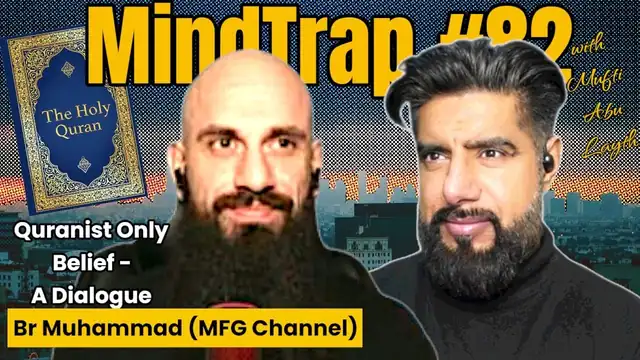 Play from 1:19:58
The video loads from YouTube only when you press play. Click a time in the transcript to seek.
Watch this part
Open on YouTube at 1:19:58The player starts at 1:19:58, the beginning of this part.
This segment1:19:58 to 1:26:18 · 6 min 20 sA view quoted in order to be discussed, not a position held
What this part covers
machinesummary, machine-writtenThe guest's prayer has no unit count: after wudu he seeks refuge, reads al-Fatiha by his own choice and a full chapter, then prostrates once with supplication, filling the prayer time as the moment dictates; in congregation the imam leads a single long prostration and prayers last up to an hour, three times a day.
In more detail
Asked how he knows whether to fold his hands, when to bow and whether to prostrate once or twice, the guest says these are not part of the salah, which is not about a unit count: one stands and recites the Book. Mufti Abu Layth asks for a sixty-second account from beginning to end. The guest says he makes wudu, stands, seeks refuge in God from the devil, opens with chapter one because it is a good dua, which he agrees is his own choice rather than something the Quran prescribes, reads a full chapter of the Quran, then prostrates to his Lord with supplication and glorification; whether he then sits, stands again or finishes depends on the moment between him and his Lord, since God gives the times of the prayers and one fills the time, perhaps with two or three chapters. In congregation, he says, the imam says 'stand for your Lord', recites the verses he wants while the others listen and ponder, then says 'prostrate' and all go into one long prostration, kneeling if he says so; their congregational prayers last thirty minutes to an hour, three times a day, with no fixed number of rak'at, only durations. Mufti repeats the word 'arbitrary' several times, and the guest says he has been cut off mid-sentence and asked no questions of his own, so this is an interrogation rather than a conversation.
- Guest speech overlaps this segment
Position stated
This segment presents a view in order to discuss or respond to it. It is recorded as quoted, never as held, and no position is attributed from it.
Kind: a view quoted in order to be discussed, not a position held Speakers: host and guest; guest speech is labelled and excluded from positionsTranscript
machine1:19:58 to 1:26:18 · click a time to seek · dotted terms open the glossary
A guest speaks in this segment. Guest speech is labelled and is excluded from the positions layer.
This segment states a view in order to discuss it. It is recorded as a quoted view, not as a position held.
um it's you know how how would you go about and applying that as in the actual salah as in you know I'm starting it maybe you fold your hands maybe you don't maybe you know when to go into rur when to do stand up after you do two sagas or one sagd in sujud. How do you understand all of this? >> This is not part of the salah.
>> Okay. So what is the salah? >> It's not it's not about it's not about a unit count and the is presented to you. You have the in the Quran says so you have to recite the book. So there's sorry. So you now you have and so the way that you apply it it's going to work. So now can I push back >> can I can I push back a bit is s that the way that you apply it be depends on how you are connecting with your lord in that moment or if there is somebody who's leading the prayer and he's going to tell you just but
just a quick question so obviously god has given us instructions in the Quran about the prayer correct >> sure look I don't want to go off to because I want to just elaborate on this point and then we'll come to your questions >> look give me a quick quick explanation just within like 60 seconds. So starting from beginning till end of salah how you would pray salah just so I can understand cuz I don't I haven't understood. I make the woodoo. I make the woodoo.
>> Not salah. Salah. It's just salah. Forget about >> I make the woodoo and after the wudoo I stand towards the >> I start with verses of the Quran. Uh usually with >> you. >> No. Do you do you don't do >> you say >> isn't that? >> You don't do Okay. Sure. >> Yeah. So you said I don't do start with I I start with so I ask God to I seek refuge to God from the devil >> and then I start with chapter one right because it's a good dua to open up and then I read a full chapter of the Quran right and then I prostrate to my Lord I have my supplication with God and >> I read
>> why do you read fata >> because it's a good one to start with >> but where would you get that from the Quran that it's good to Quran because because because because it's a very good dua to start up with. I'm not saying that it's >> No, I'm not saying that. >> Yes. I'm choosing to go with chapter >> Quran doesn't say oh it's just a choice arbitrary choice you mean? >> Yes. And then I read a full chapter of the Quran and then I prostrate to my Lord and I >> So do you do >> that rur is kneeling?
>> So So you're standing you've read your fat you've read a surah and you go straight into what? Saga. >> Sagna. >> You go straight into sagda. Okay. Do you read anything? >> Sure. No, I just wanted to understand how you do it. Exactly. So, you go straight into saga. Do you read anything in sagd? Make dua in sagd. Do you >> I do dua and glorification. Okay. And godly.
>> Does it say where does it say to do the uh dua in sjud? And >> I am doing that. >> Oh, just arbitrary. Arbit arbitrary. Okay. So then you sit up. You stand back. Yes. So God is giving you the God is giving you the times of the prayers and you fill your times with that prayer. So that's what happens. >> You have to understand that. So you sat up from saga. Do you sit up?
Do you stand up? Is it finished? Is it one ra? >> It depends again. It's between you and your lord in the moment. So if I am told to pray all the for example why is it called? >> Why is it called? It's called but I'm just going for the names sake of the convention. So when it when you're praying from the decline of the sun till the uh twilight of the night which is one prayer he's God is giving you the time that is expected of your prayer.
So in that moment you can read two chapters, three chapters, really good chapters and you get really close to the word of God and then you recitation. >> Yeah. >> But but why are we recitating it >> when you Sure. So when you stand up saying sure >> do you do you do just to I'm just trying to just finalize that so we don't get derailed. So from what I've understood correctly that you just way we we no I'm saying there isn't one way of praying there to us it's a fluid so it depends in the moment what if the structured like the >> what if the imam is praying a different
way to the people behind him >> because when we when we we're praying in congregation the man in the front he's going to be like stand for your lords we stand and then we're going to read the Quran we're he's going to keep reading the verses that he wants to But what if he's going to read you're just going to read one or he's going to read one you want to read. >> So in chapter four it says okay so when you're going to stand the prayer for them and this is when you're praying in congregation. So the guy as I was saying the im will say stand for your lord.
So we stand he's going to read the the verses that he wants and we're going to listen to what he's saying and we're going to ponder upon the Quran as gods do when the Quran's been recited. And then he's gonna say he's gonna say >> subhan Allah. And then he's going to say prostrate. And we prostrate. And then that >> he says the word. >> Yes. Yes. >> And you go. So he says this, the imam says and you all approach it. Yes.
>> So from standing you all go into sujud. Is it one saga, two sagdas? >> It's one long saga. >> One long saga. And then you get up or you >> if you want to kneel. If you want to kneel and he says kneel, then you kneel. And if he wants to do >> whatever whatever the imam is feeling on the day he says >> yes it's not feeling on the day but sure >> oh whatever yeah as in whatever the imam is like if he's feeling like I'm just going to pray one I'll pray one if I'm going to pray and that's the leader that you put in in the congregation and that's what you get but our prayers the majority of the people we pray with is a 30 minute 40m minute 45 minute 1 hour prayers so we have three times of
>> we man subhan allah question >> every day arbitrary the number of >> arbitrary there's no numbers of raqats it's about the durations filling the duration so god is telling you the durations he's not telling you >> there is a number of but there but there is prayed a in practice a numbers of raqat so like you said look that describes one raqat you're saying about a conversation and all I have been receiving from you is you're cutting me off mid-sentence and you're following up with a different question and yet I have not even asked you a single question so I'm not sure how this is a conversation and just an interrogation at this point.
Paragraphs overlapping 1:19:58 to 1:26:18. Full text on the recording page.
Cite this segment
Stable id, transcript version and tier are part of the citation. Every change to a transcript is logged.Mufti Abu Layth Archive, segment 2025-10-18-S16, auto-transcribed, may contain errors. https://muftiabulayth.org/r/onzjd7xmdhe/s/16/ (accessed 1 November 2026)
- APA 7
Mufti Abu Layth. (2025, October 18). How does a Quranist pray salah? [Video, segment 2025-10-18-S16, auto-transcribed, may contain errors]. Mufti Abu Layth Archive. Retrieved November 1, 2026, from https://muftiabulayth.org/r/onzjd7xmdhe/s/16/
- Chicago author-date
Mufti Abu Layth. 2025. "How does a Quranist pray salah?" Video, segment 2025-10-18-S16, auto-transcribed, may contain errors. Mufti Abu Layth Archive. Recorded October 18, 2025. Accessed November 1, 2026. https://muftiabulayth.org/r/onzjd7xmdhe/s/16/
- BibTeX
@misc{abulayth-2025-10-18-S16,
  author = {Mufti Abu Layth},
  title = {{How does a Quranist pray salah?}},
  year = {2025},
  month = {10},
  date = {2025-10-18},
  howpublished = {\url{https://muftiabulayth.org/r/onzjd7xmdhe/s/16/}},
  url = {https://muftiabulayth.org/r/onzjd7xmdhe/s/16/},
  organization = {Mufti Abu Layth Archive},
  urldate = {2026-11-01},
  note = {Segment 2025-10-18-S16, auto-transcribed, may contain errors}
}
Something wrong here?
Tell us what is wrong and it will be checked against the recording. Nothing changes until a person has reviewed it.
Sending a note needs JavaScript, which is off or unavailable in this browser. Nothing has been sent.
No name, email address or account is asked for or stored, and the inbox does not store your IP address. For rate limiting it keeps an unreadable fingerprint of your connection for 48 hours, and our database provider's own logs record connections as every website's do. Only your note, its kind, the page and the moment in the recording are kept, for review.