
Recordings › Does the Quran say how many Prayers? | Mufti Abu Layth · 24 Jul 2019 › Segment 1 of 1
Does the Quran say there are three or five daily prayers?
salat salaah namaz prayer salaat namaaz as-salah al-salah salawat hadeeth ahadith ahaadeeth hadis hadees ahaadith jam jam' jam' al-salah jam bayn al-salatayn jam' al-salatayn muftis sunna sunnat sunan prophetic practice koran quraan al-quran ahl al-sunnah ahl as-sunnah ahlus sunnah ahl al-sunna shiah shiite shi'i twelver ithna ashari ulama ulema ulamaaDoes the Quran say there are three or five prayers? The proto-Sunnah hypothesis
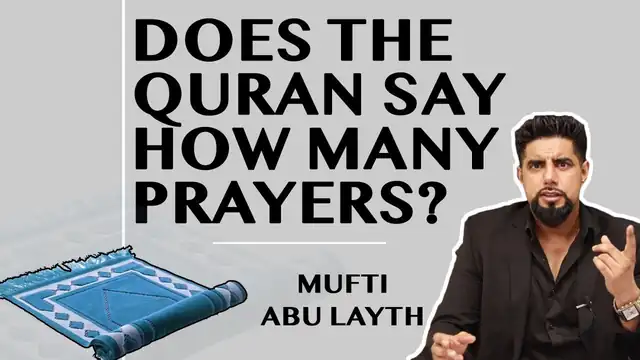 Play from 0:01
The video loads from YouTube only when you press play. Click a time in the transcript to seek.
Watch the answer
Open on YouTube at 0:01The player starts at 0:01, where the answer begins.
This segment0:01 to 3:22 · 3 min 21 sGeneral teaching
The answer in brief
machinesummary, machine-writtenThe Quran does not spell out the number of prayers, but Sunnis, Shia and Ibadis all hold there are five, which Mufti Abu Layth takes as proof of an early living tradition that preceded the hadith books. The Shia combine the five rather than reducing them to three.
In more detail
A viewer asks whether the Quran says there are three or five daily prayers. Mufti Abu Layth says the Quran does not break the matter down into detail and that he personally feels it was not addressing that question at all. He then presents what he calls the primordial or proto-Sunnah source hypothesis, put forward by a mufti who is on the stream that day [?], as something Muslims should work on: the main body of Sunnis, the Shia and the Khawarij, who survive today as the Ibadis, began at each other's throats, so the things they all agree on must come from a source that precedes the hadith books, a very early living tradition. Since the Shia, the Ibadis and the Sunnis all hold that there are five prayers, whether combined or not, he says this demonstrates in his understanding, irrefutably, that a clear proto-source in the early living tradition established five separate prayers. He adds that the Shia do not say there are only three prayers but combine the five, and that Sunni scholars also allow combining prayers, so combination is unique to neither.
Question as read aloud · questioner not identifiedAre there three or five salah in the Quran?
- Some terms in this segment are uncertain
- Low audio confidence in the transcript
Position stated
Mufti Abu Layth says he personally feels the Quran does not address how many daily prayers there are, and that the agreement of Sunnis, Shia and Ibadis on five prayers shows, in his understanding irrefutably, a proto-Sunnah living tradition that preceded the hadith books.
“demonstrate in my understanding irrefutably that they must have been some very clear proto source that was part of the early living tradition in early Islam”
Category: method
Kind: general teachingTranscript
machine0:01 to 3:22 · click a time to seek · dotted terms open the glossary
froakie fro breeze asking are they three all are the 305 solarz in the quran you see the quran does not break down into detail people the the praise it does not break down I don't even really buy the argument that the Quran was trying to say these three solarz or five I personally feel the Quran was not addressing that and I really like there's the a kind of the primer
primordial primordial source the prototype source or the proto Souness source theory or hypothesis as pushed forward as stated by Mufti maravilla Saud who is on our life today and I I think it's an amazing hypothesis that we as Muslims should work on and that is that if you look at the great major split within Islam that I've still lived on till today so you have the main body
of Muslims which identified today as Sunni you have the Shia who have lived on till today I mean regardless of the sub denominations and you have the whole Orage who have lived on as well the who are age today are the eboard eeeh so they've lived on as well now all three seconds the initial way they began they were not at harmony at all with each other in fact they were at each other's throats so the fact that way
they seem to have agreed on all these things it demonstrates that they were all taking from a particular source that precedes these books of hadith and things like this that this proto Sunnah of the Prophet this proto kind of this source that they were all equally tapping into that very early living tradition now the fact that the Shia believes that there's five pros whether they combine to or not but they believe this five Salah and the E body I
believe this five Salah the Sun Sunnis believe this five salah these skills to demonstrate in my understanding irrefutably that they must have been some very clear proto source that was part of the early living tradition in early Islam that all Muslims seem to have accepted that they were five Salah whether you pray to combined or not but they are separate salah the she I do not say that there are only three salons in a day they state them as five but they
combine and even Sunni scholars allow combination of prayers so it's not something unique to the Shia or Sunni so that's what I feel
Paragraphs overlapping 0:01 to 3:22. Full text on the recording page.
Cite this segment
Stable id, transcript version and tier are part of the citation. Every change to a transcript is logged.Mufti Abu Layth Archive, segment 2019-07-24-S01, auto-transcribed, may contain errors. https://muftiabulayth.org/r/ljpcqxiii98/s/1/ (accessed 1 November 2026)
- APA 7
Mufti Abu Layth. (2019, July 24). Does the Quran say there are three or five daily prayers? [Video, segment 2019-07-24-S01, auto-transcribed, may contain errors]. Mufti Abu Layth Archive. Retrieved November 1, 2026, from https://muftiabulayth.org/r/ljpcqxiii98/s/1/
- Chicago author-date
Mufti Abu Layth. 2019. "Does the Quran say there are three or five daily prayers?" Video, segment 2019-07-24-S01, auto-transcribed, may contain errors. Mufti Abu Layth Archive. Recorded July 24, 2019. Accessed November 1, 2026. https://muftiabulayth.org/r/ljpcqxiii98/s/1/
- BibTeX
@misc{abulayth-2019-07-24-S01,
  author = {Mufti Abu Layth},
  title = {{Does the Quran say there are three or five daily prayers?}},
  year = {2019},
  month = {7},
  date = {2019-07-24},
  howpublished = {\url{https://muftiabulayth.org/r/ljpcqxiii98/s/1/}},
  url = {https://muftiabulayth.org/r/ljpcqxiii98/s/1/},
  organization = {Mufti Abu Layth Archive},
  urldate = {2026-11-01},
  note = {Segment 2019-07-24-S01, auto-transcribed, may contain errors}
}
Something wrong here?
Tell us what is wrong and it will be checked against the recording. Nothing changes until a person has reviewed it.
Sending a note needs JavaScript, which is off or unavailable in this browser. Nothing has been sent.
No name, email address or account is asked for or stored, and the inbox does not store your IP address. For rate limiting it keeps an unreadable fingerprint of your connection for 48 hours, and our database provider's own logs record connections as every website's do. Only your note, its kind, the page and the moment in the recording are kept, for review.