
Recordings › Br Muhammad MFG | Quranist Only Belief - A Dialogue | MindTrap #82 - Mufti Abu Layth · 18 Oct 2025 › Segment 14 of 32
Can 'light' in 5:15 refer to the Prophet, or only to guidance and the book?
muftis koran quraan al-quran mufassir mufasir mufassireen quran commentator ayah aya ayat ayaat aayah aayat khalifah caliph khulafa khilafah khilafat caliphate khilafa aadaab adaab manners etiquette amanah amana amaanah amanat rahmah rahma rahmatCan 'light' mean the Prophet? Primary readings, Rashad Khalifa's followers, and mercy versus light
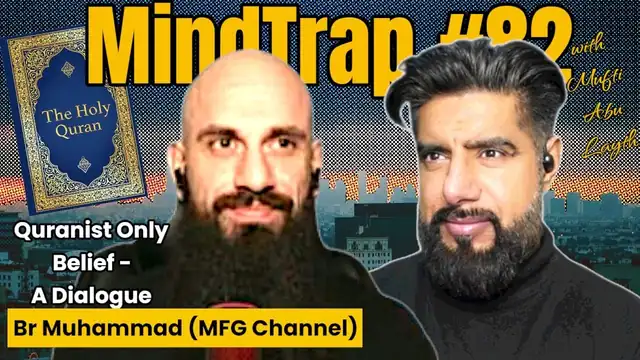 Play from 1:08:12
The video loads from YouTube only when you press play. Click a time in the transcript to seek.
Watch this part
Open on YouTube at 1:08:12The player starts at 1:08:12, the beginning of this part.
This segment1:08:12 to 1:17:13 · 9 min 01 sGeneral teaching
What this part covers
machinesummary, machine-writtenMufti Abu Layth says the primary readings of 'light' in 5:15 are guidance or the Prophet, as many mufassirun held, and that the guest's reading as the book is acceptable but may not negate the others; the guest says the word cannot refer to a human and that the mufassirun inserted the Prophet from presupposition.
In more detail
Mufti Abu Layth says he is not trying to set the guest up on his Arabic and would not give him a platform if he did not respect him; he explains that the primary understandings of 5:15 are that the light means guidance, or that it means the Prophet Muhammad as many mufassirun said, and that the guest's reading of it as a modality of the book is acceptable, but he must not claim the other understandings are negated. The guest says the problem is precisely that such interpretations do not align with the Quranic narrative, complains that Mufti lectures him and does not let him finish, says it is his duty as a believer to show Mufti where he is wrong, and offers to end the conversation since neither is benefiting. Mufti clarifies that what he objected to was the claim that the other, primary readings do not exist. The guest then states his position: reading the light as guidance or as an aspect of the book makes sense, but reading it as the Prophet cannot be proven from the Quran and is not understood linguistically, since the word cannot signify a human being in basic Arabic; the mufassirun, he says, had the presupposition that the Prophet is the highest of all other than God and inserted him into the verse, as the followers of Rashad Khalifa insert him as a messenger. He says light is a set of which the clear book is a subset. Mufti asks how a mercy is not a light, and the guest replies that even disbelievers receive God's mercy yet remain in darkness, while Mufti asks who brought the Quran to them. Mufti moves on, and the guest objects that he is not allowed to finish his points; Mufti says a conversation requires both people to talk.
- Guest speech overlaps this segment
Position stated
Waiting for the speaker checkA guest speaks in this segment and the captions do not say who said what. The view found here is held back until the speaker-separated transcript confirms the words are his, or the channel verifies it. The transcript and recording are published in full.
Kind: general teaching Speakers: host and guest; guest speech is labelled and excluded from positionsTranscript
machine1:08:12 to 1:17:13 · click a time to seek · dotted terms open the glossary
A guest speaks in this segment. Guest speech is labelled and is excluded from the positions layer.
>> But but it's not about one one minute. When you keep saying that that's your interpretation, it's your interpretation is negated by the Quran. That's the problem. This is where these differences where we don't appreciate it >> for a moment. Look, listen. Stop. Stop. Stop. Stop. Stop. Please don't do that. Right? >> Don't look. I've told you already. Nobody is here. I'm not trying to set you up in your Arabic. I'm not trying to set you up in certain things.
>> I'm giving you a platform to just >> No, I'm not. Look, and it's unfortunate if you feel that way. I would wall if I didn't respect you, I wouldn't give you a platform right now. So when I'm saying to you look in the beginning when on any interpretation just be straightforward look you can accept like I said to you look I accept you I just wanted your reflection which here this is how primmaashi when you're reading Arabic and the Quran this is the first understanding that comes to you now you could have said for example another popular main understanding that comes to you that Allah says that has come to you from Allah a light and a clarifying book
some people here said light means guidance Okay. Hud. Okay. Many mufas said N here means the Muhammad sallallahu alaihi wasallam the prophet. Now okay I asked you on your reflection. You said look my reflection is N it just means the book modality of the Quran. Right. And okay fine. Right. But to say oh the to try and say look the other understandings are being negated.
The other understandings are the primapasi understandings of Arabic. they are thead. Now, I'm not saying you can't take your understanding from the Quran as well. You can. So, please don't negate the other understandings. Don't do that because I'm not doing that to you. And I I want you to I want you to share your reflection so we can see where you're coming from. I don't want to say to you, you know what that is and so on.
No, because that will shut down the conversation. But the problem is is because there is these interpretations that do not align with the Quranic narrative is why we have these problems. So that's why our position is very solid when it comes down to the Quran. and what you want to point out. >> But you you see when you're saying things when the Quran is answering you then has that please you're lecturing me and you're telling me what to do and what not to do but then why don't you let me finish a point and then lecture you because this is not this is not fair from your end.
I don't need you to lecture me when you're saying things that are not aligning with the Quran. It is my duty as a believer, as a Muslim, to show you the verse, to show you that you're wrong. Whether you accept it or not, it's not on me. But it's my duty to show you how you're wrong. Whether you like to or not, that's fine. But you keep lecturing me, and I don't need you. You understand? >> Listen, please listen. Look, listen, listen. I don't know. Look, you're obviously perhaps used to people doing treating you in a certain way.
So, you're assuming I'm treating you in that way. I'm not I'm not treating you in that way. Yes, you do understand because you keep you keep you keep extremely brother simply you say a word you say a word I bring a verse and then you say that it's inter your interpretation and please don't don't do this and please don't do that I'm trying to talk about the context I'm trying to talk about the conversation of what the verses say and stuff I don't need you to lecture me on the adab please this is not for you nor your position if if you don't like how I'm treating you we can end this right now and I can move on because I'm not getting any benefit from what you're saying nor are you listening to what I'm saying.
So there's there's not there's not much that's going to happen here. >> Okay. Can I can I maybe you misunderstood what I said then. Can I explain just once again what I said when I said look don't do that. What I said don't do was try to say that the other understandings which are by the way the mutabad and primary understandings don't exist. So what you said is the Quran negates the other understandings. No it doesn't.
Right. Every it doesn't negate the other understandings. They are in fact the primary understandings when you read this look the primary understanding would either mean that the means guidance and or the primary understanding would mean you could say the N is the prophet Muhammad sallallahu alaihi wasallam or you could say as you've said that look I want to be of the Quran fine you could take that but to say no other understanding exists except the one I'm present that's what I said don't do so maybe you misunderstood that So that's fine.
>> So let let me clarify my position. When you're saying that the N is Muhammad, this is the part where you're not showing any accuracy from what the Quran is saying. If you want to say Huda and that makes sense. You want to say a moduality of N is the that makes sense. When you're going to say that it's prophet Muhammad is the nor here, then you have to prove that from the Quran, which you can't. That's the point that I'm trying to get across. But so yes, when you you mean it can't be No.
When you say it it's not understood linguistically, is that what you mean? It's not understood. How is it not understood >> in the Quran? We can't take a verse and in in like when we isolate a verse and we're going to say that this word means this word when the other verses in the Quran are talking about the exact same thing. So I >> So is that inaccurate? It's an inacc as in somebody who doesn't understand Arabic just wrongly understood that. Is that >> No, that's somebody who's defining the word for what it is not.
So this is a >> which is by the way incredible of this um who studied Arabic and and the Quran much longer than you and I. So they're not my lord. >> This is what I'm saying. No, they're not. But are you saying that they've misunderstood? Arab is that what you're saying that the Arabic is being misunderstood? >> The the word N here cannot signify to a human being from the basic Arabic. Okay. But we can try to say try to inter. So people look so so what you're see now this is the this is the reason let me finish >> this is why your argument is getting is getting so heavyhanded by people finish I I I trust me I'm doing all right what
I'm trying to explain very simply is that people who have made this tapere they already had this presupposition that prophet Muhammad is higher than the all highests other than God and because of that they want to put prophet Muhammad in the verse when is not there. We have the same things with individuals that say that Khalifa is a messenger. I have no I don't want you. No, no, no. Look, listen, >> but I was trying to example. I mean, like you keep interrupting me when I'm trying to land my point.
So the people that say that Rashad Khalifa is a messenger, they keep trying to they keep trying I'm trying to explain a point. I don't want to talk about I'm showing the human psych the human psychology where they want to shove a person there when he's not there. Just just to understand. So just to because what you said a moment ago is that a person cannot arrive like this is some kind of wrong Arabic that we're understanding or is it a wrong uh is that what you're saying or you're saying it's an interpretation that you just don't agree with which would have been what I told you in the beginning that the primary interpretation is actually guidance and
the prophet and the tertiary which is equally valid because you you said I want to understand it to mean it's the Quran and another modality of the Quran. Are you saying that the other interpretations are just wrong and poor Arabic? Is that what you're saying? >> Again, it's not the other interpretations that are aligning with what the verse is saying because I said N is such a big topic. It's a set and the clear book is a subset. So, we're still talking about guidance.
When you want to say that the N is prophet Muhammad, that is not something that you can prove from the Quran. That's what I'm already established. >> How is that a light? But how is the mercy not a light? >> So any because even the disbelievers get mercy from God. It does not mean that they're on light. >> Disbelievers don't get light from God. >> They're in darknesses. That's why the God clearly states here.
So they can still have mercy from God, but they're still in darkness. So again, you see that the Quran answers the guidance. Have they not had the Quran come to them? >> Who? the disbelievers. >> Yes, but they rejected it. But they still found mercy. >> But it came to them. And who brought it to them? >> I think you're missing my point. >> Look, let's Okay, let's move on.
I understand. Look, I just wanted your reflection. I don't want to turn one point into something that just goes on and on, right? So, okay. >> Well, but usually this is what I have. It's it's like when when somebody brings a point I use a verse of the Quran and then we talk about but here it's like we're not even talking about the Quran >> look yeah sure because this is why I don't want it to turn into something which is just you know I want to show that we can as brothers have a conversation I want to show them this is why I invited you and I'm trying as well believe me >> yeah but but I feel that you >> I'm trying okay let's move to the second most important
>> center If you just let me finish points when I'm making them instead of trying to >> listen Muhammad look part of a conversation is you have to understand that the other person is talking as well. It's not this is not a point where you know you know we're not suffering on some kind of spectrum where we have to say well I can't you know we can't have a conversation. It's where two people converse. Okay. It's not just you talk like a robot I talk like a robot.
Paragraphs overlapping 1:08:12 to 1:17:13. Full text on the recording page.
Cite this segment
Stable id, transcript version and tier are part of the citation. Every change to a transcript is logged.Mufti Abu Layth Archive, segment 2025-10-18-S14, auto-transcribed, may contain errors. https://muftiabulayth.org/r/onzjd7xmdhe/s/14/ (accessed 1 November 2026)
- APA 7
Mufti Abu Layth. (2025, October 18). Can 'light' in 5:15 refer to the Prophet, or only to guidance and the book? [Video, segment 2025-10-18-S14, auto-transcribed, may contain errors]. Mufti Abu Layth Archive. Retrieved November 1, 2026, from https://muftiabulayth.org/r/onzjd7xmdhe/s/14/
- Chicago author-date
Mufti Abu Layth. 2025. "Can 'light' in 5:15 refer to the Prophet, or only to guidance and the book?" Video, segment 2025-10-18-S14, auto-transcribed, may contain errors. Mufti Abu Layth Archive. Recorded October 18, 2025. Accessed November 1, 2026. https://muftiabulayth.org/r/onzjd7xmdhe/s/14/
- BibTeX
@misc{abulayth-2025-10-18-S14,
  author = {Mufti Abu Layth},
  title = {{Can 'light' in 5:15 refer to the Prophet, or only to guidance and the book?}},
  year = {2025},
  month = {10},
  date = {2025-10-18},
  howpublished = {\url{https://muftiabulayth.org/r/onzjd7xmdhe/s/14/}},
  url = {https://muftiabulayth.org/r/onzjd7xmdhe/s/14/},
  organization = {Mufti Abu Layth Archive},
  urldate = {2026-11-01},
  note = {Segment 2025-10-18-S14, auto-transcribed, may contain errors}
}
Something wrong here?
Tell us what is wrong and it will be checked against the recording. Nothing changes until a person has reviewed it.
Sending a note needs JavaScript, which is off or unavailable in this browser. Nothing has been sent.
No name, email address or account is asked for or stored, and the inbox does not store your IP address. For rate limiting it keeps an unreadable fingerprint of your connection for 48 hours, and our database provider's own logs record connections as every website's do. Only your note, its kind, the page and the moment in the recording are kept, for review.