
Recordings › Br Muhammad MFG | Quranist Only Belief - A Dialogue | MindTrap #82 - Mufti Abu Layth · 18 Oct 2025 › Segment 7 of 32
Do Quranists accept any Sunnah of the Prophet?
hadeeth ahadith ahaadeeth hadis hadees ahaadith malik ibn anas malik bin anas imam maalik imam malik ibn anas imaam imams prayer leader qiyas qiyaas muftis sunna sunnat sunan prophetic practice koran quraan al-quran madina al-madinah madeenah yathrib ulama ulema ulamaa deen al-din ad-deen ad-din rahmah rahma rahmatThe Quran as centre: is there a Sunnah of the Prophet to follow, and was it preserved?
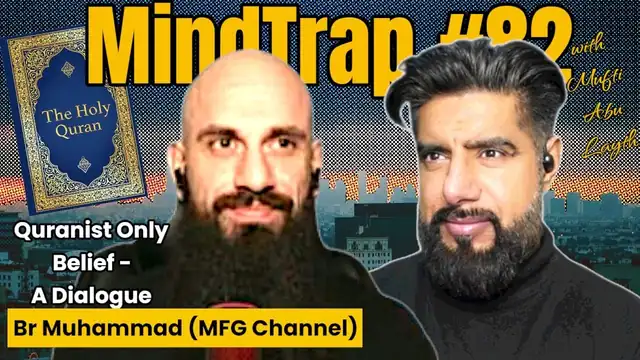 Play from 24:01
The video loads from YouTube only when you press play. Click a time in the transcript to seek.
Watch this part
Open on YouTube at 24:01The player starts at 24:01, the beginning of this part.
This segment22:29 to 27:42 · 5 min 13 sGeneral teaching
What this part covers
machinesummary, machine-writtenBoth agree the Quran is central, but the guest says the Quran names only two sunnahs, of earlier peoples and of God, and that the Prophet's own clarifications were not preserved and so cannot have been necessary; Mufti Abu Layth presents this as the school of Madinah's Quran-centred view with other sources orbiting it.
In more detail
Mufti Abu Layth says he wholeheartedly agrees that the Quran is central, which he describes as the teaching of the school of Madinah, of Imam Malik and of Abu Hanifa, repeating his analogy from the previous week that the Quran is the sun around which other sources orbit like planets and moons, and he asks whether the guest distinguishes between hadith and Sunnah at all. The guest says his definition of Sunnah differs: the Quran speaks of two sunnahs, the traditions of earlier peoples by which God guides the Prophet, and the sunnah of God in dealing with his servants and the disbelievers, and there is no specific Sunnah of the Prophet outlined in the Quran to follow. Asked whether the Prophet elaborated and clarified the Quran, the guest says he definitely did, but that this was not preserved; God guides us in the same manner, times have changed, and had it been necessary God would have preserved it, so the test is whether the word of God is sufficient or one needs to be spoon-fed. He adds that everyone claims a Quran-centric approach but in practice follows the tradition. Mufti asks whether the Prophet's guidance is therefore irrelevant, and the guest distinguishes a messenger, whose message is in the Quran for all people, from a prophet, whose guidance is localised to his own people.
- Guest speech overlaps this segment
Position stated
Waiting for the speaker checkA guest speaks in this segment and the captions do not say who said what. The view found here is held back until the speaker-separated transcript confirms the words are his, or the channel verifies it. The transcript and recording are published in full.
Kind: general teaching Speakers: host and guest; guest speech is labelled and excluded from positionsTranscript
machine22:29 to 27:42 · click a time to seek · dotted terms open the glossary
A guest speaks in this segment. Guest speech is labelled and is excluded from the positions layer.
And uh of course for us the book of God is the shortcut to the guidance that can be achieved without the book of God. But God's mercy is telling us the answer and it's coupled by uh people's understanding and people's opinion. So that's >> sure. So just to yeah to kind of get in there that that I this this view this understanding that the Quran is central.
Um I absolutely agree with that that is the teaching of the school of Medina that is in principle the school the teaching of many um Muslims and scholars in Islam. And some may disagree. I accept that. But I'm not here trying to defend that view that where some may disagree. The school of Medina, the school of um which is Imam Malik, the school of Imam Abuhanifh in principle too is that the Quran is always central and other principles or other um guidances always orbit that almost like a solar system.
And this was the analogy I gave last week in saying that the Quran is the sun and these and then you may have planets and planets may have moons and things like this. Now that's so the authority and the principle being the Quran the central that's uh you know a there's no dispute on that. So I totally wholeheartedly um you know commend you on that principle and agree with you that the Quran is always there's primacy for the Quran.
But I want to ask you that okay so you're saying in principle the uh the hadith are you distinguishing between hadith and sunnah or not at all? >> Our definition of sunnah is a little bit different than how people approach what the word sunnah means. So for us there's two types of sunnas in the Quran. The the traditions of the people who has be passed before which is what God is guiding the blessed prophet.
And then the other sunnah that we're aware of is which is the tradition of God and how God deals with his subjects and his servants and how he deals with the disbelievers. This we're in agreement >> in reg. Yeah. So there's no I mean you know what we're talking about when you're saying the sunnah the sunnah of the prophet. >> So so there is not a specific sunnah for the prophet that we have to follow that is outlined in the Quran. What we have is so lessons and what god has told us about the lessons of the other prophets including >> that stuff we don't dispute.
That stuff we don't dispute. So there's no point going into that because we agree on all of that. The lessons in the Quran are universal and we agree on all of that >> and that's the limits of prophet Muhammad to us. >> Do you feel that the prophet was do you feel that the prophet sallallahu alaihi wasallam was teaching giving guidance do you feel that he was doing this as well? Was he elaborating on the Quran?
>> Yes, he was definitely elaborating and clarifying the Quran to the people around him. We don't accept that not valuable to us as Muslims. >> It hasn't been preserved and whatever he's been teaching, he was guided by God and God is guiding you in the same manner. We don't have to express the Quran in the same way the blessed prophet did because the times have changed. So the way that the prophet lived his sunnah, he wouldn't have lived in the same manner now because times have evolved.
If it was something that was necessary for religion, then God would have preserved it. The fact that it's not preserved, it shows that this is the test. Is the word of God sufficient for you or do you need to be spoonfed? Now you you told me about the Quran centric approach which is true. Everybody claims that the Quran is the Trump and the Quran is the negating the bad hadith and all this. But when we see in practice, we don't see that that's the case. They they in fact they they they go off what the tradition and the uh the history is saying.
>> Sure. But clear versus they don't care. >> You see, but let's not strawman other people either. So I or let's not pick on bad examples because you know we can do that with everybody. I want this case to see whether there is a case to be made here that you're presenting and that is that there is if I've understood this correctly. What you're saying is that there is no that the prophet did give guidance in addition to the Quran.
>> I take it that's what you're saying. But that guidance today is are you saying it's irrelevant? Are you saying it's inv it's not valuable at all? Um are you saying it's it would have been valuable if it reached us? >> The guidance that is coming out of the messenger. Okay, that is for all the people which we find in the Quran because he's using the message that God has given him. The guidance that comes out of the prophet that's localized to his people.
So this is where is the difference between a prophet and a messenger. Now, when you're talking about this clarification, >> this when you're talking about the clarification of the Quran, >> this is not when we see these things that you assume that the prophet said, we find it wholeheartedly denying the Quran. So, we >> just to just to build on what you're saying, if you're arguing that there is guidance in the Quran to do with how other prophets advised and spent their time with their people.
Paragraphs overlapping 22:29 to 27:42. Full text on the recording page.
Cite this segment
Stable id, transcript version and tier are part of the citation. Every change to a transcript is logged.Mufti Abu Layth Archive, segment 2025-10-18-S07, auto-transcribed, may contain errors. https://muftiabulayth.org/r/onzjd7xmdhe/s/7/ (accessed 1 November 2026)
- APA 7
Mufti Abu Layth. (2025, October 18). Do Quranists accept any Sunnah of the Prophet? [Video, segment 2025-10-18-S07, auto-transcribed, may contain errors]. Mufti Abu Layth Archive. Retrieved November 1, 2026, from https://muftiabulayth.org/r/onzjd7xmdhe/s/7/
- Chicago author-date
Mufti Abu Layth. 2025. "Do Quranists accept any Sunnah of the Prophet?" Video, segment 2025-10-18-S07, auto-transcribed, may contain errors. Mufti Abu Layth Archive. Recorded October 18, 2025. Accessed November 1, 2026. https://muftiabulayth.org/r/onzjd7xmdhe/s/7/
- BibTeX
@misc{abulayth-2025-10-18-S07,
  author = {Mufti Abu Layth},
  title = {{Do Quranists accept any Sunnah of the Prophet?}},
  year = {2025},
  month = {10},
  date = {2025-10-18},
  howpublished = {\url{https://muftiabulayth.org/r/onzjd7xmdhe/s/7/}},
  url = {https://muftiabulayth.org/r/onzjd7xmdhe/s/7/},
  organization = {Mufti Abu Layth Archive},
  urldate = {2026-11-01},
  note = {Segment 2025-10-18-S07, auto-transcribed, may contain errors}
}
Something wrong here?
Tell us what is wrong and it will be checked against the recording. Nothing changes until a person has reviewed it.
Sending a note needs JavaScript, which is off or unavailable in this browser. Nothing has been sent.
No name, email address or account is asked for or stored, and the inbox does not store your IP address. For rate limiting it keeps an unreadable fingerprint of your connection for 48 hours, and our database provider's own logs record connections as every website's do. Only your note, its kind, the page and the moment in the recording are kept, for review.