
Recordings › Br Muhammad MFG | Quranist Only Belief - A Dialogue | MindTrap #82 - Mufti Abu Layth · 18 Oct 2025 › Segment 6 of 32
Is the Quran-only position an argument from epistemology or from principle?
salah salat salaah namaz salaat namaaz as-salah al-salah salawat hadeeth ahadith ahaadeeth hadis hadees ahaadith muftis sunna sunnat sunan prophetic practice koran quraan al-quran in sha allah insha'allah in shaa allah insha allah inshaa allah bismillah ir-rahman ir-rahim bismillahir rahmanir rahim bismillahi bismillah al-rahman al-rahim salam as-salamu alaykum assalamu alaikum assalamualaikum salaam salaams salam alaykum wa alaykum as-salam greeting deen al-din ad-deen ad-din rahmah rahma rahmatThe guest steelmans the Quran-only position: a principle, confirmed by epistemology
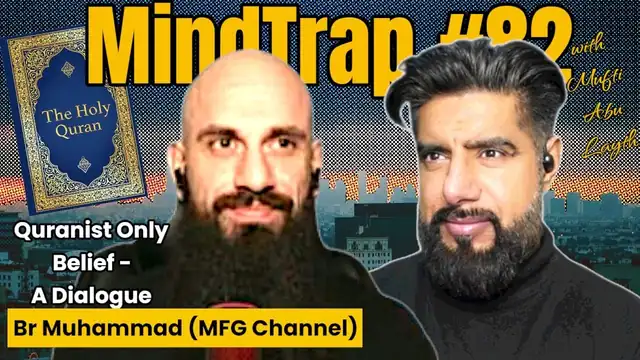 Play from 18:31
The video loads from YouTube only when you press play. Click a time in the transcript to seek.
Watch this part
Open on YouTube at 18:31The player starts at 18:31, the beginning of this part.
This segment15:38 to 22:29 · 6 min 51 sA view quoted in order to be discussed, not a position held
What this part covers
machinesummary, machine-writtenThe guest says the Quran-only position rests on principle, since God refers earlier communities only to their books, and is confirmed by epistemology, since hadith are contradictory and insulting; Quranists reject the religious authority of hadith, not history or narrations as such.
In more detail
The guest greets Mufti Abu Layth, who apologises for the delay and asks him to steelman his argument, noting that Quranist movements are not a monolith. Mufti frames the question he asked the previous week: is the Quran-only position an argument from epistemology, meaning hadith would be welcome but are set aside out of caution because one cannot be sure a report really conveys the Prophet's teaching, or an argument from principle, meaning the Quran is the only source of guidance and nothing comes even from the Prophet. The guest answers that Islam existed before the Prophet Muhammad and is the same Islam, that the Quran gives sufficient guidance on how to be a proper human being and present oneself to God, and that Quranists do not reject history or narrations but reject the religious authority of hadith as a corpus, since the Quran can be applied in many ways and remains the common ground of humanity. He says the position is from principle, because when God addresses the Jews and Christians he appeals back to the Torah, Gospel and Psalms and never to anyone's wisdom or application, and that it is also proved by epistemology, since the contradictory reports not authored by God or the messenger show inconsistency, ingratitude and an insulting nature. He adds that many converts who were not raised with hadith find the material problematic on its surface, whereas the Quran needs no one to hold your hand, and that the people of opinion who were dominant in the early courts were phased out by the hadith traditionalists.
Position stated
This segment presents a view in order to discuss or respond to it. It is recorded as quoted, never as held, and no position is attributed from it.
Kind: a view quoted in order to be discussed, not a position held Speakers: host and guest; guest speech is labelled and excluded from positionsTranscript
machine15:38 to 22:29 · click a time to seek · dotted terms open the glossary
A guest speaks in this segment. Guest speech is labelled and is excluded from the positions layer.
This segment states a view in order to discuss it. It is recorded as a quoted view, not as a position held.
How are you doing? I hope you can hear us loud and clear. I'm just going to if you speak I'll just hopefully your volume's coming through fine as well. Bismillah peace be upon you. How you doing? My good uncle. >> Well, I'm well. Uh, Shukran. So, first of all, Muhammad, I'm really jaz that you've taken the time out. I do apologize once again for being delay.
I didn't mean to be discourteous. Um, I really was genuinely delayed and it's it's a it's unfortunately a theme in my life. But I really am glad that you've joined us. even if it's for whatever time you can take out to um present. I'd like us to inshallah you know not without you know so not to waste any more of your time because I know because of the delay really you know carrying on from where we spoke last week that I'd like you to you're probably listening into my where I stand with the Quranist perspective and I know there
are some diverse Quranist movements there's not just one monolith but this is you know where where I'm at with it. I would like you to steal man your argument considering the question I did ask before we concluded last week um that is this an argument from epistemology or is it an argument from principle because sometimes I've heard different differing responses from people so just to clarify for the listeners that an argument from epistemology
is and I'd like you to steal man it of course the whole thing is that we're saying sorry that people are saying not we're but people are saying that hadith hadith may be accepted is acceptable the teachings of the prophet are they very beloved to us but we just feel that because we're not sure that the way it was conveyed to us whether this teaching like this hadith one-on-one was actually a teaching of the prophet.
Therefore, to be on the safe side and to on the side of caution, we're not going to accept the hadith to on the side of caution. Otherwise, we welcome hadith and the teachings of the prophet and the sunnah. That's from epistemology. So, it's the knowing that it's the hadith is the challenge. From principle, the argument is no. The Quran is the only source of guidance.
No other guidance comes from anything not even the prophet sallallahu alaihi wasallam. So that's the from principle argument. But yeah over to you uh Muhammad >> peace uh but then I appreciate you giving me the um ability to steelman the position so that we can clarify what the misconceptions people have about our movement. Quite simply what we argue is that Islam started before prophet Muhammad and unfortunately become the word Islam became synonymous with Muhammad and after the blessed uh the time after the blessed prophet but the Islam that prophet Muhammad was teaching existed before his time and it's the
exact same Islam. Yes, the sh the the curriculum is different from a group to a group. If you're following a certain prophet and us pro following prophet Muhammad, we have been given sufficient information in regards to what guidances in the book of God. And therefore, there is nothing outside of the book of God that is required for you to find this guidance on how to be a proper human being that on the day of judgment that you're going to present yourself in a way to God that is acceptable.
You talked to your parents correctly. You talked to the people in a good way. You've stood the prayer. Uh you stood uh against oppression and you've given from what God has given you and you served your God. That's simply what the position is entailed. Now in regards to ev the denial or the rejection of hadith, we don't reject history. We don't reject uh we don't reject historical sources. We don't reject narrations.
And in that sense, what we reject is religious authority of hadith. So therefore, hadith as a corpus is not necessary for somebody to achieve Islam. If it's some people's application that we can understand, but there's many ways of somebody applying the Quran and it's still acceptable and it's still the religion of God and this is what God has said that he has created us with many tongues and many tribes and many colors for us to learn from each other. And the Quran is still the common ground for all of this humanity where the Quran is going to be applied differently which we see in the history after the blessed prophet in regards to different people accepting the Quran.
Now in regards to principle and epistemology the concept comes from principle. So God is telling us in the Quran in many verses and even when he's comparing us to the or he's telling us the stories about the children of Israel, the Jews and the Christians specifically and the people of the book, he's always uh appealing back to the gospel to Torah to the uh psalms uh the books that he has sent. He doesn't appeal to anything outside of that.
He's not talking about anyone's wisdom or anyone's application of their books. He's just saying to refer to that book. Now we prove this principle also by epistemology. So when we see what the individuals are saying in regards to guesswork and making apologetics to things that are contradictory reports that have not been authored by God nor by the messenger we see the inconsistencies the ingratitude to what God has sent and furthermore we see the insulting nature of the hadith.
We turn away from it because it's not something that is necessary. Now in regards to the concept of about hate or love or the rage or anger or misplaced passion quite simply there's a lot of reverts that have not been grown grown they did not grow and this is a point my good brother Isa made out he he's a revert he wasn't raised with hadith and all of that but they just simply when they read the material and on the surface level it just looks extremely problematic and the Quran on a surface level it doesn't the Quran does not need somebody to hold your hand for you to get guided.
God is the one guiding you through his words. But in the hadith, you're saying that we need somebody to hold our hand. And yet, when he's holding our hand, we can't truly ask questions. In the very very onset of of what people are calling Islam after the blessed prophet Muhammad, the people of were the ones who are dominant in in the courts and in the governments, the people of opinion. And slowly that was transitioned out and phased out by the hadithist traditionalists when they when they they beat him out.
And uh of course for us the book of God is the shortcut to the guidance that can be achieved without the book of God. But God's mercy is telling us the answer and it's coupled by uh people's understanding and people's opinion. So that's >> sure. So just to yeah to kind of get in there that that I this this view this understanding that the Quran is central.
Paragraphs overlapping 15:38 to 22:29. Full text on the recording page.
Cite this segment
Stable id, transcript version and tier are part of the citation. Every change to a transcript is logged.Mufti Abu Layth Archive, segment 2025-10-18-S06, auto-transcribed, may contain errors. https://muftiabulayth.org/r/onzjd7xmdhe/s/6/ (accessed 1 November 2026)
- APA 7
Mufti Abu Layth. (2025, October 18). Is the Quran-only position an argument from epistemology or from principle? [Video, segment 2025-10-18-S06, auto-transcribed, may contain errors]. Mufti Abu Layth Archive. Retrieved November 1, 2026, from https://muftiabulayth.org/r/onzjd7xmdhe/s/6/
- Chicago author-date
Mufti Abu Layth. 2025. "Is the Quran-only position an argument from epistemology or from principle?" Video, segment 2025-10-18-S06, auto-transcribed, may contain errors. Mufti Abu Layth Archive. Recorded October 18, 2025. Accessed November 1, 2026. https://muftiabulayth.org/r/onzjd7xmdhe/s/6/
- BibTeX
@misc{abulayth-2025-10-18-S06,
  author = {Mufti Abu Layth},
  title = {{Is the Quran-only position an argument from epistemology or from principle?}},
  year = {2025},
  month = {10},
  date = {2025-10-18},
  howpublished = {\url{https://muftiabulayth.org/r/onzjd7xmdhe/s/6/}},
  url = {https://muftiabulayth.org/r/onzjd7xmdhe/s/6/},
  organization = {Mufti Abu Layth Archive},
  urldate = {2026-11-01},
  note = {Segment 2025-10-18-S06, auto-transcribed, may contain errors}
}
Something wrong here?
Tell us what is wrong and it will be checked against the recording. Nothing changes until a person has reviewed it.
Sending a note needs JavaScript, which is off or unavailable in this browser. Nothing has been sent.
No name, email address or account is asked for or stored, and the inbox does not store your IP address. For rate limiting it keeps an unreadable fingerprint of your connection for 48 hours, and our database provider's own logs record connections as every website's do. Only your note, its kind, the page and the moment in the recording are kept, for review.