
Recordings › Br Muhammad MFG | Quranist Only Belief - A Dialogue | MindTrap #82 - Mufti Abu Layth · 18 Oct 2025 › Segment 9 of 32
Does 'we sent you only as a mercy' (21:107) describe the Prophet or the act of sending him?
muftis koran quraan al-quran ayah aya ayat ayaat aayah aayat salam as-salamu alaykum assalamu alaikum assalamualaikum salaam salaams salam alaykum wa alaykum as-salam greeting rahmah rahma rahmatThe grammar of 21:107: does 'a mercy' describe the Prophet or the act of sending him?
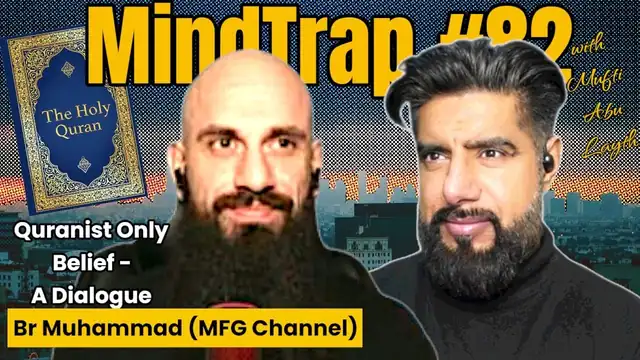 Play from 32:42
The video loads from YouTube only when you press play. Click a time in the transcript to seek.
Watch this part
Open on YouTube at 32:42The player starts at 32:42, the beginning of this part.
This segment32:42 to 43:36 · 10 min 54 sGeneral teaching
What this part covers
machinesummary, machine-writtenMufti Abu Layth says the primary Arabic reading of 21:107 is that the Prophet himself was sent as a mercy for the worlds, with the exclusive negation amplifying that, while the guest's reading that the sending is the mercy is a secondary understanding he may hold but not impose.
In more detail
The guest argues that in 'we have not sent you except as a mercy for the worlds' the mercy describes the sending, so that if the Prophet had sat in his house and done nothing there would be no mercy, and Mufti Abu Layth says he is confusing the function of the phrase; the exchange turns on whether the word is a circumstantial state describing the Prophet or a verbal noun [?]. Mufti says the primary understanding of the Arabic, which is the reading of the Quran the guest himself appeals to, is that the Prophet was sent as a mercy for the worlds, and that the guest may choose the secondary understanding that the sending of him is the mercy, but may not deny the primary one; he says he does not want to use the guest's still-developing Arabic as a trump card but asks him not to argue for the sake of argument. The guest insists his reading is verbatim and that Mufti took a portion of the verse, and that the negation with 'except' conditions the statement. Asked what the difference would be had the verse simply said 'you are but a mercy', Mufti explains that the exclusive negation amplifies rather than diminishes the meaning: it adds Allah's endorsement that his whole sending of the Prophet was as a mercy, as when a king is said to have sent someone 'but as an ambassador'. The guest replies that if he was not sent he would not be the mercy, and Mufti says that is like saying we would not exist had Allah not created us, before moving on.
- Guest speech overlaps this segment
- Some terms in this segment are uncertain
Position stated
Waiting for the speaker checkA guest speaks in this segment and the captions do not say who said what. The view found here is held back until the speaker-separated transcript confirms the words are his, or the channel verifies it. The transcript and recording are published in full.
Kind: general teaching Speakers: host and guest; guest speech is labelled and excluded from positionsTranscript
machine32:42 to 43:36 · click a time to seek · dotted terms open the glossary
A guest speaks in this segment. Guest speech is labelled and is excluded from the positions layer.
Yeah. >> So, so the sending >> Why is that not >> He's saying why not? >> Because we have not sent you except as a mercy. >> No, but a is something you are called by in Arabic. So you can be called by what you So for example, if you if Allah is calling you by this, >> right? So this is not This is a clar.
No, it isn't because it's a clarification. It's not a It's a >> It's not a It's a negation. In Arabic, you are the My grammatic definition of it is is it not Or you can describe it as it can be as well or it could be or so in either case it's describing the
prophet sallallahu alaihi wasallam is so the thing that is being described is the so clarifying the so when God is saying we have not sent you the book. So God is explaining to you why the book. So now, >> no, no, no. So wait, wait, wait, wait.
Just to correct you on this, right? We sent you as a mercy for the worlds. Now I understand I accept that you might say that you choose not to take that understanding and you want to take the understanding of the is the but the primary primary uh the primary is so you can't negate that but you could say that look we can also because I want
you look just as you want to be steelman you have to steal all other arguments that you can say that look yes but I don't want to take that understanding I want to take the perspective that the the prophet is not the is the so you can do that in Arabic but the primary >> in Arabic yeah in Arabic >> the word the word what is that
yeah yeah yeah >> no What? >> No. Allah is not just for No, no, no, no, no, no. You're talking that that would be that would be Yes. No. So, but it is it is not called it is called you're talking about now the function of it.
>> But but my my good brother is negatory. So I'm negating every every purpose of the except so now I am making condition. >> Okay, let's go with that. Let's go with that then. Let's go with that. That >> amplifies it even more. The only thing we have sent you as is a mercy for the entire world. >> So >> that's beautiful.
>> Okay. So you said you so that means the only thing that the prophet has been sent for is to be a mercy for the whole world. No, that's not what it's saying. We have sent you. >> You just said you want to go with >> you. It does not mean that he is. It's the is the That's my point. >> But the is talking. >> No. The of who? >> The sending of the messenger, the blessed prophet Muhammad is the he is the it is him being sent.
Let me put it this let me make it very clear. It is no no just Muhammad just but you've been cutting to steal money. You're not letting me even finish a point. >> I want you to finish. I want you No, no, don't. Yeah. So, >> cutting me off. >> No, but listen. Listen. I want you to complete it properly. So, it is not the verb is not on its own. It's so the verbal noun that I'd like you to expand on is not it's >> Okay.
Now, you may carry on that you're sending, >> right? It's not on its own. It's sending in Arabic sending. So what you if you want to take one minute one minute there's a difference between me saying you're sending is a mercy for the people compared to your mercy for people. So the difference here if the prophet bless peace and blessings upon him sat in his house and did absolutely nothing there is no mercy for the people.
So he is not the mercy for the people. Him being sent is the mercy for people and anybody who is going to fulfill that position >> him being sent not somebody else >> not him is because it's specifically about him but it's descending is the mercy it's not him is the mercy >> I don't want to I don't want to just carry on on this point because but I I want to clarify and and by the way is my absolute passion I if anybody's followed me they know that.
So I just want to highlight and then we can move on that look in this verse the primary understanding in Arabic because you're saying the Quran we only go with the Quran right the primary understanding of the Arabic of the Quran is that we sent you the prophet as a mercy for the whole world now you can Muhammad you can say I don't want to take that understanding I want to take the understanding of the verbal noun that that the sending of you is the mercy for the whole world.
Now that's okay. You want to take advice >> because you started a conversation. You started a conversation. You're saying Muhammad is the mercy to mankind. But here you're saying which is the of the is the sending of you. We sending you is a mercy for >> second interpretation. That's what I'm saying. You set your >> That's a verbatim. That's a verbatim. There's no other interpretation from but but this is what you did.
This is what you did. You took a portion of the verse. You said but the verse doesn't say you are a mercy for the people. It's saying we did not send you accept. So if he was not sent he wouldn't have been the mercy for people. That's how how logical I'm not going to do any dishonesty with you in the Arabic language. I want you to not argue futilities. Okay?
Don't just waste your time. Right? I I respect you uh you know as a brother um as somebody I'm showing you a lot of love right don't look I I don't mean to use this as a as a kind of trump card but I know as a fact that your Arabic is still developing and that's fine and that's great I'm going to steal man this for you I'm not trying to take this away from you right but do not argue for the sake of argumentation right because look
Most the primary understanding of the Quran is the is what is rahmed alam that we did not send you Muhammad sallallahu alaihi wasallam except as a mercy for the world for the worlds. Now you could say that I don't want to take that primary understanding and that's your choice. I want to take the understanding of what is called the verbal noun in Arabic. The verbal noun here is >> the the sending of you the sending of you Muhammad as a mercy for the whole world.
>> Perfect. >> Then in this Yeah. So, so that's fine. Let's let's move on from this because right I because I feel that look what I you said your time is limited. I don't want you to just go run and you said something and you're talking about the Arabic language. What's the difference if I said what would have been the difference in meaning there? Mhm. >> This is speaking about the >> How's that?
>> No, if you said it's highlighting I'm saying you are but a mercy for the whole world. >> You are the mercy of the world at that point. >> You are but a mercy for the whole world. >> Exactly. Then he would be then he would be what you guys say. >> Look first is us sending you as a mercy and we did not send you except as a mercy >> except as a mercy.
Exactly. >> Perfect. We did >> we did not send you >> except you except as a mercy for the whole world. >> We did not send. So if it's not we you are a mercy. It's saying sending you >> we did not send you. So you the person we did not send you accept as a mercy for the whole world. Look okay fine. >> Simply simply if I said and I have not sent him it would still be a true statement.
Okay. He would still be but if I said and I did not send him then he is not. Therefore it's holding. >> Okay. I'm going to respond to that and then we'll move on. Okay. So what is the difference as Muhammad here has said that look Allah says about the prophet
or what if Allah just said that you are but a mercy for the whole world. I mean from one perspective the meaning is very similar that the prophet sallallahu alaihi wasallam is a mercy for the entire universe. By adding what it does is it reinforces that you not just that you are a mercy but that Allah endorses that his whole sending of you was but as a mercy.
So it amplifies the meaning that the that it's being that one is if I said to you that imagine a person like a king he says well this person is you know this person is amazing or this sorry this person is an ambassador and then you say but the the king sent this person but as an ambassador so it comes with an endorsement that oh wow so you're looking >> you said it perfectly right exactly >> exactly here you're saying Allah has sent yeah sent the prophet as he wasn't sent he's not an ambassador if he was not sent then he would >> that's like saying you know if Allah didn't create us we wouldn't be here
>> so obviously that's >> prophet Muhammad sitting at prophet Muhammad if he sat Muhammad let's steal man your case you know this thing what I don't want to do look I want you to understand something and this whole opportunity is because you said look people um I'm not aware way. But I'm assuming people have been very harsh with you. They've straw manned your arguments. They've hurt your sentiment.
Paragraphs overlapping 32:42 to 43:36. Full text on the recording page.
Cite this segment
Stable id, transcript version and tier are part of the citation. Every change to a transcript is logged.Mufti Abu Layth Archive, segment 2025-10-18-S09, auto-transcribed, may contain errors. https://muftiabulayth.org/r/onzjd7xmdhe/s/9/ (accessed 1 November 2026)
- APA 7
Mufti Abu Layth. (2025, October 18). Does 'we sent you only as a mercy' (21:107) describe the Prophet or the act of sending him? [Video, segment 2025-10-18-S09, auto-transcribed, may contain errors]. Mufti Abu Layth Archive. Retrieved November 1, 2026, from https://muftiabulayth.org/r/onzjd7xmdhe/s/9/
- Chicago author-date
Mufti Abu Layth. 2025. "Does 'we sent you only as a mercy' (21:107) describe the Prophet or the act of sending him?" Video, segment 2025-10-18-S09, auto-transcribed, may contain errors. Mufti Abu Layth Archive. Recorded October 18, 2025. Accessed November 1, 2026. https://muftiabulayth.org/r/onzjd7xmdhe/s/9/
- BibTeX
@misc{abulayth-2025-10-18-S09,
  author = {Mufti Abu Layth},
  title = {{Does 'we sent you only as a mercy' (21:107) describe the Prophet or the act of sending him?}},
  year = {2025},
  month = {10},
  date = {2025-10-18},
  howpublished = {\url{https://muftiabulayth.org/r/onzjd7xmdhe/s/9/}},
  url = {https://muftiabulayth.org/r/onzjd7xmdhe/s/9/},
  organization = {Mufti Abu Layth Archive},
  urldate = {2026-11-01},
  note = {Segment 2025-10-18-S09, auto-transcribed, may contain errors}
}
Something wrong here?
Tell us what is wrong and it will be checked against the recording. Nothing changes until a person has reviewed it.
Sending a note needs JavaScript, which is off or unavailable in this browser. Nothing has been sent.
No name, email address or account is asked for or stored, and the inbox does not store your IP address. For rate limiting it keeps an unreadable fingerprint of your connection for 48 hours, and our database provider's own logs record connections as every website's do. Only your note, its kind, the page and the moment in the recording are kept, for review.