
Recordings › Dr Javad T. Hashmi | Axis of Morality & Archetypal Myths in the Quran | MindTrap 46 |Mufti Abu Layth · 11 Dec 2020 › Segment 32 of 36
What do the unusual words in the Dhul Qarnayn verses mean?
muftis koran quraan al-quran sura soorah surat suwar soora chapter ayah aya ayat ayaat aayah aayat 'alim aalim ulama ulema ulamaaReading Surah al-Kahf 18:83-90: is the story too vague to be a retold legend?
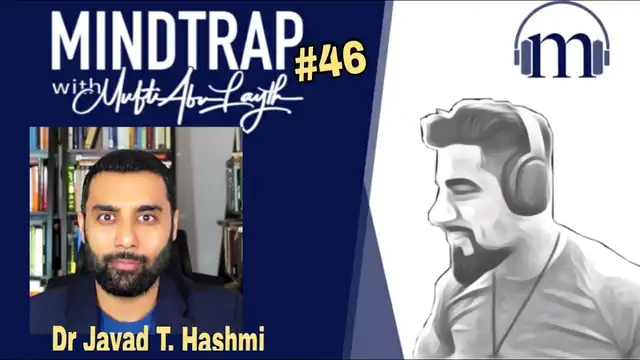 Play from 2:17:04
The video loads from YouTube only when you press play. Click a time in the transcript to seek.
Watch this part
Open on YouTube at 2:17:04The player starts at 2:17:04, the beginning of this part.
This segment2:17:04 to 2:25:43 · 8 min 39 sGeneral teaching
What this part covers
machinesummary, machine-writtenMufti Abu Layth argues the wording of 18:83-90 is too vague to be a retelling of the Alexander legend; the guest says the Syriac subtext explains it and that without it the passage invites endless speculative readings, and they agree to differ.
In more detail
Mufti Abu Layth argues that if the purpose were to retell a known legend the Quran would tell it effectively, but the story is very vague, and he reads through 18:83-86 and onward: 'we gave him of everything a sabab, and he followed a sabab', the sun setting in a murky spring, and the people for whom no covering was made, pointing to unusual wording. The guest says it made sense to the original audience who knew the Syriac story, cites a Western scholar's article tracing the word to that subtext, and says the similarities are too many to be superimposed, so one must conclude that one story preceded the other. Mufti says the verses give too little detail for the Alexander connection, and the guest says they may have to disagree: what Mufti calls Christian baggage is needed to understand the Quran, and without it the verses become vague and open to readings such as the Mongols, Western colonialism or the Soviet Union. He says his approach, literal but literary, does the Quran more justice.
- Guest speech overlaps this segment
Position stated
Waiting for the speaker checkA guest speaks in this segment and the captions do not say who said what. The view found here is held back until the speaker-separated transcript confirms the words are his, or the channel verifies it. The transcript and recording are published in full.
Kind: general teaching Speakers: host and guest; guest speech is labelled and excluded from positionsTranscript
machine2:17:04 to 2:25:43 · click a time to seek · dotted terms open the glossary
A guest speaks in this segment. Guest speech is labelled and is excluded from the positions layer.
and and make it universal because the Quran is going against uh sectarianism, religious sectarianism and this is what the Quran so basically then what it says is that this Gog and Magog are going to come at the end of times and it's just another symbolic end of I'm just saying that look you've got right so let's say now this this I think is a very good uh kind of litmos test this surah like the fact that it's kind of come up now uh and this story of surah of karnain because look I agree that the people of the book were trying
to test the prophet yes alakarnain so here Allah is demonstrating that look you know about this that's fine. So in doing so let's not repeat it again. No. So yeah and but in doing so Allah reveals a story. Right. Right. He doesn't just say well they ask him do you know the story. So that's why he's narrating the story in in in concise form because he doesn't need to go they already know the story.
But the story that is revealed right is incredibly vague. But it's not the words the words that they use that you're saying that are gay. Yeah. Like if we like just one second like if we like look it's it's not that right it's not that Allah doesn't address the issue of yatj and matooj he does.
So, but what he does on top of that, he mentions so much more. So, and then that too's so vague. So you think to yourself, well, if if this was to be a story, why not present it in a way that it would um that it would kind of because if the purpose of the story is simply uh to kind of represent the legend, uh then it should either let's say dramatize it in a way that actually makes sense to the readers.
So, so what I'm saying is it did make sense to the original audience because they knew those stories in that Syria. So, let's say it starts verse 82 and they ask you about tell them I should I will recite on to you a kind of mention of him. Yes.
Now, we established him in the earth. Now this it starts here getting vague already like it says that we established him in the earth but we gave him a suburb a means. Now in English a means sounds quite normal but in Arabic there's a Christian sorry there is a western Quranic studies scholar who's written an article that mentions this word and says that it is actually uh because it's it's the same uh origin the etmological the origin is from the Syriak subtext that the Quran is responding to.
So the only no but the word suburb is an Arabic word which just means cause but but that's why it's saying that in this context it's actually coming from I'd have to so let's just just so here it mentions look and we gave him from everything a cause now this cause doesn't mean like in English a cause it means more like uh a a means to something a something a precursor this this is it so if I was to say and we gave him for for everything a precursor.
Now, the way that sounds weird in English, that's how it sounds in Arabic. Can you tell me can you tell me the verse number by the way? Yes. So, this is 80. It starts in 82. Uh, sorry, 83. And this is now 84. And then it'll say, "And then he followed a precursor." Now, the way precursor sounds odd. If I was to say in English to someone, you know, and by the way, he he followed a precursor. Now, you're going to think, well, what do you exactly mean?
He said, uh, what what verse again? I'm sorry. Can you give me the verse again? 83. 83 what? And 83 surahul kaf um and and going into 84 there it mentions about we gave him from everything a precursor and then he followed a precursor. The next that and that's it. That's one verse. He followed a precursor. Then the next verse he he reaches this thing about the sun where people say oh the sunset into a uh muddy uh they use that.
So here that is uh it's that verse about he reaches uh a place he saw the sunset it says and he found a people and and they said either you punish or you take you know you you either take a good route so he says so and he goes on to mention look people who do good and then we will punish them and they go back and and then the next verse he goes on now rather than just reading the entire verses here what I'm
trying to say then it will say then he followed another precursor verse on its own and it says until he reaches the sun and it sets on a people we had not given them a uh a covering once again a very strange uh way of using that it's not commonly used and then the verse says Once again a strange wording. Now it goes on and then it says again he followed a precursor until he reached.
Now here about Yatj or Matj the story starts. Now my point is that this you know if this is simply to uh rearticulate a legend then it's not I'm just saying if that's the sole purpose it's not being done in a very effective way because it's it's very vague. So, so I'm saying that if you read this story before reading this story, if you read the legend of Alexander, if you read that first and then you wait, so so they already knew that story.
So you are the one who's having it. But are how are you are you not sure that you're not like people are not superimposing that story onto this because of some similarities? But the similarities like yes, that's a possibility as a scholar. You have to think about that. But the story similarities are too many. Like the the similarities between the legend that the Syriak the the the Byzantine the one that's in Bzantium.
You can look there's a there's a good article that I can give you. I'm seeing if I have that book here. Um the that the similarities between the two when they get too many then you have to conclude as a reasonable person as a scholar that one preceded the other. Yes. because the language they came from the same millu either they came from the same uh progenitor or one came from the other this comes back to the baggage point because this is what I'm saying the verses of the Quran about this are actually so vague that there isn't much detail about this kind of like the Alexander thing
something's happened to the mic oh I think it's back I think it's I start to repeat. No, I think this is where we disagree and we may not come to a resolution. Uh, is that Wait, there we're slightly. Let me try. Is it? Yeah, I think that's back. Wait. No, it's not. Is it not? Uh, okay. Here. Now it should be. Yeah, now it's back. Yeah. Yeah. Yeah.
So, I think we may not reach a resolution. We may have a difference of opinion. Sure. That's exactly where I say no. We actually need what you're calling the Christian baggage. without that so-called Christian baggage, we cannot properly understand what the Quran is doing. So, I'm actually saying that we need to look at what's sometimes called the Christian subtext of the Quran. We've moved away from using the word subtext, but uh the point is that we need that in order to understand the Quran.
And if we don't have that, then those verses become vague and unstandable. And then you can have a multiplicity of interpretations. And then I think you're actually that's where I'm saying that you're actually doing more justice to the Quran when you take the approach that I'm arguing for which is actually in some ways a more literal approach uh but a literary one. You're actually doing more justice to the Quran when you're taking this approach as opposed to saying no it refers to the Mongols.
No, it refers to uh Western colonialism. No, it refers to the Soviet Union. No, it refers to my you know somebody might say it refers to my ex-wife. you know, you could say anything, you know. Um, so so I that's but but we may disagree here. Um, and that's, you know, that's from my Quranic studies and as a from as a western academic that's what it's kind of pushed me in this direction. And then I also read the Islamic philosophers of the past and and I think that this is consistent with I just feel that there's like several people.
Paragraphs overlapping 2:17:04 to 2:25:43. Full text on the recording page.
Cite this segment
Stable id, transcript version and tier are part of the citation. Every change to a transcript is logged.Mufti Abu Layth Archive, segment 2020-12-11b-S32, auto-transcribed, may contain errors. https://muftiabulayth.org/r/zasz48lx_wi/s/32/ (accessed 1 November 2026)
- APA 7
Mufti Abu Layth. (2020, December 11). What do the unusual words in the Dhul Qarnayn verses mean? [Video, segment 2020-12-11b-S32, auto-transcribed, may contain errors]. Mufti Abu Layth Archive. Retrieved November 1, 2026, from https://muftiabulayth.org/r/zasz48lx_wi/s/32/
- Chicago author-date
Mufti Abu Layth. 2020. "What do the unusual words in the Dhul Qarnayn verses mean?" Video, segment 2020-12-11b-S32, auto-transcribed, may contain errors. Mufti Abu Layth Archive. Recorded December 11, 2020. Accessed November 1, 2026. https://muftiabulayth.org/r/zasz48lx_wi/s/32/
- BibTeX
@misc{abulayth-2020-12-11b-S32,
  author = {Mufti Abu Layth},
  title = {{What do the unusual words in the Dhul Qarnayn verses mean?}},
  year = {2020},
  month = {12},
  date = {2020-12-11},
  howpublished = {\url{https://muftiabulayth.org/r/zasz48lx_wi/s/32/}},
  url = {https://muftiabulayth.org/r/zasz48lx_wi/s/32/},
  organization = {Mufti Abu Layth Archive},
  urldate = {2026-11-01},
  note = {Segment 2020-12-11b-S32, auto-transcribed, may contain errors}
}
Something wrong here?
Tell us what is wrong and it will be checked against the recording. Nothing changes until a person has reviewed it.
Sending a note needs JavaScript, which is off or unavailable in this browser. Nothing has been sent.
No name, email address or account is asked for or stored, and the inbox does not store your IP address. For rate limiting it keeps an unreadable fingerprint of your connection for 48 hours, and our database provider's own logs record connections as every website's do. Only your note, its kind, the page and the moment in the recording are kept, for review.