
Recordings › Br Muhammad MFG | Quranist Only Belief - A Dialogue | MindTrap #82 - Mufti Abu Layth · 18 Oct 2025 › Segment 27 of 32
Why did Mufti Abu Layth bring up 3:188 against the Quran-only position?
hadeeth ahadith ahaadeeth hadis hadees ahaadith tafseer exegesis tafasir tafaseer commentary muftis koran quraan al-quran surah sura soorah surat suwar soora ayah aya ayat ayaat aayah aayat wahy wahi waheeWhy the verse was raised: compassion, the Prophet's tafsir, and whether it was preserved
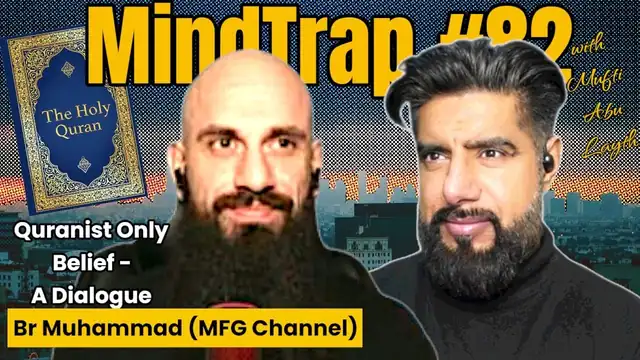 Play from 2:14:00
The video loads from YouTube only when you press play. Click a time in the transcript to seek.
Watch this part
Open on YouTube at 2:14:00The player starts at 2:14:00, the beginning of this part.
This segment2:14:00 to 2:18:51 · 4 min 51 sGeneral teaching
What this part covers
machinesummary, machine-writtenMufti Abu Layth cited 3:188 because its apparent reading is harsher than the Prophet's explanation, showing that the reasoning of those who came before is valuable; the guest says he asked for the Prophet's book of explanations and was pointed back to the Quran.
In more detail
Mufti Abu Layth says he assumed that one impetus of the Quran-only movement was finding hadith that seemed to lack compassion, yet the guest has been driven to a reading of this verse that punishes most of humanity; he cited the verse because the guest had asked for one where the Prophet's explanation made a difference. The guest says that is not what happened: he asked for the Prophet's book of clarifications and Mufti pointed him back to the Quran. Mufti recounts the chain of the argument, that reason has a role, that by the same logic the reasoning of those before us counts, and that the guest asked for an example, so he brought a verse that he has never known anyone to take on its apparent reading, which a hadith of the Prophet explains differently. The guest again demands the book of the Prophet's explanations, which Mufti says the guest himself holds was not preserved, and accuses him of strawmanning; Mufti says he brought the guest on to steelman, not strawman. He concludes that on the guest's reading, since most human beings love praise, most people will face an excruciating punishment, and the guest replies that this is the verse.
- Guest speech overlaps this segment
Position stated
Waiting for the speaker checkA guest speaks in this segment and the captions do not say who said what. The view found here is held back until the speaker-separated transcript confirms the words are his, or the channel verifies it. The transcript and recording are published in full.
Kind: general teaching Speakers: host and guest; guest speech is labelled and excluded from positionsTranscript
machine2:14:00 to 2:18:51 · click a time to seek · dotted terms open the glossary
A guest speaks in this segment. Guest speech is labelled and is excluded from the positions layer.
If somebody's a liar, if somebody's arrogant, if somebody turns away or doesn't listen those that's who God has willed to not guide. That's why God says so you see these are these are standards that God has put that's because it's not random, >> right? So look no so obviously it leads to that same argument. You see my the reason I highlighted this was not to go into the destiny talk but it was to highlight that look one of from what I understood and maybe I understood it inaccurately that look one of the key uh reasons I'm assuming or the kind of uh
impetus for the Quran only movement was that they were finding certain aid that they felt were not uh reflecting compassion. This is what I assume. Now presumably that's obviously not uh the core element but I assumed it was because they were finding hadith that they felt were not compassionate but if only to be driven to a point of view where in this verse and the reason I cited this verse is because you said show me one verse of the Quran where the prophet's taps made that difference and I gave you a verse which by the way and I didn't even ask that do you know what I asked I said bring them the prophets I
said I No, no, no. Then hear me. Hear me out. So you, that's my point. You're not listening to me. You made a point that we need the of the prophet. I said, show me it. You took me to one verse and you showed me one. Can you give me the book of Muhammad Muhammad? Look, that's not what happened. Let me tell you what happened. I said to you, is reason the voice of reason a key component in engaging the dynamic of revelation?
You said it is. I said then by that logic would not the reason of others who went before us also be valuable. So you said well uh give me an example or something where this would show that value. In any case I brought this verse which if you read it by its apparent which >> almost all I've not known any person to have actually believed this verse differently to what I said right this verse I've not known any person to have taken this verse.
With all due respect I you said to me that there's the explanation of the taken and I asked you I bro let me just point just let me finish the point. So you told me about the prophets let me finish the point. No I didn't because you keep interrupting to commenting me and you're not listening to what I'm saying. I simply asked you to bring me.
So it's a book that is explaining the Quran and and you even said okay open chapter 3. I said you're pointing me back to the Quran. I'm telling you bring me Quran a book where it says the the clarifications Muhammad you have that book when I'm saying to you it's not preserved. We can go talk about niche nish but look you're strawman.
>> Okay. So to say that look, I've brought you on here to steel man your case, not to straw man it. I the point I made to you and I say it again and people can rewind it. I said that is not reason important in interpreting the understanding you said it is. I said by that logic is not the reason of those who went before us for 1400 years plus this is my wording. I said with all of their dedication to Islam is not their reason also valuable to which you said no you didn't really accept their reason now you said well okay bring me something where give an example now forget the verbatim now the point was
here is a verse of the Quran that by its apparent reading right seems very you know it's it's kind of like what does this verse mean now I did highlight that I've not known any person who's taken this verse on its apparent meaning right and they there is a hadith of the prophet sallallahu alaihi wasallam explaining this differently and that's what everybody has gone with now when I read it to you you said if and correct me if I'm wrong that no you go with this apparent reading any person who is praised by something they've not done or they love the accomplishments and they're praised by will be punished by God for just uh loving that praise now that you by the psychology of humans
>> yeah that is the verse >> that is the we've read it time and This is it. But when you translate it, it's not just loving with what they have. No, it's the ones who love to be praised with what they've not done and they are so exaltant with what they've been given. That's most people have a pain. What? So it doesn't say yeah exing.
Okay. Yes. So look now the the point is that this by default psychology is most human beings most human beings love being praised. So according to this verse most people will face an excruciating punishment >> right now that's fine that's your interpret that's your taking your not even inter that's your reading of the verse >> look shukran shukran look what I want to say is you have given an incredible amount of time today despite us being late >> let's actually let me actually answer with what you've just presented so I I understand how this conversation was going and that's why some individuals that are in the chat they might be saying certain things is because I
Paragraphs overlapping 2:14:00 to 2:18:51. Full text on the recording page.
Cite this segment
Stable id, transcript version and tier are part of the citation. Every change to a transcript is logged.Mufti Abu Layth Archive, segment 2025-10-18-S27, auto-transcribed, may contain errors. https://muftiabulayth.org/r/onzjd7xmdhe/s/27/ (accessed 1 November 2026)
- APA 7
Mufti Abu Layth. (2025, October 18). Why did Mufti Abu Layth bring up 3:188 against the Quran-only position? [Video, segment 2025-10-18-S27, auto-transcribed, may contain errors]. Mufti Abu Layth Archive. Retrieved November 1, 2026, from https://muftiabulayth.org/r/onzjd7xmdhe/s/27/
- Chicago author-date
Mufti Abu Layth. 2025. "Why did Mufti Abu Layth bring up 3:188 against the Quran-only position?" Video, segment 2025-10-18-S27, auto-transcribed, may contain errors. Mufti Abu Layth Archive. Recorded October 18, 2025. Accessed November 1, 2026. https://muftiabulayth.org/r/onzjd7xmdhe/s/27/
- BibTeX
@misc{abulayth-2025-10-18-S27,
  author = {Mufti Abu Layth},
  title = {{Why did Mufti Abu Layth bring up 3:188 against the Quran-only position?}},
  year = {2025},
  month = {10},
  date = {2025-10-18},
  howpublished = {\url{https://muftiabulayth.org/r/onzjd7xmdhe/s/27/}},
  url = {https://muftiabulayth.org/r/onzjd7xmdhe/s/27/},
  organization = {Mufti Abu Layth Archive},
  urldate = {2026-11-01},
  note = {Segment 2025-10-18-S27, auto-transcribed, may contain errors}
}
Something wrong here?
Tell us what is wrong and it will be checked against the recording. Nothing changes until a person has reviewed it.
Sending a note needs JavaScript, which is off or unavailable in this browser. Nothing has been sent.
No name, email address or account is asked for or stored, and the inbox does not store your IP address. For rate limiting it keeps an unreadable fingerprint of your connection for 48 hours, and our database provider's own logs record connections as every website's do. Only your note, its kind, the page and the moment in the recording are kept, for review.