
Recordings › Br Muhammad MFG | Quranist Only Belief - A Dialogue | MindTrap #82 - Mufti Abu Layth · 18 Oct 2025 › Segment 28 of 32
What is Mufti Abu Layth's case for keeping the Islamic scholarly tradition?
salat salaah namaz prayer salaat namaaz as-salah al-salah salawat hadeeth ahadith ahaadeeth hadis hadees ahaadith sunna sunnat sunan prophetic practice koran quraan al-quran ayah aya ayat ayaat aayah aayat as-salaf salaf al-salih salaf us-salih al-salaf early generations sunni ahl al-sunnah ahl as-sunnah ahlus sunnah ahl al-sunna ulama ulema ulamaa niyyah niyah niyat niyya niyyatSteelmanning each other's position and the value of 1,400 years of scholarship
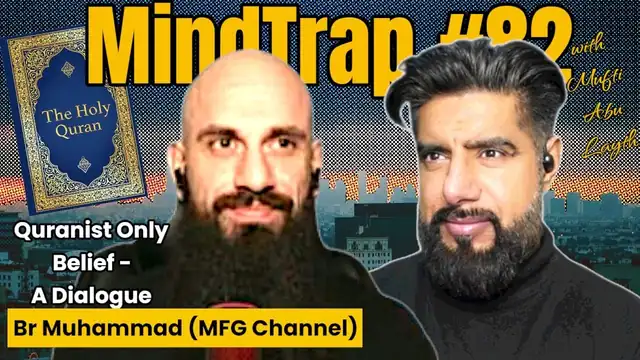 Play from 2:22:37
The video loads from YouTube only when you press play. Click a time in the transcript to seek.
Watch this part
Open on YouTube at 2:22:37The player starts at 2:22:37, the beginning of this part.
This segment2:18:51 to 2:24:01 · 5 min 10 sGeneral teaching
What this part covers
machinesummary, machine-writtenThe guest restates Mufti Abu Layth's view as relying on the tradition for a few hard verses and says the Quran's overall message has no such problems; Mufti says the 1,400-year tradition beginning with the Prophet's Sunnah is invaluable and discarding it is a disservice to Islam.
In more detail
Mufti Abu Layth thanks the guest for his time, but the guest wants to answer what was presented: he says the methodology of presenting hypotheticals one does not believe in to negate the clarity of the Quran is what most Sunnis do, and both complain about interruptions, the guest calling Mufti disrespectful. The guest then steelmans Mufti's position as he understands it: some verses allow subjective reasoning and may be hard to understand, so one relies on the wisdom and tradition of those before, attributed to the Prophet Muhammad, to solve these issues. Mufti adds that it is the whole 1,400-year tradition, not only what is attributed to the Prophet, and phrases it himself: Islam has a tradition of over 1,400 years of scholarship beginning with the Prophet, his Sunnah and hadith, continuing through the Salaf, which is invaluable and sheds guidance on verses whose understanding appears challenging, and to throw it away is a disservice to Islam. The guest replies that Mufti relies on others' understanding for a few select problems, while the overall message of the Quran has no such issues, and that on most of what was presented they already agreed without hadith or the tradition. Mufti says he disagrees.
- Guest speech overlaps this segment
Position stated
Waiting for the speaker checkA guest speaks in this segment and the captions do not say who said what. The view found here is held back until the speaker-separated transcript confirms the words are his, or the channel verifies it. The transcript and recording are published in full.
Kind: general teaching Speakers: host and guest; guest speech is labelled and excluded from positionsTranscript
machine2:18:51 to 2:24:01 · click a time to seek · dotted terms open the glossary
A guest speaks in this segment. Guest speech is labelled and is excluded from the positions layer.
Okay. Yes. So look now the the point is that this by default psychology is most human beings most human beings love being praised. So according to this verse most people will face an excruciating punishment >> right now that's fine that's your interpret that's your taking your not even inter that's your reading of the verse >> look shukran shukran look what I want to say is you have given an incredible amount of time today despite us being late >> let's actually let me actually answer with what you've just presented so I I understand how this conversation was going and that's why some individuals that are in the chat they might be saying certain things is because I
understand this methodology because we have to face it constantly where they want to negate the beautifification the how beautiful and clear the Quran is by presenting hypothes >> all right >> nobody's negating for me >> look I don't I would love to finish up point look listen but you have no >> I heard what you were saying I said do not straw man do not straw man like I've been trying to with you.
>> No, you didn't do not. >> No, no, what you're doing what you're doing quite simply what you're trying to do simply is what most of the Sunnis do is they try to present hypothetical to bring hypothetical and they think actually that's debatable. >> I've not judged your intention. I told you don't let me finish. You don't let me finish. You understand that?
>> Now you keep saying look >> you don't let me finish. You keep saying this. Look, no, don't straw man what I'm actually saying. >> But I would like to speak speak my point without you interrupting me. >> No, but if you're going to No, but if you're going to straw, man, it's not going to work because I've been respecting you. >> Don't judge my intention. I've not been judging your intention. I've been asking you to clarify. But but but you see the point that what I am gathering from this conversation is that you keep making these hypotheticals that you yourself don't believe in to try to negate on how clear the Quran is when you already had the same that I have.
I am reaching Lord man. Let me straw man you just let me straw man you and let me finish. >> No no no I won't. >> Can I just finish the point without being straw man? >> Look if you're going to steal man cool. So so so you're saying that for you to understand the position that you're in. Okay. It is the tradition that is clarifying these questions that you have presented and that's why you believe them. Even though me and you are new.
>> I've said I've not said that. I've said there's some verses on the >> I'm still manning bro. I'm steel manning. So I'm presenting it to you from how I understood it. So let me finish for the love of God bro. Likew I'm asking you for and to just let me finish a point without you being so flustered every time I open the concluding point because at this stage you are maybe you're very tired.
>> It's not about being tired. You're being very disrespectful and I understand this kind of >> I'm being disrespectful. Yes. Yes, you are because you keep interrupting me when I'm making a simple point and you are trying to push I understand your position then. >> Yes. But if you screw on it, I will interrupt. >> Steal man your position doesn't mean I have to say it verbatim. >> No, you have to say accurately >> then let me explain it.
>> Sure. >> Sure. So the presentation that you're presenting that there are some verses in the Quran where it can lead for some subjective reasoning that it might be difficult for someone to understand. So we rely on the wisdom and the tradition of those that came before us who explain the Quran that attributed to the prophet Muhammad that solves these issues that you have presented. Correct? >> Or to other scholars the whole tradition of 1400 years.
>> Correct or false? >> Right. No. So you said that. No. So you you said it shorts. I said >> look allow me to allow me to phrase it then because it's my my view isn't it? So the view is that we have a tradition in Islam of 1,400 plus years of scholarship. Now this is invaluable. This begins from the prophet sallallahu alaihi wasallam himself from his teachings from the sunnah from the hadith.
It comes down through the sal and right through the the whole 1400 years. Now this is invaluable. Now this gives guidance, sheds guidance on certain verses that maybe the understanding may appear challenging to a person that reads these select verses. Yes, of course. Now to negate that to throw that tradition away to me is an entire disservice to Islam.
>> Cool. So what I was trying to present to you is that you have presented situations where you want to rely on any someone else's understanding which they attribute to the prophet for these small select problems that you have presented but the overall of the message of the Quran does not have these issues and even with the things that you have presented the majority of it we were already in agreement before what you presented and I didn't need the hadith nor I needed the tradition to understand that position.
So but quite simply quite simply I would disagree. >> Mhm. >> Yeah you have been >> I disagree. Yeah >> because let's just so today's discussion has shown look some of the conversations we got into especially the application of Islam. We began with salah. A lot of the things you chose were all taught through the tradition you mate >> right that you just include before.
Paragraphs overlapping 2:18:51 to 2:24:01. Full text on the recording page.
Cite this segment
Stable id, transcript version and tier are part of the citation. Every change to a transcript is logged.Mufti Abu Layth Archive, segment 2025-10-18-S28, auto-transcribed, may contain errors. https://muftiabulayth.org/r/onzjd7xmdhe/s/28/ (accessed 1 November 2026)
- APA 7
Mufti Abu Layth. (2025, October 18). What is Mufti Abu Layth's case for keeping the Islamic scholarly tradition? [Video, segment 2025-10-18-S28, auto-transcribed, may contain errors]. Mufti Abu Layth Archive. Retrieved November 1, 2026, from https://muftiabulayth.org/r/onzjd7xmdhe/s/28/
- Chicago author-date
Mufti Abu Layth. 2025. "What is Mufti Abu Layth's case for keeping the Islamic scholarly tradition?" Video, segment 2025-10-18-S28, auto-transcribed, may contain errors. Mufti Abu Layth Archive. Recorded October 18, 2025. Accessed November 1, 2026. https://muftiabulayth.org/r/onzjd7xmdhe/s/28/
- BibTeX
@misc{abulayth-2025-10-18-S28,
  author = {Mufti Abu Layth},
  title = {{What is Mufti Abu Layth's case for keeping the Islamic scholarly tradition?}},
  year = {2025},
  month = {10},
  date = {2025-10-18},
  howpublished = {\url{https://muftiabulayth.org/r/onzjd7xmdhe/s/28/}},
  url = {https://muftiabulayth.org/r/onzjd7xmdhe/s/28/},
  organization = {Mufti Abu Layth Archive},
  urldate = {2026-11-01},
  note = {Segment 2025-10-18-S28, auto-transcribed, may contain errors}
}
Something wrong here?
Tell us what is wrong and it will be checked against the recording. Nothing changes until a person has reviewed it.
Sending a note needs JavaScript, which is off or unavailable in this browser. Nothing has been sent.
No name, email address or account is asked for or stored, and the inbox does not store your IP address. For rate limiting it keeps an unreadable fingerprint of your connection for 48 hours, and our database provider's own logs record connections as every website's do. Only your note, its kind, the page and the moment in the recording are kept, for review.