
Recordings › Dr Javad T. Hashmi | Axis of Morality & Archetypal Myths in the Quran | MindTrap 46 |Mufti Abu Layth · 11 Dec 2020 › Segment 31 of 36
Why does the Quran tell the story of Dhul Qarnayn so briefly?
muftis dalil daleel adillah adilla evidence koran quraan al-quran sura soorah surat suwar soora chapter ayah aya ayat ayaat aayah aayat ulama ulema ulamaa salam as-salamu alaykum assalamu alaikum assalamualaikum salaam salaams salam alaykum wa alaykum as-salam greetingWhy the Quran retells it: proof of the Prophet's knowledge, minus the Christian empire
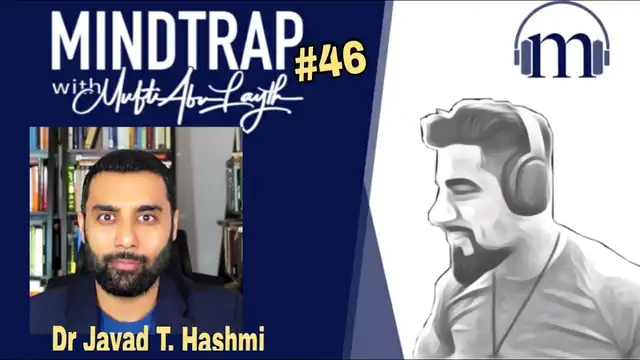 Play from 2:11:24
The video loads from YouTube only when you press play. Click a time in the transcript to seek.
Watch this part
Open on YouTube at 2:11:24The player starts at 2:11:24, the beginning of this part.
This segment2:11:24 to 2:17:04 · 5 min 40 sA view quoted in order to be discussed, not a position held
What this part covers
machinesummary, machine-writtenThe guest says the Quran retells the known legend concisely to show the Prophet's knowledge from God, while stripping its Christian imperial ending; Mufti Abu Layth objects that its unusual wording is too vague for that.
In more detail
The guest says the story is ambiguous only to later Muslims, who for theological reasons divorced the Quran from the pre-Quranic Christian and Jewish stories of its milieu. Following Khalafallah, he says the People of the Book used knowledge of sacred stories as a criterion to tell a true prophet from a false one, so the Quran, introduced by 'they ask you about', shows that the Prophet knew the story from God, and tells it concisely because the audience already knew it. Mufti Abu Layth objects that the story is not just elliptical but uses words, such as 'he followed a sabab', that the Quran never uses again, and that apart from Gog and Magog there is little to take from it; the guest answers that early exegetes found these words unclear because they rest on a Syriac subtext. He adds that the Quran theologically rearticulates the story by removing its sectarian Christian ending, making it universal.
Position stated
This segment presents a view in order to discuss or respond to it. It is recorded as quoted, never as held, and no position is attributed from it.
Kind: a view quoted in order to be discussed, not a position held Speakers: host and guest; guest speech is labelled and excluded from positionsTranscript
machine2:11:24 to 2:17:04 · click a time to seek · dotted terms open the glossary
A guest speaks in this segment. Guest speech is labelled and is excluded from the positions layer.
This segment states a view in order to discuss it. It is recorded as a quoted view, not as a position held.
ambiguous and that's and okay and that comes to your question about why the story was narrated in the Quran it says they ask you about it was people of the book who asked him about do you know about and they were and and the reason is and and now going back to this author he says that the Jews of that time and the people of the book of that time they used the criterion of differentiating between a true prophet and a false prophet knowledge of these sacred stories because they thought they were a scriptured people and and they should
have knowledge and and they differentiated that from the let's let's say it is a story that is to do that it's this sacred story in that case you take the story of Dulain to be honest for a story. It's, you know, it's not all that because it's not, it doesn't actually give you, in fact, it's very vague. Like, it keeps saying he goes here and he keeps going and it uses words like it doesn't say he follows a path.
It says he follows a suburb. Now, it doesn't explain what that means. So, so um that's actually a point in the opposite direction I think because the way that Quran uses concise language, it doesn't narrate full stories because I don't mean I don't mean just I don't mean like so one is like just to be clear on the question one is to say look uh so for example the story of Moses is mentioned on many occasions in some suras it's just going to be one verse two verses that's it so That's just elliptic.
No, that's not what I mean. That's not what I mean. No, but what I'm saying is the vast majority of stories that's fine. Not narrated. Sure. Not to digress here. So this question of this story is just mentioned once. It's not like so it's not about an ellipses in the story. The story actually uses words which the Quran never uses ever again. Okay. To so it says things like so which the scholars say means here the say he means he took a path that the two-horned one.
Yeah. No no not his name. Sorry the the verse it mentions that like he sets off but it uses a word which Arabs don't normally use. They don't say and it never uses again ever in the Quran but it uses this repetitively every time this and it mentions certain junctions like he does something he does something for he does and and and the story in its parts is not very you know as far as stories go apart from the part of Matuj at the end the other parts don't seem to really like there's not much to take away from it
so so let me let Let me let me say this is my view. Um the re what western Quranic studies scholars say is the reason why all of these early Muslim exedites said that these ver these words are ambiguous unclear we don't know what they mean is precisely because they are based on a Syriak subtext that is that the so the origin is from these other stories that now because but it's in Arabic though but it's a but but they were known at that time so it wasn't unknown to the people of that time.
So, okay, but let me just let me just give me one second here. So, it says they ask you about because they you they were using that as a criterion to differentiate a true from a false prophet. So, all the Quran was doing at this point was trying to show that the prophet knew the story from God and that his source was from stories of the Quran. the the the the uh pagans used to say that these stories you've met someone has told you these stories but the Quran is showing that no God is the one who gave the prophet the knowledge of these and so the Quran is
just giving them in if if your audience already knows the story you don't need to repeat it in great detail so but if it's going to reveal like let's say oh wait wait wait just just one second one second one second cuz so so it would be very cursive The other thing is the main point is that the Quran theologically rearticulates the story. So remember I told you that the Bzantium story ended with a Christian environment and a Christian background.
It said that at the end then this Christian empire would rule and there would be peace. The Quran eliminates that in its theological rearticulation. So so the Quran achieves two things by narrating the story. Number one, it affirms that the prophet uh knew the story when the Jews when the sorry the people of the book and the pagans were trying to catch him off guard that you don't know the story and that you're a false prophet. And number two is not only does it show that he knows the story, he theologically the Quran theologically rearticulates the story to to remove the Christian um uh uh the the sectarian Christian nature to it and say
and and make it universal because the Quran is going against uh sectarianism, religious sectarianism and this is what the Quran so basically then what it says is that this Gog and Magog are going to come at the end of times and it's just another symbolic end of I'm just saying that look you've got right so let's say now this this I think is a very good uh kind of litmos test this surah like the fact that it's kind of come up now uh and this story of surah of karnain because look I agree that the people of the book were trying
Paragraphs overlapping 2:11:24 to 2:17:04. Full text on the recording page.
Cite this segment
Stable id, transcript version and tier are part of the citation. Every change to a transcript is logged.Mufti Abu Layth Archive, segment 2020-12-11b-S31, auto-transcribed, may contain errors. https://muftiabulayth.org/r/zasz48lx_wi/s/31/ (accessed 1 November 2026)
- APA 7
Mufti Abu Layth. (2020, December 11). Why does the Quran tell the story of Dhul Qarnayn so briefly? [Video, segment 2020-12-11b-S31, auto-transcribed, may contain errors]. Mufti Abu Layth Archive. Retrieved November 1, 2026, from https://muftiabulayth.org/r/zasz48lx_wi/s/31/
- Chicago author-date
Mufti Abu Layth. 2020. "Why does the Quran tell the story of Dhul Qarnayn so briefly?" Video, segment 2020-12-11b-S31, auto-transcribed, may contain errors. Mufti Abu Layth Archive. Recorded December 11, 2020. Accessed November 1, 2026. https://muftiabulayth.org/r/zasz48lx_wi/s/31/
- BibTeX
@misc{abulayth-2020-12-11b-S31,
  author = {Mufti Abu Layth},
  title = {{Why does the Quran tell the story of Dhul Qarnayn so briefly?}},
  year = {2020},
  month = {12},
  date = {2020-12-11},
  howpublished = {\url{https://muftiabulayth.org/r/zasz48lx_wi/s/31/}},
  url = {https://muftiabulayth.org/r/zasz48lx_wi/s/31/},
  organization = {Mufti Abu Layth Archive},
  urldate = {2026-11-01},
  note = {Segment 2020-12-11b-S31, auto-transcribed, may contain errors}
}
Something wrong here?
Tell us what is wrong and it will be checked against the recording. Nothing changes until a person has reviewed it.
Sending a note needs JavaScript, which is off or unavailable in this browser. Nothing has been sent.
No name, email address or account is asked for or stored, and the inbox does not store your IP address. For rate limiting it keeps an unreadable fingerprint of your connection for 48 hours, and our database provider's own logs record connections as every website's do. Only your note, its kind, the page and the moment in the recording are kept, for review.