
Recordings › Br Muhammad MFG | Quranist Only Belief - A Dialogue | MindTrap #82 - Mufti Abu Layth · 18 Oct 2025 › Segment 20 of 32
Does the Quran alone say what breaks the fast?
salat salaah namaz prayer salaat namaaz as-salah al-salah salawat sawm roza siyam rozah saum ramadhan ramzan ramazan ramadaan muftis halaal permitted haraam forbidden mubah mubaah koran quraan al-quran surah sura soorah surat suwar soora ayah aya ayat ayaat aayah aayatWhat breaks the fast? 2:187 and whether an inference is 'what God said'
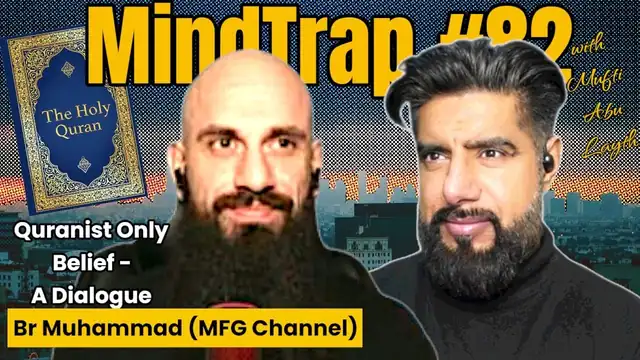 Play from 1:42:01
The video loads from YouTube only when you press play. Click a time in the transcript to seek.
Watch this part
Open on YouTube at 1:42:01The player starts at 1:42:01, the beginning of this part.
This segment1:42:01 to 1:46:26 · 4 min 25 sGeneral teaching
What this part covers
machinesummary, machine-writtenThe guest says 2:187 shows that eating, drinking and intercourse break the fast by making them lawful at night; Mufti Abu Layth says the verse does not explicitly forbid them by day, so the Quran-only reader is inferring by reason rather than reporting what God said.
In more detail
The guest says eating, drinking and sexual intercourse invalidate the fast because those are what one fasts from, as chapter two states. Mufti Abu Layth says he does not disagree with the rules everybody agrees on, but asks where the verse specifically negates these things before nightfall, given that each person is entitled to approach the Quran with his own understanding and the guest allows salah to differ from person to person. The guest distinguishes implicit from explicit verses: the verse makes the night of the fast lawful for approaching one's wives, therefore it is unlawful by day. Mufti says the verse does not say that, and reminds the guest that a moment earlier he had said not to attribute to Allah what he did not say; the guest can say he inferred it, but not that Allah said it. The guest says the negation makes it very clear, since otherwise God would be giving empty language, and that the Quran being sufficient does not remove the need to use one's eyes and reason; Mufti replies that reason is then completing what the verse leaves unsaid, which he names adverse judgment.
- Guest speech overlaps this segment
Position stated
Waiting for the speaker checkA guest speaks in this segment and the captions do not say who said what. The view found here is held back until the speaker-separated transcript confirms the words are his, or the channel verifies it. The transcript and recording are published in full.
Kind: general teaching Speakers: host and guest; guest speech is labelled and excluded from positionsTranscript
machine1:42:01 to 1:46:26 · click a time to seek · dotted terms open the glossary
A guest speaks in this segment. Guest speech is labelled and is excluded from the positions layer.
>> So wash your face, wash your hands, wipe your head, and wipe your feet. So but then we when we look at the tradition there's things that are added in there which are not part found in >> what >> okay >> so what about things like in that sense in Ramadan then how do you uh do the same thing is it like like what violates a fast and what doesn't and how do you arrive at the say >> eating and drinking and sexual intercourse will invalidate your fast because that's what you're fasting from.
So that's a very good push back question. So when God is telling you you can't eat, drink and uh approach your wives or spouses during your fasting, you >> just to clarify like which verses are you referring to? >> This is in chapter two. >> Yeah, bring them up. Let's see. Because the reason I'm asking is because if we're just going by the understanding of the verse, I understand and I don't disagree with you because these are the rules that everybody agrees on that you know that you don't eat, you don't
drink, uh you refrain from sexual intercourse. But the verses of the Quran, if it's each person is entitled to just approach the Quran with their own understanding, >> just to say that look, you can you do these things afterwards, why does the it where does it specifically negate them happening before? I'm just curious on that as a question.
>> I know it sounds obvious. Yeah. Read the read the verse and let's let's >> sure. >> Okay. So >> the reason being is if we're saying to everybody that now this is just a question that look if we say to people look when it comes to salah I want you all to approach and just do it however it comes together for you. You know it it doesn't have to be the same. Why does it have to be the same for fasting then?
>> Okay. So God because there's implicit verses and explicit verses. A lot of the verses about the prayers there's a lot of implicit behind it. Here it's explicit. Lawful >> let's go. >> Lawful for you is the night lawful for you is the night of the abstinence to go after your wife after your wives. Therefore at night it's lawful. In the morning it's not lawful. >> But it doesn't say in the morning it's not.
>> So what do you implicitly understand? >> No. But I thought we're going just by the Quran. So if you just show me from the Quran. >> That's fine. So so in in the way that you understood it, right? Listen, this is very simple. And the way that you understood it, you you you're assuming that God is not telling you translation just for people as well. >> Okay. Yeah. So what do you understand here that in the night of the abstinence?
Yeah. That it's halal. Therefore the understood during your that it's haram. That it's not something. >> It doesn't say that though. It doesn't say that. >> So why would God state this? This is just if it's legal in the morning. >> I'm just asking you. No, I'm just asking you that you that did you not a moment. No, listen, brother Muhammad. The reason I'm saying this is a moment ago when we almost had crossed when we almost crossed, you said to me that you know, do not attribute lies to Allah saying he said something when he did not say it.
So you're saying here Allah said that but he didn't say it in that verse. Now you could say I inferred it. >> Yes. >> But you can't say he said it. >> No he is making it very clear by the negation. >> No it's not making it clear. Making it clear would be to say it. >> That's fine. Listen listen listen. So there is a concept of reason right. So but you said the Quran only is sufficient. >> Yes. The Quran is sufficient. So excuse me. Now you alone is sufficient for your guidance.
You still have to use your eyes, you know. You still have to use your mouth and your head. >> No, but is it necessary? Without that, it's incomplete. >> I guess breathing is the Quran incomplete. I'm breathing as well. I'm not trying to say you're you're trying to play games. No, I'm not. No, not finish a point. >> Of course. Please, please, please do. So it says anyone who's reading this verse is understanding that now something is permissible.
If it was always permissible during the whole day then God is giving you empty language. There's a reason why God is putting it in the Quran because it's >> but he hasn't said it though >> because it's negating to you. So and as you go further it stays to you very clearly. >> This is called adverse judgment. It's called adverse judgment. It's called implicit. >> I can't finish a verse man. I can't finish a a point. >> Please do. Please do. Please do. No, it's okay. You keep saying please do and then I started to talk and then you're going to tell me about the the abstract points that I'm making.
Paragraphs overlapping 1:42:01 to 1:46:26. Full text on the recording page.
Cite this segment
Stable id, transcript version and tier are part of the citation. Every change to a transcript is logged.Mufti Abu Layth Archive, segment 2025-10-18-S20, auto-transcribed, may contain errors. https://muftiabulayth.org/r/onzjd7xmdhe/s/20/ (accessed 1 November 2026)
- APA 7
Mufti Abu Layth. (2025, October 18). Does the Quran alone say what breaks the fast? [Video, segment 2025-10-18-S20, auto-transcribed, may contain errors]. Mufti Abu Layth Archive. Retrieved November 1, 2026, from https://muftiabulayth.org/r/onzjd7xmdhe/s/20/
- Chicago author-date
Mufti Abu Layth. 2025. "Does the Quran alone say what breaks the fast?" Video, segment 2025-10-18-S20, auto-transcribed, may contain errors. Mufti Abu Layth Archive. Recorded October 18, 2025. Accessed November 1, 2026. https://muftiabulayth.org/r/onzjd7xmdhe/s/20/
- BibTeX
@misc{abulayth-2025-10-18-S20,
  author = {Mufti Abu Layth},
  title = {{Does the Quran alone say what breaks the fast?}},
  year = {2025},
  month = {10},
  date = {2025-10-18},
  howpublished = {\url{https://muftiabulayth.org/r/onzjd7xmdhe/s/20/}},
  url = {https://muftiabulayth.org/r/onzjd7xmdhe/s/20/},
  organization = {Mufti Abu Layth Archive},
  urldate = {2026-11-01},
  note = {Segment 2025-10-18-S20, auto-transcribed, may contain errors}
}
Something wrong here?
Tell us what is wrong and it will be checked against the recording. Nothing changes until a person has reviewed it.
Sending a note needs JavaScript, which is off or unavailable in this browser. Nothing has been sent.
No name, email address or account is asked for or stored, and the inbox does not store your IP address. For rate limiting it keeps an unreadable fingerprint of your connection for 48 hours, and our database provider's own logs record connections as every website's do. Only your note, its kind, the page and the moment in the recording are kept, for review.