
Recordings › Prof. Dr Khalil Andani | The Oral Text & the Ontology of The Quran | Mindtrap with Mufti #28 · 3 Jul 2020 › Segment 6 of 23
Does 'Kitab' in the Quran mean a book?
tafseer exegesis tafasir tafaseer commentary muftis koran quraan al-quran soorah surat suwar soora chapter ayah aya ayat ayaat aayah aayat tilawah tilawat tilaawah wahy wahi wahee makki and madani makki madani medinan makki surah madani surah sahabah sahaba sahabi sahabiyyah sahabiyatWhat does Kitab mean in the Quran? Divine writing, not a book
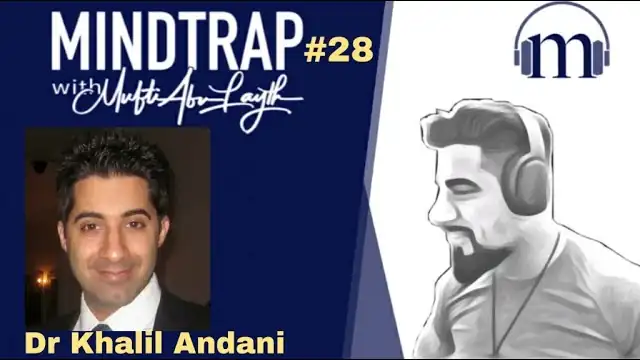 Play from 22:36
The video loads from YouTube only when you press play. Click a time in the transcript to seek.
Watch this part
Open on YouTube at 22:36The player starts at 22:36, the beginning of this part.
This segment22:36 to 27:58 · 5 min 22 sGeneral teaching
What this part covers
machinesummary, machine-writtenKitab in the Quran means divine writing or prescription rather than a physical book; the guest distinguishes the heavenly Kitab Mubin from the Arabic Quran, and Mufti Abu Layth agrees Kitab cannot mean book.
In more detail
Mufti Abu Layth asks about the term al-Kitab. The guest says its consistent meaning in the Quran is not 'book' but divine writing or prescription, covering the record of God's knowledge and his commands; Mufti says he likes that translation and agrees that Kitab cannot mean book, since the Quran was not a book while it was being revealed, citing 'it has been prescribed for you to fast' and the verse criticising those who put the scripture onto parchments. The guest adds that the Quran rejects the Meccans' demand for a Kitab on paper, and distinguishes al-Kitab al-Mubin, God's record containing his knowledge, from the Arabic Quran in which it was sent down, as in Surah Yusuf and Surah 43. He says later Muslims quickly conflated the two, as seen across the tafsir tradition; Mufti notes the early debate over whether the Arabic manifestation is identical to God's communication.
- Guest speech overlaps this segment
- Some terms in this segment are uncertain
Position stated
Waiting for the speaker checkA guest speaks in this segment and the captions do not say who said what. The view found here is held back until the speaker-separated transcript confirms the words are his, or the channel verifies it. The transcript and recording are published in full.
Kind: general teaching Speakers: host and guest; guest speech is labelled and excluded from positionsTranscript
machine22:36 to 27:58 · click a time to seek · dotted terms open the glossary
A guest speaks in this segment. Guest speech is labelled and is excluded from the positions layer.
Now, people may take certain inspirations from certain verses which people before them maybe didn't see that verse for that particular inspiration. I think that for that angle, I think for the most part most Muslims would be, you know, very comfortable with. This this oral tradition of the Quran, how is that different how is that different from the actual scripture?
And just before we get into that, are you differentiating between Kitab? Because Allah says and on many occasions it's mentioned to Alkitab. What what are your thoughts on Alkitab? It's a very good question. In my view, the meaning of Kitab, the consistent sort of overarching meaning of the term Kitab throughout the Quran is not really book, but divine writing or divine prescription.
That's, you know, and that includes so like any type of writing by God, whether it's the record of God's knowledge, right? Or God commanding laws and decrees, all of that comes under Kitab. I do personally, I think that's a very good translation by the way. I do like that whether I personally see the distinction that you're seeing or not with the oral or the written revelation, but I definitely agree that Kitab in the Quran cannot mean book because the Quran was not a book as it was being revealed.
And as Allah says in the Quran about that or that you have this has been prescribed for you to fast. It has been prescribed for you to and also [clears throat] a very interesting verse that speaking about prior scriptures that Allah says that we sent down that you make it into paper.
Yeah. Yes. Yeah. And and and that was that was criticized, right? The the the Jews I think some Jewish scribes in the Quran are criticized for putting the Kitab that was sent down onto parchments. They're criticized for doing that. Similarly, when the Meccans, I think this is in Sura 6, when the Meccans demand a Kitab on on paper, the Quran rejects that demand.
It says, "No, this is simply not going to happen. You wouldn't have believed in it anyway." So, whatever the Quran is or was during the revelatory moment, it was not a written Kitab, right? A physical Kitab. The other thing is that the way the Quran uses the word Kitab when it comes to Revelation is quite interesting because in some cases, yes, the Quran itself is called a Kitab in Arabic.
So, I agree, but there's many cases where the term It is a Kitab we sent down as an example. Right. Right. But often it's compared to the Torah for example and it says like this this is a Kitab in Arabic referring to the Quran. But there are many cases there many verses often occurring at the beginning of of middle Meccan Suras where the the Quran refers to the Kitab like Alkitab Al-Mubin for example or just Alkitab as something distinct from Quran and Arabian.
In fact, we find formulations where it clearly says this is like in the Sura Yusuf for example, also in Sura 43 you have this where it is said it is saying that there is something called Alkitab Al-Mubin and God has sent down Alkitab Al-Mubin as in the form of an Arabic Quran in in the indefinite an an Arabic Quran.
And there are other instances where we learn this this phrase or this term Alkitab Al-Mubin or or without the definite articles, many other verses tell us that God's ultimate record book, right? The Kitab that contains all of God's knowledge, that is named Kitab Mubin several times in the Quran.
So, there seems to be a distinction between the Kitab Mubin which seems to contain God's knowledge of everything and then the form in which it was revealed which is an Arabic recitation. So, there's an ontological distinction and what I find what easily happens is that Muslims of later periods conflated these very very quickly and you see it all over the Tafsir tradition.
Because you see the I mean, on this point we do find the early reasonably early as in I'm not saying in the companions, but in the generations after this discussion emerging that is the Quran the Quran in Arabic that Quran in Arabic and that we revealed it Quran in Arabic in the kind of indefinite sense.
Now, is this manifestation a mirror image or is it identical to the actual Quran or is it a worldly manifestation of God's communication? This debate begins quite early in Islam and and this is the problem they're tackling, isn't it?
Yeah, so you'll find that the whole the these issues are framed differently depending on which tradition you consult. What happened in the uh Tafsir tradition which seems to reflect some early process where after the Mushaf was compiled the term Kitab Allah Kitab Allah became associated with the Mushaf.
Paragraphs overlapping 22:36 to 27:58. Full text on the recording page.
Cite this segment
Stable id, transcript version and tier are part of the citation. Every change to a transcript is logged.Mufti Abu Layth Archive, segment 2020-07-03-S06, auto-transcribed, may contain errors. https://muftiabulayth.org/r/xznxiyp0b5s/s/6/ (accessed 1 November 2026)
- APA 7
Mufti Abu Layth. (2020, July 3). Does 'Kitab' in the Quran mean a book? [Video, segment 2020-07-03-S06, auto-transcribed, may contain errors]. Mufti Abu Layth Archive. Retrieved November 1, 2026, from https://muftiabulayth.org/r/xznxiyp0b5s/s/6/
- Chicago author-date
Mufti Abu Layth. 2020. "Does 'Kitab' in the Quran mean a book?" Video, segment 2020-07-03-S06, auto-transcribed, may contain errors. Mufti Abu Layth Archive. Recorded July 3, 2020. Accessed November 1, 2026. https://muftiabulayth.org/r/xznxiyp0b5s/s/6/
- BibTeX
@misc{abulayth-2020-07-03-S06,
  author = {Mufti Abu Layth},
  title = {{Does 'Kitab' in the Quran mean a book?}},
  year = {2020},
  month = {7},
  date = {2020-07-03},
  howpublished = {\url{https://muftiabulayth.org/r/xznxiyp0b5s/s/6/}},
  url = {https://muftiabulayth.org/r/xznxiyp0b5s/s/6/},
  organization = {Mufti Abu Layth Archive},
  urldate = {2026-11-01},
  note = {Segment 2020-07-03-S06, auto-transcribed, may contain errors}
}
Something wrong here?
Tell us what is wrong and it will be checked against the recording. Nothing changes until a person has reviewed it.
Sending a note needs JavaScript, which is off or unavailable in this browser. Nothing has been sent.
No name, email address or account is asked for or stored, and the inbox does not store your IP address. For rate limiting it keeps an unreadable fingerprint of your connection for 48 hours, and our database provider's own logs record connections as every website's do. Only your note, its kind, the page and the moment in the recording are kept, for review.