
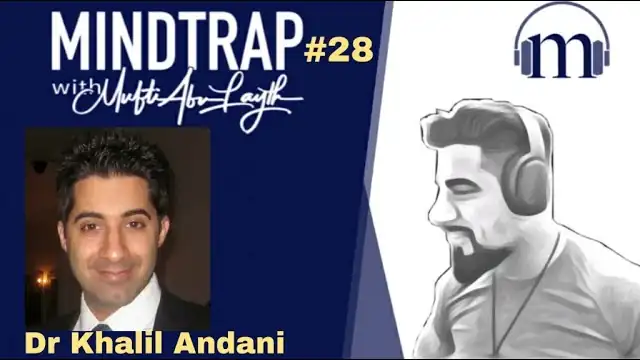
Recordings › Prof. Dr Khalil Andani | The Oral Text & the Ontology of The Quran | Mindtrap with Mufti #28 · 3 Jul 2020 › Segment 7 of 23
Is the 'Book of Allah' the same thing as the written Quran?
hadeeth ahadith ahaadeeth hadis hadees ahaadith tafseer tafasir tafaseer commentary al-bukhari imam bukhari sahih al-bukhari sahih bukhari saheeh al-bukhari saheeh bukhari imam al-bukhari imaam imams prayer leader muftis koran quraan al-quran mufassir mufasir mufassireen quran commentator ayah aya ayaat aayah aayat verse qira'at qira'ah qiraa'aat qira'aat wahy wahi wahee ummah umma ummatKitab Allah and the Mushaf: the hadith 'the book of Allah suffices us'
 Play from 27:58
The video loads from YouTube only when you press play. Click a time in the transcript to seek.
Watch this part
Open on YouTube at 27:58The player starts at 27:58, the beginning of this part.
This segment27:58 to 33:53 · 5 min 55 sA view quoted in order to be discussed, not a position held
What this part covers
machinesummary, machine-writtenThe guest argues that equating Kitab Allah with the Mushaf is a later interpretation that downsized the Quran's concept of a transcendent divine writing.
In more detail
The guest says that in the tafsir tradition, after the Mushaf was compiled, the term Kitab Allah became associated with it, at first as a symbol invoking its presence. Mufti Abu Layth raises the hadith in Bukhari in which the dying Prophet asks for something to write on and Umar says the book of Allah suffices, when there was no book at that stage. The guest asks whether the hadith dates to Umar, says that in the Quran itself Kitab Allah is never equated with the Quran but means God's decree, as in the twelve months and blood relations verses, and calls the claim that the Arabic recitations exclusively are the Kitab Allah an interpretation, since the Prophet's teaching of the Kitab and hikmah is distinct from reciting the verses. He argues that the tafsir tradition projected the earthly Mushaf into heaven, so that the guarded tablet holds the Arabic text and revelation is just its transport, which he calls a downsizing of the transcendent Kitab, though he allows that this is an academic debate.
- Some terms in this segment are uncertain
Position stated
This segment presents a view in order to discuss or respond to it. It is recorded as quoted, never as held, and no position is attributed from it.
Kind: a view quoted in order to be discussed, not a position held Speakers: host and guest; guest speech is labelled and excluded from positionsTranscript
machine27:58 to 33:53 · click a time to seek · dotted terms open the glossary
A guest speaks in this segment. Guest speech is labelled and is excluded from the positions layer.
This segment states a view in order to discuss it. It is recorded as a quoted view, not as a position held.
Now, is this manifestation a mirror image or is it identical to the actual Quran or is it a worldly manifestation of God's communication? This debate begins quite early in Islam and and this is the problem they're tackling, isn't it?
Yeah, so you'll find that the whole the these issues are framed differently depending on which tradition you consult. What happened in the uh Tafsir tradition which seems to reflect some early process where after the Mushaf was compiled the term Kitab Allah Kitab Allah became associated with the Mushaf.
It seems that at some early point the Mushaf was being treated as a symbol of Kitab Allah, but not identical to it, but as a symbol. Almost as if the presence of Kitab Allah was invoked by the Mushaf. Interesting that even the famous the Hadith in Bukhari where the prophet is in his final moments and they're disputing and he says, you know, like bring me a something to write on.
And Omar's response is that the book of Allah that the book of Allah is sufficient for us, but there was no book at that stage. Correct. Correct. So, so we have to ask sort of firstly like where does this Hadith date to, right? Is it is it historical or does it date to, you know, a first century or something? That's one question.
Now, whether regardless of how you answer that question, I can tell you that the term Kitab Allah in the Quran itself is never equated with the Quran. It's always used in this more generic sense of God's decree, God's prescription. So, for example, we we read in the Quran that, you know, there are 12 months, you know, according to the Kitab Allah or blood relations are are closer to to I forgot the phrasing like but blood relations are closer in the Kitab Allah.
We read the Kitab Allah is associated like with one God created the heavens and the earth. Also um be with the in the judgment of God? Yes, in the judgment of God is also again the decree of God, the judgment of God. But my point is that in the Quran itself the concept the term Kitab Allah has a much wider connotation than the Quran and Arabian, right? They're they're not simply identical.
Now whether the Hadith dates to Omar himself or later the Hadith is I mean I hesitate to say but there's an innovative interpretation going on in that Hadith. The claim that the Quran the Arabic recitations constitute the Kitab Allah exclusively that in my eyes is a it is an interpretation it is not a given because according to the Quran itself whatever the prophet taught the community verbally I mean apart from what he recited but what the prophet
actually taught that is also Kitab. Like that is also called Kitab. There's several verses where it says about the messenger he's been sent to teach them Kitab Allah will Hikmah, right? You've you've seen those? Right? So teaching the Kitab in other words reciting the Quran or reciting the ayat. Right. So that's distinct.
So so teaching the Kitab by the prophet is distinct from the prophet reciting the ayat of God. So it seems to me that that the term Kitab even in the Quran it embraces more than the the recitations. Anything that the prophet would have taught as divine guidance merits the the name and the function of Kitab. But then to later after the prophet is dead to now say okay only the Quran only the Mushaf is Kitab Allah that is downsizing the very notion of Kitab.
Not to mention the distinction ontologically in the Quran between the transcendent Kitab Mubeen and the earthly Arabic Quran. That distinction is important. What happens in the Tafsir tradition is the transcendent Kitab Allah is almost anthropomorphized into a material text where the Arabic Quran is already written there in Arabic.
That's what you find in the Tafsir tradition. So the Mufassirun believe that the whole Quran the same content that we have it today right in Arabic Surahs verses the Mufassirun the exegesis they believe that that exists [snorts] in the heavenly book in Arabic in already in Arabic. Mahfuz the kind of the Imam Mubeen or Kitab Mubeen that is with Allah.
Right. So so that ontological difference is gone because all they've what they've done is they've projected the earthly Mushaf into heaven and it now revelation is simply a matter of transporting this text down. Are you saying the downsizing is a qualitative downsizing as well? Definitely is is that's what we're It is it is in the way that the way that they think about the the guarded tablet or the heavenly Kitab Mubeen they've downsized the concept because again in my reading and I could be wrong I mean this is an academic debate that one can have but in my reading which I think has
support the Quranic heavenly Kitab Mubeen is not simply a bunch of master transcripts. Right? It's it's something far beyond that it's equated with with the very ilm of God himself. So it seems like it's we're talking about something transcendent and and it's the the the revelatory process makes that partially manifest in a form in which in this case it's the Arabic Quran.
Paragraphs overlapping 27:58 to 33:53. Full text on the recording page.
Cite this segment
Stable id, transcript version and tier are part of the citation. Every change to a transcript is logged.Mufti Abu Layth Archive, segment 2020-07-03-S07, auto-transcribed, may contain errors. https://muftiabulayth.org/r/xznxiyp0b5s/s/7/ (accessed 1 November 2026)
- APA 7
Mufti Abu Layth. (2020, July 3). Is the 'Book of Allah' the same thing as the written Quran? [Video, segment 2020-07-03-S07, auto-transcribed, may contain errors]. Mufti Abu Layth Archive. Retrieved November 1, 2026, from https://muftiabulayth.org/r/xznxiyp0b5s/s/7/
- Chicago author-date
Mufti Abu Layth. 2020. "Is the 'Book of Allah' the same thing as the written Quran?" Video, segment 2020-07-03-S07, auto-transcribed, may contain errors. Mufti Abu Layth Archive. Recorded July 3, 2020. Accessed November 1, 2026. https://muftiabulayth.org/r/xznxiyp0b5s/s/7/
- BibTeX
@misc{abulayth-2020-07-03-S07,
  author = {Mufti Abu Layth},
  title = {{Is the 'Book of Allah' the same thing as the written Quran?}},
  year = {2020},
  month = {7},
  date = {2020-07-03},
  howpublished = {\url{https://muftiabulayth.org/r/xznxiyp0b5s/s/7/}},
  url = {https://muftiabulayth.org/r/xznxiyp0b5s/s/7/},
  organization = {Mufti Abu Layth Archive},
  urldate = {2026-11-01},
  note = {Segment 2020-07-03-S07, auto-transcribed, may contain errors}
}
Something wrong here?
Tell us what is wrong and it will be checked against the recording. Nothing changes until a person has reviewed it.
Sending a note needs JavaScript, which is off or unavailable in this browser. Nothing has been sent.
No name, email address or account is asked for or stored, and the inbox does not store your IP address. For rate limiting it keeps an unreadable fingerprint of your connection for 48 hours, and our database provider's own logs record connections as every website's do. Only your note, its kind, the page and the moment in the recording are kept, for review.