
Recordings › Prof. Dr Khalil Andani | The Oral Text & the Ontology of The Quran | Mindtrap with Mufti #28 · 3 Jul 2020 › Segment 8 of 23
Do Ash'aris and Maturidis believe the Arabic Quran is God's eternal speech?
aqidah aqeedah aqida creed aqeeda aqaid fiqah jurisprudence fikh tafseer tafasir tafaseer qiyas qiyaas muftis tawheed tauheed touheed oneness of god ilm al-kalam kalaam asha'irah ashariyyah ash'arite maturidiyyah maturidite koran quraan al-quran mufassir mufasir mufassireen quran commentator tilawah tilawat tilaawah wahy wahi wahee ahl al-sunnah ahl as-sunnah ahlus sunnah ahl al-sunna ulama ulema ulamaaKalam Allah in Ash'ari and Maturidi theology: is the Arabic Quran created?
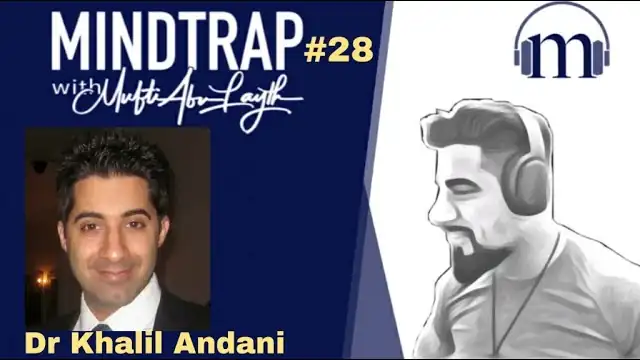 Play from 34:47
The video loads from YouTube only when you press play. Click a time in the transcript to seek.
Watch this part
Open on YouTube at 34:47The player starts at 34:47, the beginning of this part.
This segment33:53 to 39:44 · 5 min 51 sA view quoted in order to be discussed, not a position held
What this part covers
machinesummary, machine-writtenIn Ash'ari and Maturidi theology God's eternal speech is not Arabic sounds and letters; the Arabic Quran expresses it and is created.
In more detail
Mufti Abu Layth cites al-Baqillani and others describing the Arabic Quran as a hikaya or ibara, an expression of the meaning that is with God, since finite Arabic cannot capture the infinite. The guest says the Kalam tradition, unlike the tafsir tradition, treated the Quran as an oral phenomenon and spoke of a transcendent Kalam Allah, which for Ash'aris and Maturidis is not in Arabic and not sounds and letters; Mufti describes this as the distinction between kalam nafsi and kalam lafzi. The guest explains that the eternal attribute of speech contains command, prohibition and information, that God created the sounds and letters expressing it, whether in Gabriel, the tablet or the Prophet, and that the Prophet experienced it through the recitation. He concludes that for Ash'aris and Maturidis the Arabic Quran, its verses, surahs, sounds and letters, is created, so they do not believe God speaks Arabic.
Position stated
This segment presents a view in order to discuss or respond to it. It is recorded as quoted, never as held, and no position is attributed from it.
Kind: a view quoted in order to be discussed, not a position held Speakers: host and guest; guest speech is labelled and excluded from positionsTranscript
machine33:53 to 39:44 · click a time to seek · dotted terms open the glossary
A guest speaks in this segment. Guest speech is labelled and is excluded from the positions layer.
This segment states a view in order to discuss it. It is recorded as a quoted view, not as a position held.
support the Quranic heavenly Kitab Mubeen is not simply a bunch of master transcripts. Right? It's it's something far beyond that it's equated with with the very ilm of God himself. So it seems like it's we're talking about something transcendent and and it's the the the revelatory process makes that partially manifest in a form in which in this case it's the Arabic Quran.
Presumably it could have very early scholars like people like Abu Bakr al-Baqillani and other people stating that the Quran and Arabi Quran and Arabi and that we have the Arabic Quran is a Hikaya or Ibara it is a kind of it is an expression of the meaning the the kind of revelatory meaning which is with God.
That it's not Yes. actually it's not that God because God Arabic is a language which is finite so God is not captured within the finite God is infinite so they were drawing this distinction when they was this this was the crux of the problem. Yeah so so you've you've mentioned Baqillani and and that that takes us to a different tradition where the whole issue was framed differently.
So in the Tafsir tradition imagine how they're engaging the Quran they're they're dealing with the Quran as a physical book the Mufassirun. Like the way they do exegesis they start from the beginning they go all the way to the end. So they're they're dealing with the Mushaf in one way or another. But in the Kalam tradition which is often called the theological tradition they were speculating about the Quran as an oral phenomenon.
And therefore while the Quran itself may talk about a transcendent Kitab for various reasons these Mutakallimun the theologians they talk about a transcendent Kalam Allah. It's the same idea though right? It the idea is that there is a transcendent reality that is in God or with God or associated with God an attribute of God.
This transcendent reality is beyond Arabic so they call it the Kalam Allah and at least in the Ash'ari tradition and the Maturidi tradition the Kalam Allah is not in Arabic it it's not sound letters. Yeah they distinguish between the and this is for the most part for our viewers this is mainly the predominantly the Sunni tradition.
They distinguish between Kalam Nafsi which they say is Allah's kind of meaning what he's revelation at its core if you like some kind of almost like a frequency they don't use that word but like that and you've got Kalam on Lafzi which is the the human expression of the Quran.
And that's almost where that frequency is being picked up. I mean I know Farabi obviously speaks more much more about this kind of like frequency but it is a very similar analogy with the rest of the Sunnis they don't use this kind of wording but it's a similar kind of thing. Yeah so what you have in in the Sunni Kalam tradition at least in the the Ash'ari and and Maturidi schools is this notion that God has an eternal unchanging attribute called Kalam Kalam Allah and that attribute contains content so it
contains command prohibition and information. And as an aside if you think about what the Fiqh project is all about the Fiqh project is really trying to access some of that knowledge you know through through deductive practices. But anyway that's what the Kalam Allah contains however that knowledge that content had to become accessible to humans right to human hearers.
So through the revelatory process and and most Ash'aris will either say you know through some process God had to create sounds and letters to represent or to express the Kalam Allah. So in the case of Islam God created the sounds and letters that make up the Quran. He either created it in Gabriel or maybe he created it in the heavenly tablet there's disagreement over how it was done.
But some say some say within the prophet himself. Like so the prophet is is kind of seeing these words appear to him and he's expressing them and yeah. Yeah it could be created I mean it could be created any level we don't speculate but the point is that that the prophet in the Ash'ari and the Maturidi view the prophet did not experience the Kalam Allah in its pure form in at least when it comes to revelation the Quranic revelation he experienced it through the recitation the Qira'a.
And that that refers to the sounds and letters in Arabic. It's it used to be called Rasm then it was called Hikayat then it was called Ibarat then it was called Qira'a and then also it's been called Dalala. So there's so much the Ash'aris kept changing terms but the basic idea is that for Ash'aris and Maturidis very clear the Arabic Quran the verses the the Surahs the sounds and letters that is not eternal that is created.
So nobody should come and say to a traditional Sunni of these schools oh you believe God speaks Arabic because that is not what Ash'ari and Maturidi Sunnis believe at least they're not supposed to believe. But I would ask you this why is it so widespread today? this is the fascinating point because you know when when I read Ash'ari books or sometimes the discussion of Ash'aira the Sunnis mainstream Sunnis on this very point so you could see commentaries like I know we discussed previously Bajuri's commentary on Jawharat al-Tawhid and where he's mentioning that look what is
Paragraphs overlapping 33:53 to 39:44. Full text on the recording page.
Cite this segment
Stable id, transcript version and tier are part of the citation. Every change to a transcript is logged.Mufti Abu Layth Archive, segment 2020-07-03-S08, auto-transcribed, may contain errors. https://muftiabulayth.org/r/xznxiyp0b5s/s/8/ (accessed 1 November 2026)
- APA 7
Mufti Abu Layth. (2020, July 3). Do Ash'aris and Maturidis believe the Arabic Quran is God's eternal speech? [Video, segment 2020-07-03-S08, auto-transcribed, may contain errors]. Mufti Abu Layth Archive. Retrieved November 1, 2026, from https://muftiabulayth.org/r/xznxiyp0b5s/s/8/
- Chicago author-date
Mufti Abu Layth. 2020. "Do Ash'aris and Maturidis believe the Arabic Quran is God's eternal speech?" Video, segment 2020-07-03-S08, auto-transcribed, may contain errors. Mufti Abu Layth Archive. Recorded July 3, 2020. Accessed November 1, 2026. https://muftiabulayth.org/r/xznxiyp0b5s/s/8/
- BibTeX
@misc{abulayth-2020-07-03-S08,
  author = {Mufti Abu Layth},
  title = {{Do Ash'aris and Maturidis believe the Arabic Quran is God's eternal speech?}},
  year = {2020},
  month = {7},
  date = {2020-07-03},
  howpublished = {\url{https://muftiabulayth.org/r/xznxiyp0b5s/s/8/}},
  url = {https://muftiabulayth.org/r/xznxiyp0b5s/s/8/},
  organization = {Mufti Abu Layth Archive},
  urldate = {2026-11-01},
  note = {Segment 2020-07-03-S08, auto-transcribed, may contain errors}
}
Something wrong here?
Tell us what is wrong and it will be checked against the recording. Nothing changes until a person has reviewed it.
Sending a note needs JavaScript, which is off or unavailable in this browser. Nothing has been sent.
No name, email address or account is asked for or stored, and the inbox does not store your IP address. For rate limiting it keeps an unreadable fingerprint of your connection for 48 hours, and our database provider's own logs record connections as every website's do. Only your note, its kind, the page and the moment in the recording are kept, for review.