
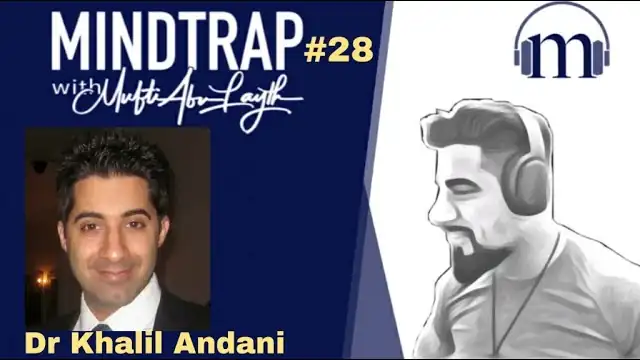
Recordings › Prof. Dr Khalil Andani | The Oral Text & the Ontology of The Quran | Mindtrap with Mufti #28 · 3 Jul 2020 › Segment 9 of 23
Why do so many Muslims think God speaks Arabic if their scholars said otherwise?
aqidah aqeedah aqida creed aqeeda aqaid hadeeth ahadith ahaadeeth hadis hadees ahaadith tafsir tafseer exegesis tafasir tafaseer hambali hanbalite hanbali school muftis tawheed tauheed touheed oneness of god ilm al-kalam kalaam asha'irah ashariyyah ash'arite maturidiyyah maturidite jahannam jahanam jahannum koran quraan al-quran wahy wahi wahee ahl al-sunnah ahl as-sunnah ahlus sunnah ahl al-sunna salafi salafism wahhabi wahabi wahhabism ulama ulema ulamaaWhy do Muslims believe God speaks Arabic? Elites, commoners and the Hanbalis
 Play from 40:15
The video loads from YouTube only when you press play. Click a time in the transcript to seek.
Watch this part
Open on YouTube at 40:15The player starts at 40:15, the beginning of this part.
This segment39:44 to 46:24 · 6 min 40 sGeneral teaching
What this part covers
machinesummary, machine-writtenMufti Abu Layth says scholars' habit of not discussing this before ordinary people helped the public believe something different from their own scholars; the guest describes the popular Hanbali view that even the Mushaf is uncreated.
In more detail
Mufti Abu Layth asks why the belief that God speaks Arabic is so widespread, noting that al-Bajuri's commentary on Jawharat al-Tawhid lists views on how revelation was created and says not to discuss this before the common people, and he says he feels this played a huge role in the public believing something different from their own scholars. The guest says the distinction between elite and common people runs through every Muslim discipline, partly from an infantilisation of ordinary people, and that eleventh-century reports say most of the masses held the popular Hanbali view that the Arabic Quran, even the Mushaf, is uncreated and eternal. He says Ash'aris and Maturidis make an ontological distinction while holding that the Arabic Quran is a mysterious access point to God's speech, whereas more sophisticated Hanbalis such as Abu Ya'la add negations, saying God's speech has no sequence. Mufti says the Hanbalis, today's Salafis, tell people not to do kalam while still answering theological questions, which in his experience is a contradiction; the guest replies that there are different kinds of Hanbalis.
- Guest speech overlaps this segment
Position stated
Waiting for the speaker checkA guest speaks in this segment and the captions do not say who said what. The view found here is held back until the speaker-separated transcript confirms the words are his, or the channel verifies it. The transcript and recording are published in full.
Kind: general teaching Speakers: host and guest; guest speech is labelled and excluded from positionsTranscript
machine39:44 to 46:24 · click a time to seek · dotted terms open the glossary
A guest speaks in this segment. Guest speech is labelled and is excluded from the positions layer.
So nobody should come and say to a traditional Sunni of these schools oh you believe God speaks Arabic because that is not what Ash'ari and Maturidi Sunnis believe at least they're not supposed to believe. But I would ask you this why is it so widespread today? this is the fascinating point because you know when when I read Ash'ari books or sometimes the discussion of Ash'aira the Sunnis mainstream Sunnis on this very point so you could see commentaries like I know we discussed previously Bajuri's commentary on Jawharat al-Tawhid and where he's mentioning that look what is
revelation that it could be something being created in the mind of Gabriel or in the mind of the prophet or but then he gives different opinions but then he will say and other scholars before him will say that oh by the way don't discuss this in front of the alarm. How that up they would say this is well I you call they say don't say and in that little the three say constant unless you're just teaching it specifically.
I feel this played a huge role in the public ending up believing something totally different and their own scholars believe something different. [laughter] I don't know if you feel this. So that this this distinction between the elite and the common people is so pervasive across almost every Muslim discipline.
So the Hadith you know the Hadith folk said the same thing. They would make the same distinction where the elite and then there are the common people. Everybody did this and what tends tends at least from the 11th century you not feel it's partially done as a I mean there's the elitism angle but I feel this is partially done because of an infantilization of the common people saying that they they just won't get it.
You know like don't tell them they're too thick. Like there's a I feel that is the elitism but but this is not a Sorry I thought when you said elitism you're right. I thought you meant it about it is a classism but I I thought you meant just about being a class like a kind of an aristocracy. Okay yes of course Or it's an intellectual elitism but again it's not it's not unique to the the theologians like everybody the master of every discipline thought he was the elite and everyone outside the discipline is not the elite.
So they all did this but what seems to have happened is again in the pre-modern context in the 11th century there reports that that most of the masses believed in the Quran and the Kalam Allah in the way the the Hanbalis do. For example like those are the reports we get. So so the Hanbali position like which is a simplification but the the Hanbali position the simplified version the popular version of it is that Allah speaks eternal Arabic you know so so the very Quran in Arabic the sounds and letters are eternal.
So that's the popular position. And the the popular [clears throat] position in the actual texts some of them went to the extent to say even the Mus'haf like they would say it's all uncreated and you're thinking Yeah. Well sorry what are you saying? That that I mean for people that's the even saying the actual printed book isn't made and you're thinking well of course it's made it was [laughter] [gasps] I I think that the the the the most precise formula I've seen was like it is uncreated everywhere.
So when it's written it's uncreated. I don't know if they would say the paper is but but it leads to the same problem I mean you're right they wouldn't say the paper but they would say the even the Quran there in the Mus'haf yeah exactly. Wherever the Quran is it's uncreated. The the thing with that is that So what I found helpful and I I do this in my thesis is that when you're sorting out all these claims because you know the Ash'aris would still say that the Kalam Allah is heard written and memorized and then they would add but it does not indwell in the
paper it does not indwell in the heart and you know it does not indwell in the mouth. So they're trying to have it both ways is and what's happening here is that in reality the the Maturidis and the Ash'aris they're making what I would call a ontological difference between the Kalam Allah and the Arabic Quran. They're making an ontological difference.
But they they are saying that in some mysterious way the Kalam Allah is present present but not incarnate through the Arabic So the Arabic Quran has this mysterious power or function that it can put a person in touch with the Kalam Allah. It's almost the Arabic Quran becomes for Ash'aris and Maturidis like an access point almost like a tunnel that leads you to experience the Kalam Allah.
That's what they would say. But ontologically they're distinct whereas the Hanbalis would say a more sort of sophisticated Hanbali would say well we never said that you know what Allah spoke has order or any material quality. We never said that. That's what they'll say. Abu Ya'la will say this right? He'll be like no it doesn't resemble human speech and he'll give the example he'll say well when Allah spoke the Quran or when he speaks the Quran it doesn't have any sequence.
The Hanbalis will say this. So they'll they'll start with the idea that Allah directly spoke the Quran but then they'll add all these negations. Well it has no sequence there was no organ you know there's no like sound particles or whatever But I mean the Hanabila the Hanbalis who are the modern day Salafis the the kind of inherent ironic problem you find with them is they point one is do not do Kalam.
Then the which means do not have any it's wrong to ask any discussion on theology or to ask any detailed questions on theology and point two is then they try to still answer some of the questions. So it's it's it's like a contradiction because they're trying to keep as removed from theology as possible while still being as involved in theology as possible.
Yeah. I mean that's my experience of them. No it's true and I think what you end up with over history is you have different groups of Hanbalis with their own approaches. So there is a more Kalamish Hanbalism and then there is an anti-Kalam Hanbalism and there's different species of them and and then we could say it's probably true for for many groups but but the overall issue that that is plaguing everybody including the the current controversy is this.
Paragraphs overlapping 39:44 to 46:24. Full text on the recording page.
Cite this segment
Stable id, transcript version and tier are part of the citation. Every change to a transcript is logged.Mufti Abu Layth Archive, segment 2020-07-03-S09, auto-transcribed, may contain errors. https://muftiabulayth.org/r/xznxiyp0b5s/s/9/ (accessed 1 November 2026)
- APA 7
Mufti Abu Layth. (2020, July 3). Why do so many Muslims think God speaks Arabic if their scholars said otherwise? [Video, segment 2020-07-03-S09, auto-transcribed, may contain errors]. Mufti Abu Layth Archive. Retrieved November 1, 2026, from https://muftiabulayth.org/r/xznxiyp0b5s/s/9/
- Chicago author-date
Mufti Abu Layth. 2020. "Why do so many Muslims think God speaks Arabic if their scholars said otherwise?" Video, segment 2020-07-03-S09, auto-transcribed, may contain errors. Mufti Abu Layth Archive. Recorded July 3, 2020. Accessed November 1, 2026. https://muftiabulayth.org/r/xznxiyp0b5s/s/9/
- BibTeX
@misc{abulayth-2020-07-03-S09,
  author = {Mufti Abu Layth},
  title = {{Why do so many Muslims think God speaks Arabic if their scholars said otherwise?}},
  year = {2020},
  month = {7},
  date = {2020-07-03},
  howpublished = {\url{https://muftiabulayth.org/r/xznxiyp0b5s/s/9/}},
  url = {https://muftiabulayth.org/r/xznxiyp0b5s/s/9/},
  organization = {Mufti Abu Layth Archive},
  urldate = {2026-11-01},
  note = {Segment 2020-07-03-S09, auto-transcribed, may contain errors}
}
Something wrong here?
Tell us what is wrong and it will be checked against the recording. Nothing changes until a person has reviewed it.
Sending a note needs JavaScript, which is off or unavailable in this browser. Nothing has been sent.
No name, email address or account is asked for or stored, and the inbox does not store your IP address. For rate limiting it keeps an unreadable fingerprint of your connection for 48 hours, and our database provider's own logs record connections as every website's do. Only your note, its kind, the page and the moment in the recording are kept, for review.