
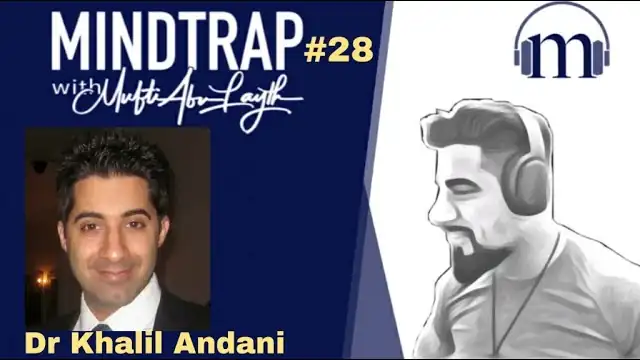
Recordings › Prof. Dr Khalil Andani | The Oral Text & the Ontology of The Quran | Mindtrap with Mufti #28 · 3 Jul 2020 › Segment 10 of 23
Is the Ash'ari view of God's speech really different from the Mu'tazili view?
aqidah aqeedah aqida creed aqeeda aqaid muftis hasan hadith hasan li-ghayrihi hasan li-dhatihi hasan sahih ilm al-kalam kalaam asha'irah ashariyyah ash'arite maturidi maturidiyyah maturidite mutazilite mu'tazilah koran quraan al-quran ahl al-sunnah ahl as-sunnah ahlus sunnah ahl al-sunna sunnis 'alim aalimIs the Ash'ari view just the Mu'tazili view rebranded?
 Play from 46:24
The video loads from YouTube only when you press play. Click a time in the transcript to seek.
Watch this part
Open on YouTube at 46:24The player starts at 46:24, the beginning of this part.
This segment46:24 to 50:31 · 4 min 07 sGeneral teaching
What this part covers
machinesummary, machine-writtenThe guest says the Ash'aris borrowed heavily from the Mu'tazila but differ on whether speech is sounds and letters or meaning; Mufti Abu Layth says sectarian politics produced ambiguous creeds.
In more detail
The guest frames the issue behind the current controversy: what the relation is between God's speech and the Arabic Quran, and whether its revelatory form is oral or written, adding that if its function is to put people in touch with God's speech, a little alteration may not affect that, which bears on what preservation means. Mufti Abu Layth says he feels sectarian politics has played a huge role in producing ambiguous teachings and creeds, and recounts an Ash'ari scholar telling him that their view is in essence what the Mu'tazila said, rebranded. The guest says Ash'aris and Maturidis clearly borrowed method and concepts from the Mu'tazila, who preceded them by a century or more and in whose theology al-Ash'ari was trained, under al-Jubba'i. He gives one key difference: for the Mu'tazila God's speech is sounds and letters, whereas for Ash'aris speech is the meaning expressed through them, so the primary debate is the nature of speech, not whether it is created.
- Guest speech overlaps this segment
Position stated
Waiting for the speaker checkA guest speaks in this segment and the captions do not say who said what. The view found here is held back until the speaker-separated transcript confirms the words are his, or the channel verifies it. The transcript and recording are published in full.
Kind: general teaching Speakers: host and guest; guest speech is labelled and excluded from positionsTranscript
machine46:24 to 50:31 · click a time to seek · dotted terms open the glossary
A guest speaks in this segment. Guest speech is labelled and is excluded from the positions layer.
Yeah. I mean that's my experience of them. No it's true and I think what you end up with over history is you have different groups of Hanbalis with their own approaches. So there is a more Kalamish Hanbalism and then there is an anti-Kalam Hanbalism and there's different species of them and and then we could say it's probably true for for many groups but but the overall issue that that is plaguing everybody including the the current controversy is this.
What is the relationship between God's actual speech and the Arabic Quran? And then what is the nature of the Arabic Quran? It is is the revelatory form oral or is the revelatory form written? Those are those are your questions. Because the whole question is it preserved? Like to say oh is the Quran preserved? Well well what do we mean by the Quran? And then what utility does preservation have because if whatever the Quran is if it's only if it's main job if the main function is to put a person in touch with the Kalam Allah then frankly a little alteration
here or there may not even affect it may not affect that at all. And if Because I felt that in the traditional I mean in the traditional narrative politics and not just by politics sectarian politics has played a huge role in ending up sometimes with just ambiguous kind of teachings and you know kind of creeds in the sense that like if we take this issue the Ash'aira who represent the dominant Sunni kind of strand of Muslims
they seem to be saying one thing in a book in their books but then they also will say things like you know like like you're saying oh no but this is and yes we are it's like they want to draw in essence it's like one Sunni Ash'ari scholar said to me in essence it's just what the Mu'tazila said but it's just rebranded and they don't want to kind of get attached with that name. So they want to make sure they've kind of rebranded it differently but it's not in essence saying anything different.
I mean I don't know what your thoughts on that are. I think it's certainly true that the Ash'aris and the Maturidis have have borrowed a lot of Mu'tazili thinking. I I don't think anybody can deny that. They've borrowed the methodology they've borrowed a whole bunch of concepts from the Mu'tazili. So You know you say borrow but could it not be that they are simultaneously kind of coming up with similar because similar eras similar kind of ideas like people have similar ideas in in the same era.
It's true you're right on that sense but it is also true that historically speaking the Mu'tazili as a more sort of scholastic group precede the Ash'aris by at least a century or century and a half. Right? And we do know whether the myth is true or not but like Abu al-Hasan al-Ash'ari himself was trained in in Mu'tazili theology.
I mean he was he was the nephew of Jubba'i isn't it? Abu Ali al-Jubba'i I believe I believe so but I'm not I don't know the family relation per se but he was trained by by them. And so that never that didn't really leave us thinking. As to the the question of is the Ash'ari view the same as the Mu'tazili view? Now the Hanbalis the Hanbalis would say that it is.
The Hanbalis would polemicize against that. But, I think one key difference is this. For the Mu'tazilites, God's speech is sounds and letters. That's what Kalam Allah is for Mu'tazilites. The Kalam is sounds and letters. For Ash'aris, Kalam, whether human or divine, is not sounds and letters. It's the meaning being expressed through sounds and letters.
Yeah. Now, that is an important integral difference there. It is cuz that sort of change that set that frames the whole debate. Uh it's not that Mu'tazilites say the Kalam Allah is created and the Ash'aris say it's uncreated. That's That's the secondary debate. The primary debate is what's the nature of Kalam? What's the nature of speech? And on this, even grammarians would have a different answer. Because what's funny is you get some grammarians.
Paragraphs overlapping 46:24 to 50:31. Full text on the recording page.
Cite this segment
Stable id, transcript version and tier are part of the citation. Every change to a transcript is logged.Mufti Abu Layth Archive, segment 2020-07-03-S10, auto-transcribed, may contain errors. https://muftiabulayth.org/r/xznxiyp0b5s/s/10/ (accessed 1 November 2026)
- APA 7
Mufti Abu Layth. (2020, July 3). Is the Ash'ari view of God's speech really different from the Mu'tazili view? [Video, segment 2020-07-03-S10, auto-transcribed, may contain errors]. Mufti Abu Layth Archive. Retrieved November 1, 2026, from https://muftiabulayth.org/r/xznxiyp0b5s/s/10/
- Chicago author-date
Mufti Abu Layth. 2020. "Is the Ash'ari view of God's speech really different from the Mu'tazili view?" Video, segment 2020-07-03-S10, auto-transcribed, may contain errors. Mufti Abu Layth Archive. Recorded July 3, 2020. Accessed November 1, 2026. https://muftiabulayth.org/r/xznxiyp0b5s/s/10/
- BibTeX
@misc{abulayth-2020-07-03-S10,
  author = {Mufti Abu Layth},
  title = {{Is the Ash'ari view of God's speech really different from the Mu'tazili view?}},
  year = {2020},
  month = {7},
  date = {2020-07-03},
  howpublished = {\url{https://muftiabulayth.org/r/xznxiyp0b5s/s/10/}},
  url = {https://muftiabulayth.org/r/xznxiyp0b5s/s/10/},
  organization = {Mufti Abu Layth Archive},
  urldate = {2026-11-01},
  note = {Segment 2020-07-03-S10, auto-transcribed, may contain errors}
}
Something wrong here?
Tell us what is wrong and it will be checked against the recording. Nothing changes until a person has reviewed it.
Sending a note needs JavaScript, which is off or unavailable in this browser. Nothing has been sent.
No name, email address or account is asked for or stored, and the inbox does not store your IP address. For rate limiting it keeps an unreadable fingerprint of your connection for 48 hours, and our database provider's own logs record connections as every website's do. Only your note, its kind, the page and the moment in the recording are kept, for review.