
Recordings › Why isn't Mufti from the Mu'tazilah? | Mufti Abu Layth · 15 Mar 2021 › Segment 3 of 3
Does using reason in Islam make someone a Mu'tazili?
averroes ibn rushd al-hafid maaliki malikite malikiyyah maliki school muftis halaal permitted lawful sunna sunnat sunan prophetic practice mutazilite mu'tazilah akhirah akhira aakhirah akhirat hereafter jannah janna jannat koran quraan al-quran as-salaf salaf al-salih salaf us-salih al-salaf early generations ahl al-sunnah ahl as-sunnah ahlus sunnah ahl al-sunna shiah shiite shi'i twelver ithna ashari al-din ad-deen ad-din religion ajr sawab thawab thawaab sawaabWhat defined the Mu'tazila, how Sunnis came to distrust reason, and labelling as a tactic
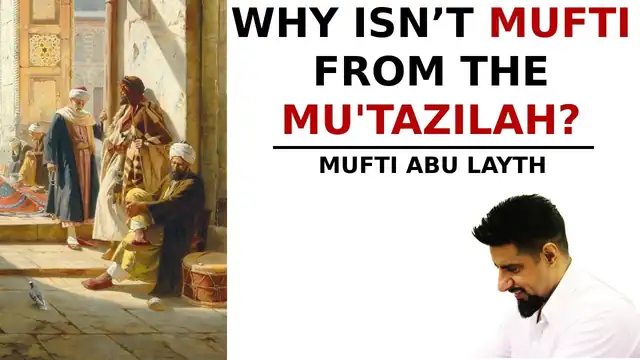 Play from 6:58
The video loads from YouTube only when you press play. Click a time in the transcript to seek.
Watch this part
Open on YouTube at 6:58The player starts at 6:58, the beginning of this part.
This segment6:58 to 14:05 · 7 min 07 sGeneral teaching
What this part covers
machinesummary, machine-writtenThe Mu'tazila were defined by doctrines about sin and God's obligations, not by reason; the Sunni distrust of reason was a later reaction to losing debates. Calling someone Mu'tazili for using reason is a tactic to avoid debate.
In more detail
Mufti Abu Layth says what defined the Mu'tazila was the view that a sinner is no longer a Muslim, that God is not in control of the evil in the world, and that God is duty-bound to do what is good, so that he must reward a good deed with paradise, whereas mainstream Sunnis held that God is omnipotent and not duty-bound. These issues, not reason, split them off; but over the next two centuries, he says, many Mu'tazila were grammarians and philosophers who gained the upper hand in debates, and around the fourth and fifth centuries Sunnis reacted by saying the deen is not built on intellect ('aql), a narrative later generations inherited. He says that in the first two to three hundred years the earliest people to claim and own reason were Sunnis, that the great philosophers such as al-Kindi [?] and al-Farabi [?] were not Mu'tazila, and that Ibn Rushd [?], a Maliki who inspires him, was not one either; he says Ibn Taymiyya later attacked anyone using reason with the label of a sect that had long died out, which he compares to calling someone a communist for supporting the NHS. He says this labelling is a dirty tactic of people who cannot handle a debate and want to disown their opponent, that the Quran instructs people to use reason, and that Ibn Taymiyya was neither God nor the Prophet, so there is no reason to treat him as supreme.
- Low audio confidence in the transcript
- Some terms in this segment are uncertain
Position stated
Mufti Abu Layth says Sunnis started to say that the deen is not built on intellect only as a reaction, to get back at their opponents in debate, and that later generations inherited this narrative.
“sunnis tried to say oh but the deen isn't built on intellect and they started to pump this narrative just to get back at them it was all a reaction that's all it was and later subsequent generations just inherited”
Category: historical claim
Kind: general teachingTranscript
machine6:58 to 14:05 · click a time to seek · dotted terms open the glossary
argued was halal many of the people after him argue this then it falls out of flavor with many of the people but the shia continue it so they're just getting targeted as as part of this theological turf war that hey look at them look at them prostitution blah blah blah blah blah you know temporary marriages so in a similar way the material that what defined the material was the fact that they said that if a person commits a sin he is no longer a muslim this was what
defined them they also said that god has no real control uh or does not dictate any um you see they they said that god is not in control of the kind of evil that happens in this world and also what ties into that is that god is duty-bound to serve what is always good so these few points which are a bit intricate so for example let's say you did a good deed
uh god is not all powerful enough to i mean he is all-powerful but god is now duty-bound to make sure that you find a blissful afterlife whereas sunnis mainstream sunnis always held that god is omnipotent and he's not duty-bound he does what he does but he's not duty-bound if god wants there will be no afterlife for example now according to the martez that's impossible because god because you've done the good deed you have to be rewarded so therefore there has to be
that god is duty bound to recompense and so these issues are what split them off it was nothing to do with reason nothing to do with oh they were rationalists but what happens is as islam progresses and muslims progress in the next 200 years or so because a lot of material happened to be gramerians and also philosophers they did argue some points with the sunnis so what they did do is gain the upper hand from a point of reasoning
like they made some of the sunnis feel dumb on some points so what the sunni reaction was oh but you're using your aqua and this was a dumb point so obviously when they said this to them just owned it and said well yeah because islam tells us to but sunnis used to also own it prior to this point but when around the 4th century of islam sunni started to fourth and fifth century sunni started to say well oh because they were taking a little beating in some debates so they started to say oh but oh wait
you know you're trying to use your aqua your intellect and they said okay here sunnis tried to say oh but the deen isn't built on intellect and they started to pump this narrative just to get back at them it was all a reaction that's all it was and later subsequent generations just inherited this but if you go back before that debate so let's say you go back to the time of the salaf you go back to the first 200 maybe under 300 years of islam you will see
that in the early times many sunni muslims in fact some of the earliest people to claim reason and to own it were sunni was sunni islam so these this difference of reason was not a matazili point hence all the great philosophers of islam were not mata zillia were not mata you know obviously before his thing but hindi farabi these people were not i mean i suppose some people could say well some of them were from the shia
ibn arush who was maliki who's you know somebody who i'm inspired by take a lot of my roon he was never you see it does not mean to follow your reason you are mata zilla this is later on people like ibn tamir he really spewed this on steroids it's like he injected himself and he would just bash on anyone using reason saying oh my mother had long died before ibn saying i mean this they didn't even they didn't even exist in his day and age
but this retrospect it's like i give an example it's like today if somebody says something you start calling them a communist ah you're a communist you're a communist i mean communism isn't really around today and by saying something you're not actually a communist you know it's not like if you say look i think they should be let's say like like in the uk this should be a national health service as the nhs exists and it's great now oh you're a commie you're a commie why why do you believe that the government should provide this that's communism communism you see this is what ibrate mia was
doing he was just like any person that was using his cease to exist way before ibn staff writes that looked haven't existed for centuries that in our and he's from the six hundreds he says that the mata have long died out but this is what they used to believe so i hope that helps and the reason i kind of went on the explaining that is because on many occasions you will get this kind of uh dirty tactic
by muslims who can't handle your debate so what they say is oh just call yourself a different sect and therefore we can disown you and we don't need to deal with you because if you say why would i say i'm a mata when i'm not that's like me saying i'm a roman catholic why would i say i'm a roman catholic so you say oh but you use reason well what don't you use reason you know you know what's that even supposed to mean the quran instructs you to use reason
so they say oh yeah but uh you know but do you say so you say well is this in the quran sunnah no oh who told you which one to take then oh our dada ibn taymiyah well last time i checked ibna taimiya wasn't god and he wasn't the prophet he was however somebody who suffered from mental health issues and albeit you know still performed on on many uh rulings greatly but he was someone who obviously suffered throughout his life you know for god's sake
why why should we be taking him to be so supreme
Paragraphs overlapping 6:58 to 14:05. Full text on the recording page.
Cite this segment
Stable id, transcript version and tier are part of the citation. Every change to a transcript is logged.Mufti Abu Layth Archive, segment 2021-03-15-S03, auto-transcribed, may contain errors. https://muftiabulayth.org/r/wmzc28plysq/s/3/ (accessed 1 November 2026)
- APA 7
Mufti Abu Layth. (2021, March 15). Does using reason in Islam make someone a Mu'tazili? [Video, segment 2021-03-15-S03, auto-transcribed, may contain errors]. Mufti Abu Layth Archive. Retrieved November 1, 2026, from https://muftiabulayth.org/r/wmzc28plysq/s/3/
- Chicago author-date
Mufti Abu Layth. 2021. "Does using reason in Islam make someone a Mu'tazili?" Video, segment 2021-03-15-S03, auto-transcribed, may contain errors. Mufti Abu Layth Archive. Recorded March 15, 2021. Accessed November 1, 2026. https://muftiabulayth.org/r/wmzc28plysq/s/3/
- BibTeX
@misc{abulayth-2021-03-15-S03,
  author = {Mufti Abu Layth},
  title = {{Does using reason in Islam make someone a Mu'tazili?}},
  year = {2021},
  month = {3},
  date = {2021-03-15},
  howpublished = {\url{https://muftiabulayth.org/r/wmzc28plysq/s/3/}},
  url = {https://muftiabulayth.org/r/wmzc28plysq/s/3/},
  organization = {Mufti Abu Layth Archive},
  urldate = {2026-11-01},
  note = {Segment 2021-03-15-S03, auto-transcribed, may contain errors}
}
Something wrong here?
Tell us what is wrong and it will be checked against the recording. Nothing changes until a person has reviewed it.
Sending a note needs JavaScript, which is off or unavailable in this browser. Nothing has been sent.
No name, email address or account is asked for or stored, and the inbox does not store your IP address. For rate limiting it keeps an unreadable fingerprint of your connection for 48 hours, and our database provider's own logs record connections as every website's do. Only your note, its kind, the page and the moment in the recording are kept, for review.