
Recordings › Monday Nights with Mufti #210 | Q&A Unscripted & Unrestricted! 😉 | Mufti Abu Layth · 13 Apr 2021 › Segment 35 of 50
When should reason take priority over religious texts?
salat salaah namaz prayer salaat namaaz as-salah salawat haj pilgrimage hadj hadeeth ahadith ahaadeeth hadis hadees ahaadith muftis dalil daleel adillah adilla evidence iman imaan eemaan eeman ayah aya ayat ayaat aayah aayat deen al-din ad-deen ad-dinWhen does reason take precedence over text? Interpretation, and how hadith dogmatism took hold
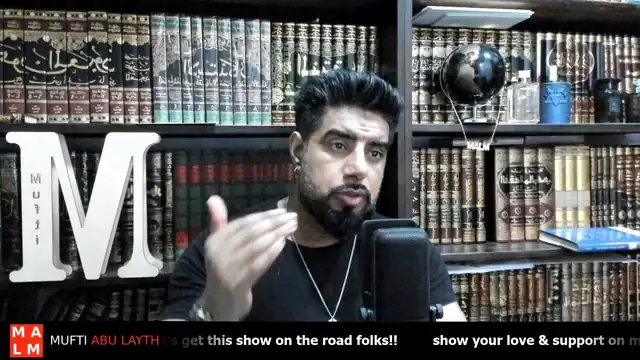 Play from 2:09:48
The video loads from YouTube only when you press play. Click a time in the transcript to seek.
Watch the answer
Open on YouTube at 2:09:48The player starts at 2:09:48, where the answer begins.
This segment2:09:48 to 2:18:55 · 9 min 07 sGeneral teaching
The answer in brief
machinesummary, machine-writtenReason always comes first, Mufti Abu Layth says, because every reading of scripture is already an interpretation; hadith dogmatism grew from Ibn Taymiyya's era and revived under colonialism.
In more detail
Asked when one's reason takes precedence over textual proof in light of paradigm shifts in knowledge, Mufti Abu Layth says faith is built on reason and must always be based on it; he accepts that reason needs a starting point it cannot itself justify, but says we accept it because it is the only thing we have. He calls the wish to put scripture first a nice sentiment but nonsensical, since scripture must be read and understood through vocabulary, context and applied linguistics, citing the Sapir-Whorf hypothesis, so every reader is already interpreting with their aql; he adds that people understand the same verse differently and that 'going by the books' ignores discourse analysis, power dynamics and interpretative repertoires, likening the debate to a layman arguing with a doctor. He says hadith dogmatism took shape in the era of Ibn Taymiyya, with Ibn al-Salah before him and Ibn Hajar and al-Dhahabi, faded, and revived under colonialism, because when religion is attacked amid instability and fear people turn fundamentalist rather than rational, citing studies linking instability with conservatism and the rise of fanaticism across religions in the early twentieth century.
Question as read aloud · questioner not identifiedAt what point does one's rationale take precedence, in light of paradigm shifts in knowledge, over textual proof?
Position stated
Mufti Abu Layth says reason necessarily comes first because scripture can only be understood through human interpretation, and that hadith dogmatism took shape in the era of Ibn Taymiyya and revived under colonialism, when attacks on religion amid instability pushed people towards fundamentalism.
“all perception and sensation is based on the human interpreting it it's based on interpretation so whether you like it or not you are already interpreting something”
Category: method
Kind: general teachingTranscript
machine2:09:48 to 2:18:55 · click a time to seek · dotted terms open the glossary
important right now right so the thing is that people who are just trolling uh you can mock and block people mock and block right so hmm faith is built on reason it must always be based on reason now people do highlight that you see there is a point where reason um you know it like there must be a starting point
unquestionably so because you can't base reason on reason and i get that i get that but that does not mean you base things now on a lack of re that's just dumb i get it's a valid point you know if somebody it's a valid point and i've made this point before that look um it is true that there is there comes a point where you have to just
accept like if you incredibly reduce everything then how does one justify reason you can't justify it by itself so that is true so you just accept reason why do you accept reason because it is the only thing we have in this world to go by between people for anything in this world that we reason so once you accept the building block then everything after that ought to make sense or at least you try to make sense of it
to say well look i i want texts or scripture to come first is it's an amazing statement i i value the statement because you but what it is it's a misunderstanding like you're confused okay you're very confused as a person but i i appreciate the love that you're trying to give to the textual sources but it's just your statement is nonsensical you know you i get it i get it you're trying to show love
but you know so for that you know that's that's nice but it's actually a dumb statement because you can't understand anything without the brain do you understand you can't like so to say that oh i wanna like so like you want to take a particular oh not just a book but actual scripture you want to take scripture but scripture has to be read for it to be ready as to make sense semantically for it to make sense he has to rely on a vocab for it to rely on a vocab it has to rely on context
for it to rely on context it has to there is applied linguistics taking place applied linguistics naturally it takes place through the sapio warfian hypothesis as demonstrated within psychology but because these people are too dumb to understand this kind of stuff they think that they somehow have unadulterated non-human god understanding of texts and that that's just delusional
all perception and sensation is based on the human interpreting it it's based on interpretation so whether you like it or not you are already interpreting something so you are already applying your akal and your intellect without even knowing that you're applying it so this is the problem so you this is why this question as romantically put as you know it's it's nice that you're trying to say look i love scripture above me
which is nice but to say i so basically what you're saying is i choose that i choose that but remove me and my brain out of the picture but then that what does what is that like what does that mean because scripture is meaning and meaning requires a mind to understand the meaning so let's say we all read one verse we're going to understand it differently we may understand it differently so whose meaning do we go by and then you say well we'll go by what the books have put down
but then you forgot because you haven't bloody studied any psychology in your life you've forgotten the concept of discourse analysis you've forgotten how people even subconsciously manipulate uh features how power dynamics play a huge role the concept of agency the concept of interpretative repertoires i mean you've never even you don't even understand these things so to explain them to you would you not have to put you through a course of psychology so the problem with this discussion is it's like a layman arguing with a doctor a medical doctor
about something medical medicinal and just because he doesn't understand it it's like he's saying yeah but these pills look just like those pills so why are they different why would this make a difference to me but he doesn't have a background in medicine doesn't have a background in chemistry doesn't have a background in science it's it's difficult to explain to these people these things because they're coming at it from such a you know uneducated perspective that oh i like scripture and that's a nice sentiment i like that but the fact that you even said that shows to me how okay
that this is way above your grade of even understanding comprehension you're not going to even grasp it let alone like you don't even you can't that just shows to me you haven't even understood the true question this is why hypnotamia you know even and these people are a product of people like hypnotamia you see really begins in those centuries this you know this hadith dogmatism really gets shaped in those kind of centuries of islam the 7th century eighth century onwards uh you start to get the likes of ibn hajj alaska ibn salah before him you're gonna get hypnotamia
the habi even and you know all these people it is this mindset that starts to kind of germinate and it then you know for a while i mean it spreads for a while it kind of dies a little death uh then with colonialism it ironically comes back because with colonialism and this once again because people haven't bloody studied any psychology i wish they would you'd understand how the human psyche works that once a person is you know once religion is attacked so harshly
people tend to turn fundamental they don't become rational so if you start hammering criticizing somebody's religion but then also at an equation of instability and fear so you see like colonialism obviously they tipped the entire scale and people's lives were jeopardized and people were tortured and and at the same time religion was attacked people will just dig deeper into becoming fundamentalists they will not become rationalists that's not how the human
brain works even standard very mild studies have shown like even studies in america several uh social studies have demonstrated that if that during times of uh that during times of instability more people become conservative and they will vote for republicans and things like this because they feel a social unease they feel an instability and it's during times of social stability that people become more liberal their
social studies have demonstrated this let alone when you take it to an nth degree and add violence and all these kind of things and attacking religion people become fundamentalists this is why at the beginning of the 20th century religions worldwide became fanatics not just islam even christianity because they faced this threat incognito much love for the super chat much love right yeah dmx has gone you know i i saw that there was a clip i did actually think i wouldn't mind sharing it but uh i don't have it here but
Paragraphs overlapping 2:09:48 to 2:18:55. Full text on the recording page.
Cite this segment
Stable id, transcript version and tier are part of the citation. Every change to a transcript is logged.Mufti Abu Layth Archive, segment 2021-04-13-S35, auto-transcribed, may contain errors. https://muftiabulayth.org/r/8xuhmcz2n3u/s/35/ (accessed 1 November 2026)
- APA 7
Mufti Abu Layth. (2021, April 13). When should reason take priority over religious texts? [Video, segment 2021-04-13-S35, auto-transcribed, may contain errors]. Mufti Abu Layth Archive. Retrieved November 1, 2026, from https://muftiabulayth.org/r/8xuhmcz2n3u/s/35/
- Chicago author-date
Mufti Abu Layth. 2021. "When should reason take priority over religious texts?" Video, segment 2021-04-13-S35, auto-transcribed, may contain errors. Mufti Abu Layth Archive. Recorded April 13, 2021. Accessed November 1, 2026. https://muftiabulayth.org/r/8xuhmcz2n3u/s/35/
- BibTeX
@misc{abulayth-2021-04-13-S35,
  author = {Mufti Abu Layth},
  title = {{When should reason take priority over religious texts?}},
  year = {2021},
  month = {4},
  date = {2021-04-13},
  howpublished = {\url{https://muftiabulayth.org/r/8xuhmcz2n3u/s/35/}},
  url = {https://muftiabulayth.org/r/8xuhmcz2n3u/s/35/},
  organization = {Mufti Abu Layth Archive},
  urldate = {2026-11-01},
  note = {Segment 2021-04-13-S35, auto-transcribed, may contain errors}
}
Something wrong here?
Tell us what is wrong and it will be checked against the recording. Nothing changes until a person has reviewed it.
Sending a note needs JavaScript, which is off or unavailable in this browser. Nothing has been sent.
No name, email address or account is asked for or stored, and the inbox does not store your IP address. For rate limiting it keeps an unreadable fingerprint of your connection for 48 hours, and our database provider's own logs record connections as every website's do. Only your note, its kind, the page and the moment in the recording are kept, for review.