
Recordings › In Depth: The Sanaʽa Manuscript -Mufti Abu Layth · 1 Mar 2019 › Segment 6 of 11
Why might an early Arab have written a Quranic word differently?
imam imaam prayer leader muftis al-ayn nazar evil eye koran quraan al-quran ayah aya ayat ayaat aayah aayat sahabah sahaba sahabi sahabiyyah sahabiyatTribal pronunciation and why native speakers of classical Arabic could swap words
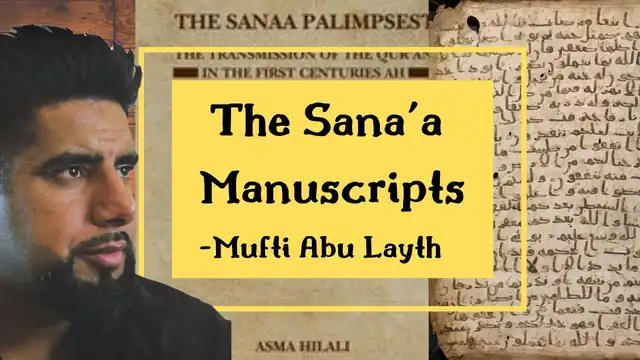 Play from 16:56
The video loads from YouTube only when you press play. Click a time in the transcript to seek.
Watch this part
Open on YouTube at 16:56The player starts at 16:56, the beginning of this part.
This segment16:56 to 19:34 · 2 min 38 sGeneral teaching
What this part covers
machinesummary, machine-writtenThe companions spoke classical Arabic as their everyday language, so substituting a word from memory was far easier for them than for later Muslims who memorise Quranic Arabic as a separate language. Tribal pronunciation differences were known and are not the issue; the general transmission is.
In more detail
Mufti Abu Layth continues with the examples of dialect: in the Prophet's time some tribes swapped the hamza for an 'ayn or one guttural letter for another because that was how they spoke Arabic, just as Gulf Arabs today pronounce the qaf as a g; these things are already known and are not presented as a shock. He says the real question is the general transmission of the Quran, not what one person may have written or omitted. He then makes a further point of background: for Muslims today, eloquent classical Arabic is something met only in the Quran and classical poetry, since even Arabs do not speak or read it and Modern Standard Arabic is not eloquent in that style, whereas the ancient Arabs spoke that very language. For someone whose everyday speech and poetry were in that language it was much more feasible to replace or mix up a word when writing from memory, while for later Muslims, who keep Quranic Arabic in a separate mental compartment and simply memorise it, substitution is less easy. He says he mentions this only as backdrop before looking at the manuscript itself.
Position stated
No position summary has been recorded for this segment.
Kind: general teachingTranscript
machine16:56 to 19:34 · click a time to seek · dotted terms open the glossary
English you get some people like in the UK um they pronounce the T in certain things as a a kind of glottal stop like they won't say water they'll say w like a like that and so that's an example like in the Arab world today you'll have some people who pronounce a like the Egyptians will pronounce a g as a gim and some people pronounce the as a gaff like in Saudi in the gulf and so like this even in the prophet's time some of the tribes used to do things like that so they used to so in imam's his introduction he explains this and he
mentions like some of the companions for example would swap Hamza with an and some would swap a with an so instead of they would say just because they they come from the the same kind of uh position within within the throat so and this was just the way they spoke Arabic so these things we already know it's not that you know we're not saying this is like comes as a shock to Muslims so the question was what was the O the general transmission of the Quran we're not talking about what one person may have written something or somebody else
may have omitted a verse another important point to remember here right another important point to remember is you see for us today Arabic is something especially clear eloquent Arabic is something we only read in the Quran or In classical poetry even for Arabs Arabs don't speak classical Arabic uh in fact they don't even read classical Arabic even Modern Standard Arabic which is proper Arabic but Modern Standard Arabic is not eloquent it's not it's not eloquent sorry it's not eloquent in that style I mean they might consider it eloquent for today's standards but it's not eloquent like
classical Arabic now you have to understand that the ancient Arabs spoke like that so when you speak in a particular way and that is how the verses are being revealed now I'm not saying they spoke as eloquently but they did speak that exact language then it's very easy for you to replace words sometimes because that is your absolute way of speaking whereas for us today to change words is still very S easy but it's not as easy because when we memorize Arabic we don't normally speak like Arabic like that so
we're not normally speaking Arabic anyway so Arabic is only our Islamic language so it's easy to keep that in a separate mental compartment and just memorize it but for them this is how they spoke this is how they used to write you know do eloquent poetry they used to do so for them to sometimes mix up words was much more feasible some of them I'm just saying right now just to give you a um a kind of backdrop okay so with all of these things in mind okay now um I would explain that Dr Asma hilali in her analysis of these
Paragraphs overlapping 16:56 to 19:34. Full text on the recording page.
Cite this segment
Stable id, transcript version and tier are part of the citation. Every change to a transcript is logged.Mufti Abu Layth Archive, segment 2019-03-01-S06, auto-transcribed, may contain errors. https://muftiabulayth.org/r/k6faz7xw53y/s/6/ (accessed 1 November 2026)
- APA 7
Mufti Abu Layth. (2019, March 1). Why might an early Arab have written a Quranic word differently? [Video, segment 2019-03-01-S06, auto-transcribed, may contain errors]. Mufti Abu Layth Archive. Retrieved November 1, 2026, from https://muftiabulayth.org/r/k6faz7xw53y/s/6/
- Chicago author-date
Mufti Abu Layth. 2019. "Why might an early Arab have written a Quranic word differently?" Video, segment 2019-03-01-S06, auto-transcribed, may contain errors. Mufti Abu Layth Archive. Recorded March 1, 2019. Accessed November 1, 2026. https://muftiabulayth.org/r/k6faz7xw53y/s/6/
- BibTeX
@misc{abulayth-2019-03-01-S06,
  author = {Mufti Abu Layth},
  title = {{Why might an early Arab have written a Quranic word differently?}},
  year = {2019},
  month = {3},
  date = {2019-03-01},
  howpublished = {\url{https://muftiabulayth.org/r/k6faz7xw53y/s/6/}},
  url = {https://muftiabulayth.org/r/k6faz7xw53y/s/6/},
  organization = {Mufti Abu Layth Archive},
  urldate = {2026-11-01},
  note = {Segment 2019-03-01-S06, auto-transcribed, may contain errors}
}
Something wrong here?
Tell us what is wrong and it will be checked against the recording. Nothing changes until a person has reviewed it.
Sending a note needs JavaScript, which is off or unavailable in this browser. Nothing has been sent.
No name, email address or account is asked for or stored, and the inbox does not store your IP address. For rate limiting it keeps an unreadable fingerprint of your connection for 48 hours, and our database provider's own logs record connections as every website's do. Only your note, its kind, the page and the moment in the recording are kept, for review.