
Recordings › Ponderings on the Holy Quran
In Depth: The Sanaʽa Manuscript -Mufti Abu Layth
salat salaah namaz prayer salaat namaaz as-salah al-salah salawat hadeeth ahadith ahaadeeth hadis hadees ahaadith imaam prayer leader ramadhan ramzan ramazan ramadaan muftis dalil daleel adillah adilla proof mawdu' mawdoo maudu mawdhu jahannam jahanam jahannum koran quraan al-quran sura soorah surat suwar soora chapter ayah aya ayat ayaat aayah aayat qira'at qira'ah qiraa'aat qira'aat tilawah tilawat tilaawah sahabi sahabiyyah sahabiyat jihaad mujahid in sha allah insha'allah in shaa allah insha allah inshaa allah duaa duaas supplication deen al-din ad-deen ad-dinvideo · 36:41 · 37,000 views · 1 Mar 2019 · 11 segments · Open on YouTube
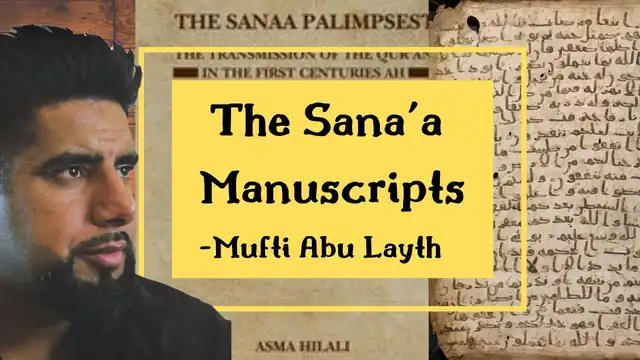 Press play to load from YouTube. Nothing loads until you do.
11 segments
machine11Each block is a segment in time order. Click to open it.All segments · in time order
Transcript
machineauto-transcribed, may contain errors · source: youtube auto · click a time to seek · dotted terms open the glossaryright so let's look at what is this uh manuscript thing going on so okay let me give you some backdrop to all of this right um what is going on well people right so well this whole issue begins with in Yemen okay so in the 70s they were I don't know reconstructing or working on some Masid in s is the capital of
Y not this is not the name of some girl this is right so this is where the great Legends like you get IM and these great people were from okay so so what's happened anyway is that whilst reconstructing or working on the dome in U S they found a whole bunch of kind of old manuscripts kind of stuck in some Loft section so they've taken them out and and and it was quite common this this is nothing shocking by the way because a lot of the time in the past
when people uh wanted to dispose of let's say certain sacred texts and things like this it's it's very likely that they would just collect them uh and maybe put them away somewhere High like in the dome in a section and and then maybe with time burn them or do something once they've got a certain amount now what's happened is here obviously they've just left them and presumably forgotten about them now um right they've just forgotten about them so what's happened is in 197 in I think 1972 or whatever it was they've
discovered these things pulled them out they've realized a certain amount of them um there's varying there's there's quite a few pages but there's different things but in some they've said that they've realized this is the Quran okay or page it's not the complete Quran uh some people say it's pretty much a lot of Surah Toba there some people have said I think they they may be up to uh something like I think 80 Pages or something like this worth by the way these are not Pages like these kind of pages these are parchments so things like ancient um um initially cloth like cloth but it's actually taken from
animal hide so animal skin that was used to write on so that was one method that people used to write on so they found a lot of these and then anyway to cut all that story short they you know they called in some experts and the experts thought well you know this sounds interesting so they they put all all this stuff on microfilm and then then there was all this long legal battle going on with the yemeni government but anyway I think in the '90s the the German experts were allowed to release those uh uh the these microfilms or whatever it was um and they started to research these manuscripts now these
manuscripts had a like I said uh verses of the Quran on them which is nothing so surprising but what when it got interesting was that they realized that these this writing these verses of the Quran um they had like an like an a like a shadow effect underneath them so it appeared that beneath them there seems to have been something written before that was obviously then wiped clean and then Rewritten so the writing they have on there is is not the the earliest
writing on that parchment okay and this once again is nothing new so in the past like in uh ancient Arabia because writing was not big anyway and the was no such thing as paper uh what people would do is write on these parchments write on animal skin and because uh if they needed to rewrite something or what they would often do is wash it clean or wipe it clean and write on it again so this is common practice I mean it's nothing so unusual up until this point then what happens is using the latest technological equipment they've managed to kind of extract the under
text so the lower text has managed to be so they've used using computer visualization they've got it they've had managed to extract it using um um using certain lighting techniques and things like this I think they've used like ultraviolet rays and things like this but they've managed to extract the lower text so the lower text is also appears to be the Quran right now so that so okay so up until here that's seems okay it gets a bit more interesting that the lower text
of the Quran seems to be different to uh the current understanding of the Quran in some ways so this has become known as the manuscript and they also call it a um a pal oh bloody hell a palest right I believe palest is what it's called as well Rob so that's a document that is I call I say document but a parchment that has
been kind of wiped clean and then reused they call that a pmest now anyway so if you see these words being thrown around you know what they what they're speaking about okay rather one one must be rather academic so this has had there's a couple uh Dr Mr and Mrs uh Quinn I believe they they are called um and they they're German so they've had an ample amount of opportunity to do research on this s manuscript and they've written
their thesis on this then there's a few other people that have specialized on this there is a doctor um a female doctor Asma hilali who has done her her her work on this and released an actual book called The palest and she's kind of discussing um she's discussing that or the manuscript I think she may have called the book um then there is a doct uh s who's also quite an expert on this and a drzi so these are the main people who
have worked on this manuscript they've they've produced thesis that are a aable you can find their documents online if you go but they are academic kind of works they're not like your everyday kind of reads so what are the conclusions so far and what is this controversy so a lot of people have picked this up and said aha the Quran was wrong because look this was a pre this is one of the earliest versions of the Quran and it's different to the Quran you guys have got haahahaha so that's what seems to be going on a lot online
um right so um right guys if you can pay attention don't uh troll please I'll just I can see some messages about some people trolling I'll just say right so okay I've right don't worry I've got the admin team on it Mock and block crew are on there anybody trolling block them and blast them into Oblivion right so the coming back to this so now okay this is the issue is this what are the concerns let's bring up the concerns
first the concerns have been by certain ex-muslims certain Christians that we have stumbled upon an ancient early version of the Quran that Muslims have deviated from and this shows the Quran was changed and this shows that the Quran that Muslims have got today is not the real Quran this is what the the claims are okay now I'd like to show first of all uh responding to this and I'll bring in some of the research from these key uh contributors so Dr uh
Elizabeth Quinn she um also she states in an academic way that yes like looking at this I feel she's saying she feels that the Quran was almost a work in progress so she feels that people wrote the Quran then with time they decided to actually we should touch up on this point here then they kind of modified it then with each generation they Contin to so it was an evolving process this is her conclusion now that is not the conclusion by the way of the other uh expert researchers like s or people like
uhi or people like Asma hilali um who've not said that at all so right so now let's look at the facts what we do have right first of all one thing we need to understand very clearly before beginning that is that the Quran has been part of the Muslim living tradition okay we have many manuscripts of the Quran that are very old okay including like the Birmingham manuscript that was found in brm toown people right dating back back to the first century of of Islam now this that they they found
the manuscript also dates back to the first century of Islam so they're not sure where they're putting it somewhere like they feel it may have been written anything between 30 years after the prophet to maybe it was written 60 years after the prophet anything in between that they kind of and they've done that by dating the the actual I think it was deer skin um that it was written on so anyway way and there are other manuscripts of the Quran that are also very very classic in that sense Dat Back to the first century of Islam so it's not that this is the only manuscript they found okay to start off with secondly we understand that the Quran
was part of the living tradition within Islam so all communities wherever they went that was the one thing they took with them Hadith was not documented till almost a 100 years after the prophet at least okay in the whole first 100 years the only documentation that Muslims were really doing was the Quran the only thing they were really making sure that it was taught from father to child was the Quran hence I've explained in other topics and discussions as well why was the Quran difficult to corrupt I've explained that because it was difficult
because it was one it was so widespread two the nature of the Quran is it doesn't go into so much details about so many things so if you are trying to corrupt it what message would you try to put in and the message that you try to put in has to match the style the NM of the Quran the flow of the Quran the it has to go with the suras it has to go with those verses and then everybody's reading the Quran everywhere they're reading it in their Salah they complete it in Ramadan they you see it's too widespread like it's it's a it's not a the the results the investment there
ain't much return on investment if if you see what I mean like if you were trying to corrupt a religion the return on investment is too little here so it's easier for you to corrupt the Hadith it's easier and hence I'm not saying all Hadith are corrupt but what I'm trying to say is that hence you had a lot of fabricated Hadith emerge because it was easier to do that so right so these these things so far are fact now I would like to highlight that look this at all this finding does not show that this was an evolution in Pro in
progress or the Quran was for example a working model that people were working on it and changing it why and allow me to explain and that is that Muslims already accept and believe this is we already believe right that when the Quran was revealed it was revealed with some kind of fluidity okay now we don't truly understand that fluidity today except that we understand we know from the Hadith that there were different ways to read the Quran and we have a Hadith that the prophet saw some companions reading in a certain way
and grabs the person and brings him to the prophet and says to him that what the hell you're misreading the Quran and the prophet says let him read and he read reads it and then the prophet says okay now you read what we and he says I've read it like this and the prophet says well both are correct now and he says that the Quran is read in multiple kind of ways now what's interesting is that we know that this was happening okay so this did happen that there were multiple kind of recitation and these are not by the way the seven recitations we have today this is not speaking about that although that could be part of it but that's not what it's speaking about
and I'll explain why so look now that's one thing we have another thing we have already in our books in many Hadith books in many so for example in things like you're going to have bukari Muslim all these kind of other Hadith books thi you're going to have Hadith where you will read that okay certain companions um that there were one or two companions that sometimes would disagree with uh that they would um have what they thought was a correct reading of the Quran in some verses and
they may be mistaken and that's not so I mean first of all that's common sense I mean it's quite easily understandable but that did happen we already have that as part of our tradition so we know for example abdah uh used to assume that um that the Dua like that was part of the Quran he assumed because it had a certain Rhythm to it and he saw the prophet teaching it in such a religious way that he assumed it was part of the Quran and he had it as a little Sur um other people told him that was actually just a Dua and that
was not part of the Quran similarly he assumed that sorry not which are known as the to seek Refuge because they are a Dua he assume they were just duas and not part of the Quran now okay but the companions once again told him that look the other people that no these are actually yes they are a Dua but they are part of the Quran now you this is already part of our tradition we already know this this is not a shock this is like something actually well written and documented in
our books there's transparency about these things that in fact if you read imam's mad his introduction which I also I think I have a a kind of explanation of his introduction on YouTube um or it might be on Soundcloud but where I speak about how some of Imam highlights how some of the sahaba even their pronunciation because of the tribes they were from so he mentions I mas for example uh being amongst them and other companions that they would sometimes swap the Hamza with the because they sound Sim and that's like a um it was just like a dialectical like the tribe you were from might do things so for example in
English you get some people like in the UK um they pronounce the T in certain things as a a kind of glottal stop like they won't say water they'll say w like a like that and so that's an example like in the Arab world today you'll have some people who pronounce a like the Egyptians will pronounce a g as a gim and some people pronounce the as a gaff like in Saudi in the gulf and so like this even in the prophet's time some of the tribes used to do things like that so they used to so in imam's his introduction he explains this and he
mentions like some of the companions for example would swap Hamza with an and some would swap a with an so instead of they would say just because they they come from the the same kind of uh position within within the throat so and this was just the way they spoke Arabic so these things we already know it's not that you know we're not saying this is like comes as a shock to Muslims so the question was what was the O the general transmission of the Quran we're not talking about what one person may have written something or somebody else
may have omitted a verse another important point to remember here right another important point to remember is you see for us today Arabic is something especially clear eloquent Arabic is something we only read in the Quran or In classical poetry even for Arabs Arabs don't speak classical Arabic uh in fact they don't even read classical Arabic even Modern Standard Arabic which is proper Arabic but Modern Standard Arabic is not eloquent it's not it's not eloquent sorry it's not eloquent in that style I mean they might consider it eloquent for today's standards but it's not eloquent like
classical Arabic now you have to understand that the ancient Arabs spoke like that so when you speak in a particular way and that is how the verses are being revealed now I'm not saying they spoke as eloquently but they did speak that exact language then it's very easy for you to replace words sometimes because that is your absolute way of speaking whereas for us today to change words is still very S easy but it's not as easy because when we memorize Arabic we don't normally speak like Arabic like that so
we're not normally speaking Arabic anyway so Arabic is only our Islamic language so it's easy to keep that in a separate mental compartment and just memorize it but for them this is how they spoke this is how they used to write you know do eloquent poetry they used to do so for them to sometimes mix up words was much more feasible some of them I'm just saying right now just to give you a um a kind of backdrop okay so with all of these things in mind okay now um I would explain that Dr Asma hilali in her analysis of these
manuscripts she has mentioned that it appears that these manuscripts were most likely personal notes that some person had taken in some study Circle this was her interpretation and the reason she says this is for two reasons she says that the person first of all when he writes letters like now uh when it's written at the end of a word it has a tale to it okay when it's written in the middle of a word it's just a round thing and Carries On so she identified that this person seems
to write the with a tail in certain words words in the middle of a word which doesn't really make sense because that's not how the C is written in the middle of a word so she so from here she assumes that this person was maybe writing it off with the c and then later adding to it like saying oh I realized that this word was like this another important thing that c thing I think is okay I think more interestingly she points out another point and this is definitely fascinating that how the person had
written before Toba uh now Surah does not begin with so the person had written do not say bismah here so now that's just a note so that's actually in this manuscript the person had written before Surah Toba now you know well that's not the Quran you know this is clearly a personal note that somebody's writing now so I would say that look with these things what we have first of
all I'd like to highlight uh what is what is this most likely so I feel that I'm not so sure whether it was a student documenting it in a study circle like Dr Asma hilali has said but what I think is this is definitely somebody's personal script if it wasn't like I know Dr Quinn seems to uh emphasize she thinks this was some kind of standard manuscript that people were sending out and there's no evidence for that at all if anything this seems to be somebody's personal uh script personal copies that they're writing and they're making some
notes okay so like don't say bah here don't do this don't do that the other thing is I think that where they've disagreed so they've made made a list by the way I won't go through all the things here but they've made a list of some of the disagreement discrepancies they've said the uh the variations between this uh manuscript and between how we read the Quran today and sometimes words are missing like for example in one it says Allah will punish them and it says like in our reading of the Quran today it says Allah will punish them uh uh a severe punishment but in there
doesn't say it just says Allah will punish them or in some it will say things like um they're saying that those who do you know those who do with their wealth and money and in this verse today in that particular verse I know in a different verse it does say that with their wealth and money but in this particular verse it doesn't say that in the Quran just says J those who who struggle in the path of God so so there's these kind of discrepancies and they've and a lot of these people have listed them they've gone through them so whether there's like I think they've highlighted
something like 20 to 30 kind of discrepancies that they've found now a lot of them are very small just like instead of you it says they and things like this but there are words missing as well stuff like this so in my understanding the truth to this is is one is this is most likely because we we don't have certain knowledge but we can go by our interpretation our assessment that this is most likely somebody he may have been a companion he may have been I'm not denying that um but somebody's personal notes so somebody seems to have
been writing uh certain verses of the Quran for himself and this seems to be that and it seems to be his personal reading which I feel firstly that he may have been mistaken in or that may have been his way of what he thought was the Quran now that's most plausible okay that's most likely what has happened here and then maybe a few decades later uh what's happened is when they've started to realize because we know withman as
well we know that he said that people have started to misread the Quran so let's standardize and let's bring together the readings of the Quran and he wrote a particular script now his script is still flexible so because it never had the diacritical marking like the dots and it never had most the dots anyway so some words could be read in different ways so for example could be read as so because there wasn't the dot you could read it as or like that they are act what the actions
they do or the actions you do that it could be read like that and this is all part this ommani reading is all one reading of the Quran even with these variants okay it's not so we do accept that there were other readings that have then gone that they were in the time of the Prophet how they read certain things we have that in our tradition but we know that one main reading was um locked into for people to be transmitted andman he took that endeavor in saying let's lock it in so people don't get confused
and it's easy for people to read now even how he locked in and still had room to read in different variations now this is no hidden knowledge this is transparent knowledge Muslims have been saying these things for ages I mean it's written in all our books and it's very clear so the people say the seven ways to read or the 10 ways to read certain things they're all part of this one way so highlights that okay so just to he highlights that in his Mah by the way as well and in his other books so now this is just to be clear about this so this under text of the manuscript was most
likely somebody's personal note who thought that that reading was how it was and most likely I feel that he was mistaken uh why do I feel this this is most likely what I feel the plausible response the second response is that it may also be it may also be that he was not mistaken but this was a way to read the those verses of the Quran that he learned from the prophet it could be that this was a way that was then locked wasn't the one that was locked in it's possible but I actually feel it was more
option a uh it was the fact that he was most likely mistaken why do I say this and by the way in some of the in some of these discrepancies it may be the second thing it may be that some of the discrepancies were the the the kind of fluency of how to read but but the first um but some of them like when he missed out words I think that was just his mistake as in he thought that because remember language it was their language they were doing a lot of other things as well and and and it's quite it's human error so that's
fine and we have Hadith telling us that the sahaba Sometimes some sahabah did misread certain verses it's you know like we all misread verses today you know it's not it's nothing so huge and remember they were memorizing and they weren't just sitting down students of knowledge all day there were people that were in campaigns military campaigns fighting for here traveling the world they weren't people just sitting with a library behind them and saying well oh you know let me pull this out I mean I've memorized the Quran and if I've read the Quran today I from my memory I'll make tons and tons of mistakes you know I'll need to revise and revise and
revise and and make sure and that that's natural you know it's not but so I'm just saying I think that's the most the second thing it is true it may have been that the it was another reading that was locked off and it wasn't locked into when Osman locked in the recitation as to this being an evolution of the Quran as mentioned by Dr Quinn and mentioned by some uh ex-muslims and Christian uh Evangel you know some preachers and other people as well and why do I feel that that is absolutely wrong apart from obviously this is going to be biased because I'm Muslim but why
do I feel that if we look at the discrepancies let's just look at them if this was an evolution in progress like somebody decided because Dr Elizabeth and other people suggest that somebody decided to change it right so and especially some of the ex-muslims have suggested this and some uh islamophobes to have have have mentioned things like the some of the companions purposely decided to change the Quran why do I feel that that's absolutely false is let's look at the discrepancies the discrepancies have no fundamental they they bring nothing they they don't
do any change you know oh Allah is aware of what you are doing Allah is aware of what they are doing it makes no that I mean if I was trying to corrupt the Quran I would try to corrupt it with a powerful message if that's what they were trying to do just changing it by dropping a word that still Allah is going to punish them and let's us say they dropped the word a severe punishment it doesn't like that doesn't change anything because in the other verses they're still saying that so it doesn't really it doesn't really show any purpose like any purposive purpose
serving kind of alteration like if somebody was trying to manipulate the Quran then surely they would put in a good message to manipulate that they're trying to get across by changing it with these little pronouns like I changed the oh here Allah I said Allah knows what uh you know Allah is seeing what uh they are saying and here I said what you are saying haahahaha I changed the Quran I mean that's that's a futile kind of effort because think about it people who were trying to let's say they were purposely trying to change the Quran that was a life-threatening risk that let's us say Let's us be real if this
was what they were trying to do why if they are going to risk it they're going to risk it for something so meaningful like to get a message in there praise their gods or or do something or to change it with these like petty little differences is meaningless so to me that doesn't hold up at all okay so with that just to summarize that then I'm going to give a little conclusion in summary yes we acknowledge that the manuscripts do demonstrate that these were from first century Islam they do demonstrate that there was an under text and an overtext they do demonstrate there are discrepancies they also demonstrate that
the discrepancies are not so huge as in they're not actually they don't derail the message in any way right they're not that substantial right they also demonstrate that most likely these were a mistake that the that whoever wrote them he wrote and these were part of his notes why because they use words like like I said notes like don't say that sounds like a very personal note the other thing is this may have been it it has some potential that this was one of the writings that was then not locked in sorry one of the readings that was not locked in it's possible
although I don't believe that to be the stronger interpretation so that and in conclusion I want to add here this also you know in a positive spin to this I want to show a positive spin to this which people haven't really highlighted this actually reaffirms for us that the message that we've been passing generally down the generations has been accurate because you know there's many mus there's many people who've said for example the Quran was actually invented after the 2 Century of Islam it
disproves them there's many people who have said all Hadith have been fabricated but it proves that in the Hadith we showed it said in certain Hadith that certain companions used to make mistakes about certain Quran certain companions wrote this that they used to do this and that was true the living tradition told us thatman had actually to to to get rid of uh people's kind of debating and whatever decided to lock in a recitation now this is part of our just historic stories but yet it's true then because it shows that there
was and that it seems to have been locked in or people have tried to work on it it demonstrates that they these things were not fabricated because some people have said Muhammad was not even a real figure and his companions didn't even really exist and people afterwards made them up but it shows that that actually so these things have been true that that Muslims when they said that there was a Quran and it was there in the first century of Islam it proves that it said that when Muslims themselves said in our own books that by the way that there were various ways of reading the Quran it was true that Muslims themselves said that certain companions did make mistakes and you
know we're going to be honest about that but they went with a majority reading that was true Muslims themselves said that certain in the time ofman people started to argue and disagree andman tried to take strategic action to lock in the reading of the Quran it shows that to be true so it shows that there is you know even though there are I'm sure there are many Hadith sometimes that have been misrepresented and are not true and things like this but it shows a lot of the living tradition the living stories and things like this that have come down have actually held you
know throughout the ages and they've conveyed significant truths like we're seeing this with modern day technology now revealing and affirming the stories that we've only been reading for decades so I think that's an amazing spin on this and it shows that you know Muslims have been trans transparent and had have we covered up these things then it could have come as a shock so okay I hope that's of some help inshallah answer some of these questions um right so right people inshallah so any other issues you can reach out to me I will what I will try to do as well is go
through some of these in some detail but there isn't it's nothing so substantial to go through like I said the biggest one I could see was the drop of one word like like a severe punishment and things like this what I said those who do Jihad with their wealth and their lives like okay it had that you know it claimed to have had that word but here it didn't exist in in the in the modern day reading or in the current Quran that we have but then we know that those wordings do exist in other suras of the Quran so it's not that it doesn't exist in the Quran but just not in that Surah and so it's possible that the person
whilst reading put it there because it's a common way that it's read in the in the other verse so these things do happen okay right folks let's um let's move on what else have we got
Something wrong here?
Tell us what is wrong and it will be checked against the recording. Nothing changes until a person has reviewed it.
Sending a note needs JavaScript, which is off or unavailable in this browser. Nothing has been sent.
No name, email address or account is asked for or stored, and the inbox does not store your IP address. For rate limiting it keeps an unreadable fingerprint of your connection for 48 hours, and our database provider's own logs record connections as every website's do. Only your note, its kind, the page and the moment in the recording are kept, for review.
Cite this recording
Stable id, transcript version and tier are part of the citation. Every change to a transcript is logged.Mufti Abu Layth Archive, auto-transcribed, may contain errors. https://muftiabulayth.org/r/k6faz7xw53y/ (accessed 1 November 2026)
- APA 7
Mufti Abu Layth. (2019, March 1). In Depth: The Sanaʽa Manuscript -Mufti Abu Layth [Video, auto-transcribed, may contain errors]. Mufti Abu Layth Archive. Retrieved November 1, 2026, from https://muftiabulayth.org/r/k6faz7xw53y/
- Chicago author-date
Mufti Abu Layth. 2019. "In Depth: The Sanaʽa Manuscript -Mufti Abu Layth." Video, auto-transcribed, may contain errors. Mufti Abu Layth Archive. Recorded March 1, 2019. Accessed November 1, 2026. https://muftiabulayth.org/r/k6faz7xw53y/
- BibTeX
@misc{abulayth-K6fAZ7xW53Y,
  author = {Mufti Abu Layth},
  title = {{In Depth: The Sanaʽa Manuscript -Mufti Abu Layth}},
  year = {2019},
  month = {3},
  date = {2019-03-01},
  howpublished = {\url{https://muftiabulayth.org/r/k6faz7xw53y/}},
  url = {https://muftiabulayth.org/r/k6faz7xw53y/},
  organization = {Mufti Abu Layth Archive},
  urldate = {2026-11-01},
  note = {Auto-transcribed, may contain errors}
}