
Recordings › In Depth: The Sanaʽa Manuscript -Mufti Abu Layth · 1 Mar 2019 › Segment 5 of 11
Did the companions ever read or understand the Quran differently from each other?
hadeeth ahadith ahaadeeth hadis hadees ahaadith al-bukhari imam bukhari sahih al-bukhari sahih bukhari saheeh al-bukhari saheeh bukhari imam al-bukhari imaam prayer leader muftis jahannam jahanam jahannum koran quraan al-quran ayah aya ayat ayaat aayah aayat qira'at qira'ah qiraa'aat qira'aat tilawah tilawat tilaawah wahy wahi wahee sahabah sahabi sahabiyyah sahabiyat duaa duaasFluidity in revelation: companions who read differently, and Ibn Mas'ud's view of the qunut and the mu'awwidhatayn
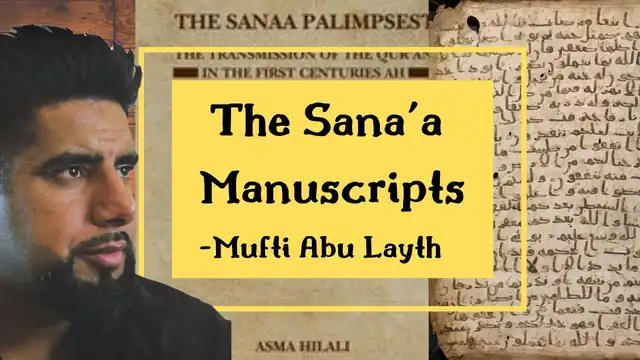 Play from 13:02
The video loads from YouTube only when you press play. Click a time in the transcript to seek.
Watch this part
Open on YouTube at 13:02The player starts at 13:02, the beginning of this part.
This segment13:02 to 16:56 · 3 min 54 sGeneral teaching
What this part covers
machinesummary, machine-writtenMuslims already accept that the Quran was revealed with fluidity: the Prophet approved different recitations, and the tradition openly records companions such as Ibn Mas'ud holding mistaken views about what was part of the Quran and pronouncing letters by their tribal dialect. None of this is a shock to Muslims.
In more detail
Mufti Abu Layth explains the fluidity Muslims already accept in how the Quran was revealed, which he says is not fully understood today except through hadith showing there were different ways to read it. He recounts the report in which a companion hears another reciting differently, takes him to the Prophet, and the Prophet has each recite and says both are correct and the Quran is read in multiple ways; he stresses that these multiple recitations are not the seven readings known today, though those may be part of it. He says the hadith books, Bukhari, Muslim and others, also record that one or two companions sometimes held what they thought was the correct reading of a verse and may have been mistaken, which he calls common sense. He gives the example of Ibn Mas'ud [?], who assumed the qunut supplication was part of the Quran because of its rhythm and the reverence with which the Prophet taught it, until others told him it was a du'a, and who conversely assumed the two surahs of seeking refuge were only supplications and not part of the Quran, until the companions corrected him. He says all this is well documented in Muslim books with transparency, and mentions an imam's introduction [?], which he has explained on YouTube or SoundCloud, that describes how some companions, Ibn Mas'ud among them, pronounced letters differently because of their tribes, swapping the hamza for a similar sound; he compares this to the glottal stop in British English and to how Egyptians and Gulf Arabs pronounce the jim and the qaf.
- Some terms in this segment are uncertain
Position stated
Mufti Abu Layth says the tradition itself records that the Prophet approved different recitations and that companions such as Ibn Mas'ud sometimes held mistaken views about what belonged to the Quran, so variant readings in an early manuscript are nothing new to Muslims.
“this is already part of our tradition we already know this this is not a shock this is like something actually well written and documented in our books”
Category: historical claim
Kind: general teachingTranscript
machine13:02 to 16:56 · click a time to seek · dotted terms open the glossary
progress or the Quran was for example a working model that people were working on it and changing it why and allow me to explain and that is that Muslims already accept and believe this is we already believe right that when the Quran was revealed it was revealed with some kind of fluidity okay now we don't truly understand that fluidity today except that we understand we know from the Hadith that there were different ways to read the Quran and we have a Hadith that the prophet saw some companions reading in a certain way
and grabs the person and brings him to the prophet and says to him that what the hell you're misreading the Quran and the prophet says let him read and he read reads it and then the prophet says okay now you read what we and he says I've read it like this and the prophet says well both are correct now and he says that the Quran is read in multiple kind of ways now what's interesting is that we know that this was happening okay so this did happen that there were multiple kind of recitation and these are not by the way the seven recitations we have today this is not speaking about that although that could be part of it but that's not what it's speaking about
and I'll explain why so look now that's one thing we have another thing we have already in our books in many Hadith books in many so for example in things like you're going to have bukari Muslim all these kind of other Hadith books thi you're going to have Hadith where you will read that okay certain companions um that there were one or two companions that sometimes would disagree with uh that they would um have what they thought was a correct reading of the Quran in some verses and
they may be mistaken and that's not so I mean first of all that's common sense I mean it's quite easily understandable but that did happen we already have that as part of our tradition so we know for example abdah uh used to assume that um that the Dua like that was part of the Quran he assumed because it had a certain Rhythm to it and he saw the prophet teaching it in such a religious way that he assumed it was part of the Quran and he had it as a little Sur um other people told him that was actually just a Dua and that
was not part of the Quran similarly he assumed that sorry not which are known as the to seek Refuge because they are a Dua he assume they were just duas and not part of the Quran now okay but the companions once again told him that look the other people that no these are actually yes they are a Dua but they are part of the Quran now you this is already part of our tradition we already know this this is not a shock this is like something actually well written and documented in
our books there's transparency about these things that in fact if you read imam's mad his introduction which I also I think I have a a kind of explanation of his introduction on YouTube um or it might be on Soundcloud but where I speak about how some of Imam highlights how some of the sahaba even their pronunciation because of the tribes they were from so he mentions I mas for example uh being amongst them and other companions that they would sometimes swap the Hamza with the because they sound Sim and that's like a um it was just like a dialectical like the tribe you were from might do things so for example in
English you get some people like in the UK um they pronounce the T in certain things as a a kind of glottal stop like they won't say water they'll say w like a like that and so that's an example like in the Arab world today you'll have some people who pronounce a like the Egyptians will pronounce a g as a gim and some people pronounce the as a gaff like in Saudi in the gulf and so like this even in the prophet's time some of the tribes used to do things like that so they used to so in imam's his introduction he explains this and he
Paragraphs overlapping 13:02 to 16:56. Full text on the recording page.
Cite this segment
Stable id, transcript version and tier are part of the citation. Every change to a transcript is logged.Mufti Abu Layth Archive, segment 2019-03-01-S05, auto-transcribed, may contain errors. https://muftiabulayth.org/r/k6faz7xw53y/s/5/ (accessed 1 November 2026)
- APA 7
Mufti Abu Layth. (2019, March 1). Did the companions ever read or understand the Quran differently from each other? [Video, segment 2019-03-01-S05, auto-transcribed, may contain errors]. Mufti Abu Layth Archive. Retrieved November 1, 2026, from https://muftiabulayth.org/r/k6faz7xw53y/s/5/
- Chicago author-date
Mufti Abu Layth. 2019. "Did the companions ever read or understand the Quran differently from each other?" Video, segment 2019-03-01-S05, auto-transcribed, may contain errors. Mufti Abu Layth Archive. Recorded March 1, 2019. Accessed November 1, 2026. https://muftiabulayth.org/r/k6faz7xw53y/s/5/
- BibTeX
@misc{abulayth-2019-03-01-S05,
  author = {Mufti Abu Layth},
  title = {{Did the companions ever read or understand the Quran differently from each other?}},
  year = {2019},
  month = {3},
  date = {2019-03-01},
  howpublished = {\url{https://muftiabulayth.org/r/k6faz7xw53y/s/5/}},
  url = {https://muftiabulayth.org/r/k6faz7xw53y/s/5/},
  organization = {Mufti Abu Layth Archive},
  urldate = {2026-11-01},
  note = {Segment 2019-03-01-S05, auto-transcribed, may contain errors}
}
Something wrong here?
Tell us what is wrong and it will be checked against the recording. Nothing changes until a person has reviewed it.
Sending a note needs JavaScript, which is off or unavailable in this browser. Nothing has been sent.
No name, email address or account is asked for or stored, and the inbox does not store your IP address. For rate limiting it keeps an unreadable fingerprint of your connection for 48 hours, and our database provider's own logs record connections as every website's do. Only your note, its kind, the page and the moment in the recording are kept, for review.