
Recordings › In Depth: The Sanaʽa Manuscript -Mufti Abu Layth · 1 Mar 2019 › Segment 4 of 11
Does the Sana'a manuscript show that the Quran was changed?
salat salaah namaz prayer salaat namaaz as-salah al-salah salawat hadeeth ahadith ahaadeeth hadis hadees ahaadith ramadhan ramzan ramazan ramadaan muftis mawdu' mawdoo maudu mawdhu koran quraan al-quran sahabah sahaba sahabi sahabiyyah sahabiyat deen al-din ad-deen ad-dinThe claims and the facts: first-century dating, the living tradition, and why hadith was easier to corrupt
 Play from 7:47
The video loads from YouTube only when you press play. Click a time in the transcript to seek.
Watch this part
Open on YouTube at 7:47The player starts at 7:47, the beginning of this part.
This segment7:47 to 13:02 · 5 min 15 sGeneral teaching
What this part covers
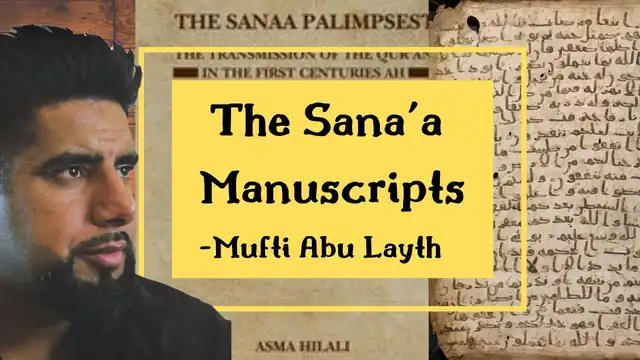
machinesummary, machine-writtenThe Sana'a manuscript and others such as the Birmingham manuscript date to the first century of Islam, when the Quran was the one text Muslims documented and taught everywhere. The Quran was too widespread and too distinctive in style to corrupt profitably, which is why fabrication targeted hadith instead.
In more detail
Mufti Abu Layth states the concern raised by certain ex-Muslims and Christians: that an early version of the Quran has been found from which Muslims deviated, showing that the Quran was changed and that today's Quran is not the real one. He reports that Elisabeth Puin [?] concludes, in academic terms, that the Quran was almost a work in progress, modified with each generation in an evolving process, and says this is not the conclusion of the other researchers, Sadeghi [?], Goudarzi [?] or Asma Hilali. He then sets out the facts: the Quran has been part of the Muslim living tradition; many very old manuscripts exist, including the Birmingham manuscript, dating to the first century of Islam; the Sana'a manuscript also dates to the first century, placed by dating the skin somewhere between thirty and sixty years after the Prophet; and it is not the only manuscript found. He says that in the first hundred years the Quran was the only thing Muslims documented and taught from parent to child, while hadith was not documented until at least a century after the Prophet. Repeating what he has explained elsewhere, he says the Quran was difficult to corrupt because it was so widespread, because its nature is not to go into detail so there is little to insert, because any insertion would have to match its style and flow, and because everybody was reading it in their prayers and completing it in Ramadan, so the return on investment for a corrupter was too little; it was easier to corrupt hadith, which is why many fabricated hadith emerged, though he is not saying all hadith are corrupt. He ends by saying the finding does not show an evolving Quran, because Muslims already accept that the Quran was revealed with a kind of fluidity.
- Some terms in this segment are uncertain
Position stated
Mufti Abu Layth holds that the Sana'a find does not show an evolving Quran: the manuscript dates to the first century like others, the Quran was the one text documented and taught everywhere from the start, and it was too widespread and too distinctive in style to corrupt, so fabrication targeted hadith instead.
“this finding does not show that this was an evolution in Pro in progress or the Quran was for example a working model that people were working on it and changing it”
Category: historical claim
Kind: general teachingTranscript
machine7:47 to 13:02 · click a time to seek · dotted terms open the glossary
um right so um right guys if you can pay attention don't uh troll please I'll just I can see some messages about some people trolling I'll just say right so okay I've right don't worry I've got the admin team on it Mock and block crew are on there anybody trolling block them and blast them into Oblivion right so the coming back to this so now okay this is the issue is this what are the concerns let's bring up the concerns
first the concerns have been by certain ex-muslims certain Christians that we have stumbled upon an ancient early version of the Quran that Muslims have deviated from and this shows the Quran was changed and this shows that the Quran that Muslims have got today is not the real Quran this is what the the claims are okay now I'd like to show first of all uh responding to this and I'll bring in some of the research from these key uh contributors so Dr uh
Elizabeth Quinn she um also she states in an academic way that yes like looking at this I feel she's saying she feels that the Quran was almost a work in progress so she feels that people wrote the Quran then with time they decided to actually we should touch up on this point here then they kind of modified it then with each generation they Contin to so it was an evolving process this is her conclusion now that is not the conclusion by the way of the other uh expert researchers like s or people like
uhi or people like Asma hilali um who've not said that at all so right so now let's look at the facts what we do have right first of all one thing we need to understand very clearly before beginning that is that the Quran has been part of the Muslim living tradition okay we have many manuscripts of the Quran that are very old okay including like the Birmingham manuscript that was found in brm toown people right dating back back to the first century of of Islam now this that they they found
the manuscript also dates back to the first century of Islam so they're not sure where they're putting it somewhere like they feel it may have been written anything between 30 years after the prophet to maybe it was written 60 years after the prophet anything in between that they kind of and they've done that by dating the the actual I think it was deer skin um that it was written on so anyway way and there are other manuscripts of the Quran that are also very very classic in that sense Dat Back to the first century of Islam so it's not that this is the only manuscript they found okay to start off with secondly we understand that the Quran
was part of the living tradition within Islam so all communities wherever they went that was the one thing they took with them Hadith was not documented till almost a 100 years after the prophet at least okay in the whole first 100 years the only documentation that Muslims were really doing was the Quran the only thing they were really making sure that it was taught from father to child was the Quran hence I've explained in other topics and discussions as well why was the Quran difficult to corrupt I've explained that because it was difficult
because it was one it was so widespread two the nature of the Quran is it doesn't go into so much details about so many things so if you are trying to corrupt it what message would you try to put in and the message that you try to put in has to match the style the NM of the Quran the flow of the Quran the it has to go with the suras it has to go with those verses and then everybody's reading the Quran everywhere they're reading it in their Salah they complete it in Ramadan they you see it's too widespread like it's it's a it's not a the the results the investment there
ain't much return on investment if if you see what I mean like if you were trying to corrupt a religion the return on investment is too little here so it's easier for you to corrupt the Hadith it's easier and hence I'm not saying all Hadith are corrupt but what I'm trying to say is that hence you had a lot of fabricated Hadith emerge because it was easier to do that so right so these these things so far are fact now I would like to highlight that look this at all this finding does not show that this was an evolution in Pro in
progress or the Quran was for example a working model that people were working on it and changing it why and allow me to explain and that is that Muslims already accept and believe this is we already believe right that when the Quran was revealed it was revealed with some kind of fluidity okay now we don't truly understand that fluidity today except that we understand we know from the Hadith that there were different ways to read the Quran and we have a Hadith that the prophet saw some companions reading in a certain way
Paragraphs overlapping 7:47 to 13:02. Full text on the recording page.
Cite this segment
Stable id, transcript version and tier are part of the citation. Every change to a transcript is logged.Mufti Abu Layth Archive, segment 2019-03-01-S04, auto-transcribed, may contain errors. https://muftiabulayth.org/r/k6faz7xw53y/s/4/ (accessed 1 November 2026)
- APA 7
Mufti Abu Layth. (2019, March 1). Does the Sana'a manuscript show that the Quran was changed? [Video, segment 2019-03-01-S04, auto-transcribed, may contain errors]. Mufti Abu Layth Archive. Retrieved November 1, 2026, from https://muftiabulayth.org/r/k6faz7xw53y/s/4/
- Chicago author-date
Mufti Abu Layth. 2019. "Does the Sana'a manuscript show that the Quran was changed?" Video, segment 2019-03-01-S04, auto-transcribed, may contain errors. Mufti Abu Layth Archive. Recorded March 1, 2019. Accessed November 1, 2026. https://muftiabulayth.org/r/k6faz7xw53y/s/4/
- BibTeX
@misc{abulayth-2019-03-01-S04,
  author = {Mufti Abu Layth},
  title = {{Does the Sana'a manuscript show that the Quran was changed?}},
  year = {2019},
  month = {3},
  date = {2019-03-01},
  howpublished = {\url{https://muftiabulayth.org/r/k6faz7xw53y/s/4/}},
  url = {https://muftiabulayth.org/r/k6faz7xw53y/s/4/},
  organization = {Mufti Abu Layth Archive},
  urldate = {2026-11-01},
  note = {Segment 2019-03-01-S04, auto-transcribed, may contain errors}
}
Something wrong here?
Tell us what is wrong and it will be checked against the recording. Nothing changes until a person has reviewed it.
Sending a note needs JavaScript, which is off or unavailable in this browser. Nothing has been sent.
No name, email address or account is asked for or stored, and the inbox does not store your IP address. For rate limiting it keeps an unreadable fingerprint of your connection for 48 hours, and our database provider's own logs record connections as every website's do. Only your note, its kind, the page and the moment in the recording are kept, for review.