
Recordings › Engineer Muhammad Mirza's Methods | Hadith Vs Sunnah | Mufti Abu Layth · 6 Feb 2023 › Segment 1 of 1
Is Engineer Muhammad Ali Mirza consistent in how he criticises hadith?
hadeeth ahadith ahaadeeth hadis hadees ahaadith saheeh saheeh hadith sound hadith authentic imaam imams prayer leader muftis sunna sunnat sunan prophetic practice raawi ruwat rijal narrator madina al-madinah madeenah yathrib 'alim aalim ulema ulamaa shaykh shaikh sheik shuyukh shaykhs umma ummat communityEngineer Muhammad Ali Mirza's hadith criticism does not go far enough
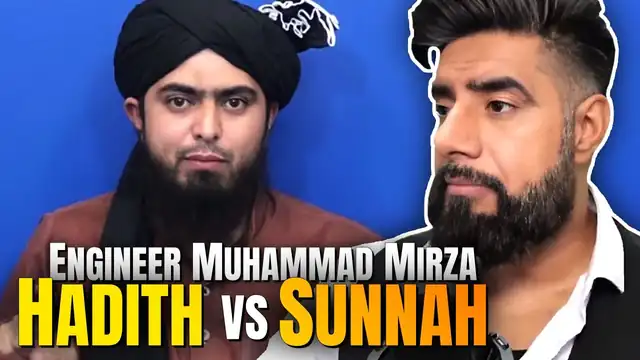 Play from 0:01
The video loads from YouTube only when you press play. Click a time in the transcript to seek.
Watch this part
Open on YouTube at 0:01The player starts at 0:01, the beginning of this part.
This segment0:01 to 8:29 · 8 min 28 sGeneral teaching
What this part covers
machinesummary, machine-writtenNot fully, says Mufti Abu Layth: Engineer Mirza's rational critique of others' hadith stops short of scrutinising how sahih hadith were authenticated. Mufti still calls him a legend and a much-needed voice.
In more detail
Responding to a comment that Engineer Muhammad Ali Mirza exposes hypocritical views and literature, Mufti Abu Layth calls him an unquestionable and profound scholar and a much-needed, less dogmatic voice in Pakistan, as he says another Pakistani scholar also is, but says he is not a hundred percent true to his own principle. Mufti argues that if one criticises others' hadith by an objective criterion, the same scrutiny should go further, to how sahih hadith are made sahih: narrators are often vouched for, by scholars like Imam Ahmad, two or more generations after they lived, without the sources being disclosed. He says this does not make everything collapse, because the scholars of Madinah and Kufa distinguished hadith, as historical documentation, from the Sunnah, the living tradition inherited from parent to child; there are hadith dogmatists and hadith relativists, and the problem is saying the other has no right to exist in Islam. Wrapping up, Mufti stresses that he does not mean to belittle Engineer Mirza, whom he calls a legend he loves and respects, that he will not tolerate rudeness towards him, and that the mystics, philosophers, jurists and hadith scholars each have their tradition within the colourful legacy of Islam.
- Some terms in this segment are uncertain
Position stated
Not yet double-checkedA summary of the view expressed is published here only after a second, independent review has found the sentence in the transcript where he says it. Until then, the transcript and the recording speak for themselves.
Kind: general teachingTranscript
machine0:01 to 8:29 · click a time to seek · dotted terms open the glossary
really exposes the hypocritical views and literature he does he does but you know the thing with look uh Muhammad uh you know Sheikh engineer Muhammad Ali Mirza and he is look he is a scholar unquestionable he's a profound scholar of Islam but you see when you say he exposed this stuff he does but he you see he's not 100 genuine to the principle he's not I mean I'm not saying this as a diss sure look may Allah bless him and give him more and more and more I mean
you know he's doing things with a great cause and he's guided you know millions of people and he is a much needed voice in Pakistan just as ramadi Sab is is definitely a much-needed voice um so engineer Mirza Sab is less dogmatic and therefore that is needed because he's calling people to some kind of um uh rationalism some kind of rationalism um but my point was that look my point was just when he is criticizing other people
which I get it because that's his thing he does that and you know people was you know and I get that because in the past I'd been caught up in that and so when you just you just get so caught up in it you don't you know it's it's it kind of consumes you and so but what I was saying is his thing you see the rational element to showing the hypocrisy it doesn't stop where he stops it goes further but he doesn't take it further see he covers that part up or he refuses to discuss that part because then it would
get problematic you see so it's like saying well look I'm going to criticize you for not following because now I have a criteria and your Hadith doesn't match up to that criteria and I'm being objective so okay so let's take it a step further let's evaluate the sahih Hadith and say well okay I'm going to evaluate it according to these standards so okay but then we're going to evaluate from uh you you you're going to look at this from from a knowledge viewpoint okay an epistemological viewpoint
that how are these things equate how how are these things generating uh you see a certain thing like like look put it like this most of the ulama of Islam traditionally they went by the living tradition they did not just go by Hadith they made a distinction between Hadith and Sunnah now you have to honor that that tradition if you're not going to honor it and you're just going to take this tradition that oh I'm just a very AMA Hadith dogmatist I only go by when the Hadith okay but then let's take that further
then let's analyze how is the Hadith made sahih and you say well such and such a person vouched for it so I said well okay let's say Imam Ahmed vouches for a particular rawi most of the rawi that the people vouch for they never actually met in their lifetimes because they were a generation or two before them or not most but many you know and aren't an indispensable number of rewards are being commented and being validated by people who come at least two generations after them so the question is when they validate them they don't disclose their sources
very rare that they disclose the disclose these sources so let's say let's say is saying this person is this this only you know the the layer of people that they meet the first layer of transmitters to them sure you could say well how maybe they met them so they had an assessment what about the people one generation ahead or two generation ahead or three generations ahead how how do you know their memory was good it's like me saying oh I know my grandad's
neighbors uh memory was good so well how do you know that did you ever meet him no well imagine I said my great great granddads Chen his his neighbor's memory was really good so how do you know so this is a question now because I must have had it through sources but I don't disclose the sources is that not a question mark if we're going to be objective let's be objective so you see either you now the people say oh but if you do that then the whole thing Falls no it doesn't you see because we had the living
tradition because Hadith and Sunnah were never considered the same thing by the school of Medina or the school of kufa and Hadith was simply documentation so they were like historical documents and the sun now is the living tradition which we inherited by a living tradition from father to child so you see now what either you acknowledge the multidisciplinary approach and then fine you know you will you see I I have no problem you accepting this Hadith with its kind of punctuated blind spots uh in the is not
fine we're not going to raise it as a as a question mark because you're gonna say well your tradition doesn't it's just inherited you know on mass it's a living tradition so fine there's a multi-disciplinary approach so people do their own thing this Hadith dogmatist there's Hadith relativists but when you say you don't have a right to exist in Islam that's a problem okay because then either I don't know or if I do know then it's a greater Calamity as the poet said that you know
okay guys you know what I've gotta wrap this up as well so um no look I want to say here by the way and I want to add this in look no please don't I I'm not trying to belittle um I think he's a great I think he's a legend you know he what he's done people would have said it was impossible to do okay I think he's a Legend um you know I I I have my love for him I have my Endearment for him I have my
respect you know unquestionable respect for him he's a he's a great scholar you know I'm not in any way to trying and I would not tolerate anybody being rude to him I'm just saying that look we have a discipline and we just own it and other people have their own approach and they're allowed their approach you know it's this is the beautiful color you know the colorful Legacy of Islam we all have a different way the mystics in Islam have their own way you know they have a tradition the the people who the philosophers have their tradition the usulin have their tradition the fokaha
of their tradition the hadithian have their tradition the you know people have their own tradition so so and sure we can be critical but let's just now and then concede to it you know it's fine you know okay we've got these blind spots you've got those blind spots fine you know we we all coalesce we are the ummah of Islam it's not a a thing you know don't let my words don't understand my words in any way to be weaponized against I'm not I'm I respect I honor I don't I'm just being true I'm trying to be as true to myself as I can
Paragraphs overlapping 0:01 to 8:29. Full text on the recording page.
Cite this segment
Stable id, transcript version and tier are part of the citation. Every change to a transcript is logged.Mufti Abu Layth Archive, segment 2023-02-06-S01, auto-transcribed, may contain errors. https://muftiabulayth.org/r/dnueakqqzxy/s/1/ (accessed 1 November 2026)
- APA 7
Mufti Abu Layth. (2023, February 6). Is Engineer Muhammad Ali Mirza consistent in how he criticises hadith? [Video, segment 2023-02-06-S01, auto-transcribed, may contain errors]. Mufti Abu Layth Archive. Retrieved November 1, 2026, from https://muftiabulayth.org/r/dnueakqqzxy/s/1/
- Chicago author-date
Mufti Abu Layth. 2023. "Is Engineer Muhammad Ali Mirza consistent in how he criticises hadith?" Video, segment 2023-02-06-S01, auto-transcribed, may contain errors. Mufti Abu Layth Archive. Recorded February 6, 2023. Accessed November 1, 2026. https://muftiabulayth.org/r/dnueakqqzxy/s/1/
- BibTeX
@misc{abulayth-2023-02-06-S01,
  author = {Mufti Abu Layth},
  title = {{Is Engineer Muhammad Ali Mirza consistent in how he criticises hadith?}},
  year = {2023},
  month = {2},
  date = {2023-02-06},
  howpublished = {\url{https://muftiabulayth.org/r/dnueakqqzxy/s/1/}},
  url = {https://muftiabulayth.org/r/dnueakqqzxy/s/1/},
  organization = {Mufti Abu Layth Archive},
  urldate = {2026-11-01},
  note = {Segment 2023-02-06-S01, auto-transcribed, may contain errors}
}
Something wrong here?
Tell us what is wrong and it will be checked against the recording. Nothing changes until a person has reviewed it.
Sending a note needs JavaScript, which is off or unavailable in this browser. Nothing has been sent.
No name, email address or account is asked for or stored, and the inbox does not store your IP address. For rate limiting it keeps an unreadable fingerprint of your connection for 48 hours, and our database provider's own logs record connections as every website's do. Only your note, its kind, the page and the moment in the recording are kept, for review.