
Recordings › Br Muhammad MFG | Quranist Only Belief - A Dialogue | MindTrap #82 - Mufti Abu Layth · 18 Oct 2025 › Segment 17 of 32
How do Muslims know how to pray if the Quran does not spell it out?
salat salaah namaz salaat namaaz as-salah al-salah salawat hadeeth ahadith ahaadeeth hadis hadees ahaadith sajdah sajda sujood prostration masjid masjed masaajid masajid fatwah fatawa fatwaa fataawa legal opinion sunna sunnat sunan prophetic practice koran quraan al-quran sura soorah surat suwar soora ayah aya ayat ayaat aayah aayat tilawah tilawat tilaawah madina al-madinah madeenah yathrib subhanallah subhaanallah subhanallaah deen al-din ad-deen ad-dinMufti Abu Layth's counter: an unbroken living tradition of prayer; the guest asks why two prayers are silent
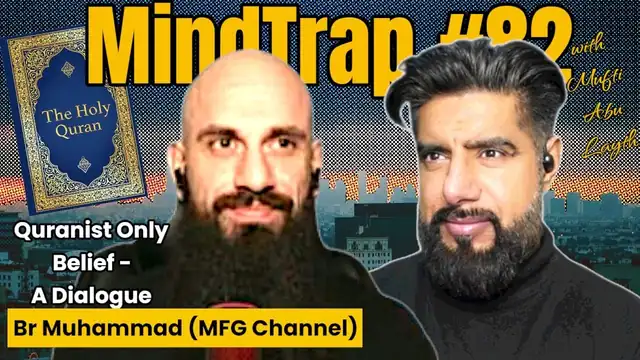 Play from 1:27:01
The video loads from YouTube only when you press play. Click a time in the transcript to seek.
Watch this part
Open on YouTube at 1:27:01The player starts at 1:27:01, the beginning of this part.
This segment1:26:18 to 1:31:09 · 4 min 51 sGeneral teaching
What this part covers
machinesummary, machine-writtenMufti Abu Layth says Muslims know how to pray from an unbroken living tradition of more than 1,400 years, father to child, documented in the books of every century; the guest asks why God describes prayer in the Quran if it must be learned at the mosque, and why two prayers are silent when 17:110 forbids silence.
In more detail
Mufti Abu Layth says it is not an interrogation; he is simply trying to understand, as many people are, how the guest applies Islam. The guest pushes back: if these concepts are strange and one must learn salah from the living tradition, why does God mention these things in the Quran, if one just has to go to the mosque and learn from the man there something that does not align with what God says? Mufti states his own position, which he says is that of Muslims generally: there is an unbroken chain of living tradition of over 1,400 years, from father to child, of how to pray, guided by countless books built on Sunnah, hadith and fatwa, so that for any century one picks he could show from the books of the school of Madinah how people prayed as he does. The guest wants to push back on this and complains that his earlier question was never allowed; Mufti promises to come back to it but first wants to finish steelmanning the guest's salah. The guest says this is his personal salah, that people understand the Quran as God allows them, and that where there is a leader the group follows his application. He then asks why, when the Quran says in chapter 17 not to be loud or silent in prayer but to find a middle way, two of Mufti's prayers are silent in congregation, negating the book of God; Mufti says he will answer after closing the salah point.
- Guest speech overlaps this segment
Position stated
Waiting for the speaker checkA guest speaks in this segment and the captions do not say who said what. The view found here is held back until the speaker-separated transcript confirms the words are his, or the channel verifies it. The transcript and recording are published in full.
Kind: general teaching Speakers: host and guest; guest speech is labelled and excluded from positionsTranscript
machine1:26:18 to 1:31:09 · click a time to seek · dotted terms open the glossary
A guest speaks in this segment. Guest speech is labelled and is excluded from the positions layer.
>> we man subhan allah question >> every day arbitrary the number of >> arbitrary there's no numbers of raqats it's about the durations filling the duration so god is telling you the durations he's not telling you >> there is a number of but there but there is prayed a in practice a numbers of raqat so like you said look that describes one raqat you're saying about a conversation and all I have been receiving from you is you're cutting me off mid-sentence and you're following up with a different question and yet I have not even asked you a single question so I'm not sure how this is a conversation and just an interrogation at this point.
>> No, no, this is not an interrogation at all. Look, I just a simple thing I'm just trying to understand as many people are. How do for example, you practice the application of Islam without you? You're you're you're trying to measure me up to a certain standard, right? That >> I'm trying to understand you. Look look listen. Imagine you would. Yes. So this is honestly but but here's here help me understand it.
Help me understand. >> Here is here here is my push back to you. Here's my push back to you so that you can hear me out please. So if you're saying that these concepts that we're presenting to you is not right or something is weird about it and that we're going to have to learn from the living tradition on how salah is done. Then why is God mentioning these things in the Quran if it's not things for you to pick up yet? You just have to go to the mosque and learn it from the guy that's sitting in the mosque and it's not aligning to what God is saying.
So that's the push back. So yes, you could say that we're inventing a new religion or anything. We're trying to look, I'm not trying to put words in your look, but of what you're saying. >> So I don't want you to put words in my mouth. I've not said anything berating or disrespectful to you. Right? Look, if you ask me, okay, let me clarify my position. Steel man mine, steel man yours. My position as that of Muslims generally speaking worldwide is that there is an unbroken chain of tradition of living tradition between us and the prophet Muhammad sallallahu alaihi wasallam of 1,400 years plus from father
to child of how to pray. This is guided in the countless myriad books of explanations built upon sunnah, built upon hadith, built upon fatwa, built upon, right? But I could show you in every single century for example you pick a century show you from that century 9th century 10th century 6th century from the books of the school of Medina how they prayed like me now when I'm understanding just to understand it you see you said well okay the Quran mentions we pray now now let me push back you said something let me push back please so you said that there's this uncut tradition all the way back from
the prophet right so now if we look >> before we come to that Let's just steal man your salah just so we know >> earlier earlier when when you asked me so many questions and I asked you can I ask a question you said sure let me ask this finish this point and then ask a question and we moved on to the I never asked my question no I didn't sure I still have a question and now now you made a point when I want to push back and expose how what you're saying is not accurate then you don't want to talk about it that's fine >> sure no I will I will I will come back to that and people are watching I will come back to this right but just to steal the salah thing.
So people don't say that look, oh we we misplaced words in your mouth, right? So just so people understand because we've unraveled this that you pray let's say three times a day and the your salah has so you don't do you just start regime now the Quran says >> this is my personal salah you're asking this is your personal this is how all Quranists as you call us pray this is how I approach my prayers just so that >> so does everybody just do it on their own they just do their own thing >> people people are allowed to understand the Quran to what God is allowing them to understand yes Because your tradition but the salah everybody just does their
own salah. >> Perfect. Perfect. And if there there's exactly and if there is a leader among the group then they're going to go by the way that that man is applying it. But very simply now God says in the Quran do not be loud in your prayer and do not be silent in your prayer. Okay? And find a m way in between. So this is a clear instruction from God in the Quran. Why is it that two of your prayers and you guys are silent when it comes down to the congregation negating the book of God?
>> Okay. As in why do we pray silently? Is that what you're asking? >> Yes. When God said that you can't pray silently, >> right? Okay. Where does he say you can't pray silently? >> In chapter 17. >> Yeah. Go. Sorry. Sorry. Yeah. Yeah. >> I I said the verse, but I'll bring it back. >> Sure. >> At the end of chapter 17, it says >> Yeah. And I'll answer that and I'm going to answer that and and when I answer it I just want you to finalize after I've answered it.
I want you to finalize that point on salah so we can close it move on right just because I don't want people to say well I misrepresent >> what's your point so what's your point >> so my point is like to understand how you so this is what I've understood from your salah that each person and this is why I want to steal man I don't want to straw man it >> each person they do it for their own salah all right so however salah comes to them they do it but how you choose to do it is you generally let's say pray three times times a day.
Okay. And you pray by which is to stand. You do recitation which is once again you said arbitrary as in you like it, you prefer it and a surah and then you go straight into sujud. You only do one s and then you finish the salah. You just do salah. >> It's again you're you're you're trying to structure something that I don't have structured.
Paragraphs overlapping 1:26:18 to 1:31:09. Full text on the recording page.
Cite this segment
Stable id, transcript version and tier are part of the citation. Every change to a transcript is logged.Mufti Abu Layth Archive, segment 2025-10-18-S17, auto-transcribed, may contain errors. https://muftiabulayth.org/r/onzjd7xmdhe/s/17/ (accessed 1 November 2026)
- APA 7
Mufti Abu Layth. (2025, October 18). How do Muslims know how to pray if the Quran does not spell it out? [Video, segment 2025-10-18-S17, auto-transcribed, may contain errors]. Mufti Abu Layth Archive. Retrieved November 1, 2026, from https://muftiabulayth.org/r/onzjd7xmdhe/s/17/
- Chicago author-date
Mufti Abu Layth. 2025. "How do Muslims know how to pray if the Quran does not spell it out?" Video, segment 2025-10-18-S17, auto-transcribed, may contain errors. Mufti Abu Layth Archive. Recorded October 18, 2025. Accessed November 1, 2026. https://muftiabulayth.org/r/onzjd7xmdhe/s/17/
- BibTeX
@misc{abulayth-2025-10-18-S17,
  author = {Mufti Abu Layth},
  title = {{How do Muslims know how to pray if the Quran does not spell it out?}},
  year = {2025},
  month = {10},
  date = {2025-10-18},
  howpublished = {\url{https://muftiabulayth.org/r/onzjd7xmdhe/s/17/}},
  url = {https://muftiabulayth.org/r/onzjd7xmdhe/s/17/},
  organization = {Mufti Abu Layth Archive},
  urldate = {2026-11-01},
  note = {Segment 2025-10-18-S17, auto-transcribed, may contain errors}
}
Something wrong here?
Tell us what is wrong and it will be checked against the recording. Nothing changes until a person has reviewed it.
Sending a note needs JavaScript, which is off or unavailable in this browser. Nothing has been sent.
No name, email address or account is asked for or stored, and the inbox does not store your IP address. For rate limiting it keeps an unreadable fingerprint of your connection for 48 hours, and our database provider's own logs record connections as every website's do. Only your note, its kind, the page and the moment in the recording are kept, for review.