
Recordings › Br Muhammad MFG | Quranist Only Belief - A Dialogue | MindTrap #82 - Mufti Abu Layth · 18 Oct 2025 › Segment 18 of 32
Does the Quranist prayer have any set structure?
salat salaah namaz salaat namaaz as-salah al-salah salawat sajdah sajda sujood muftis koran quraan al-quran sura soorah surat suwar soora ayah aya ayat ayaat aayah aayat tilawah tilawat tilaawah sunni ahl al-sunnah ahl as-sunnah ahlus sunnah ahl al-sunna niyyah niyah niyat niyya niyyat dhikr zikr zikar dhikar zikir adhkar azkarPrayer 'in the moment': no fixed structure, hours in prostration, feedback from followers
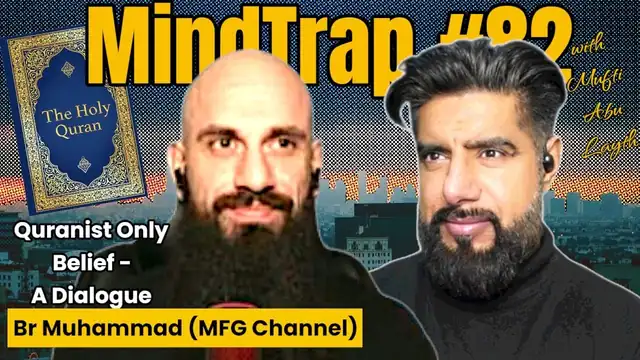 Play from 1:31:46
The video loads from YouTube only when you press play. Click a time in the transcript to seek.
Watch this part
Open on YouTube at 1:31:46The player starts at 1:31:46, the beginning of this part.
This segment1:31:09 to 1:36:54 · 5 min 45 sA view quoted in order to be discussed, not a position held
What this part covers
machinesummary, machine-writtenThe guest's prayer has no set structure: it changes in the moment, may include hours of prostration or prostrating mid-recitation when a verse moves him, and its purpose per 29:45 is to restrain immorality; he says Quranists may also pray like Sunnis, minus words not from God.
In more detail
Mufti Abu Layth summarises the guest's prayer as generally three times a day, with standing, a chosen recitation and a single prostration; the guest says Mufti is trying to structure something he does not have structured, that it changes with how he is working with God in the moment, and that some days he spends four hours prostrating. He says the structure is set by the people of a society by agreed convention, while God gives the ingredients and the reason for prayer, citing the verse that prayer restrains immorality and obscenity and that the remembrance of God is greater; those who are not restrained did not really pray. Mufti clarifies for a viewer that 'arbitrary' does not mean random but put together by oneself. The guest paints a picture of reading a verse that hits close to home, contextualising it to himself rather than to history, weeping at the beauty of God's words and prostrating in the middle of his prayer to glorify and thank him before standing to carry on the chapter; he says people who pray as he teaches report feeling they have prayed for the first time in their lives, and mentions those who mock their prayers. Mufti says nobody is mocking and that the Quran making one cry is beautiful, and confirms that the prayer is set in the moment rather than on the day. The guest says he understands the questioning as an attempt at an undercutting defeater, to show the position as emotional and arbitrary, and adds that one may also pray exactly as the Sunnis do, apart from some words that are not from God.
Position stated
This segment presents a view in order to discuss or respond to it. It is recorded as quoted, never as held, and no position is attributed from it.
Kind: a view quoted in order to be discussed, not a position held Speakers: host and guest; guest speech is labelled and excluded from positionsTranscript
machine1:31:09 to 1:36:54 · click a time to seek · dotted terms open the glossary
A guest speaks in this segment. Guest speech is labelled and is excluded from the positions layer.
This segment states a view in order to discuss it. It is recorded as a quoted view, not as a position held.
Okay. And you pray by which is to stand. You do recitation which is once again you said arbitrary as in you like it, you prefer it and a surah and then you go straight into sujud. You only do one s and then you finish the salah. You just do salah. >> It's again you're you're you're trying to structure something that I don't have structured.
>> So it so it just changes every day. that this is what I want on how I am working with God in that moment. This is the beautiful part about salah. It's not supposed to be this overly structured when you're by yourself. >> So some days it has like three, two, some days. >> Some days I'll stay four hours prostrating to my God. >> It's not the prostration. I'm just >> Okay, but that's I started my salah with prostration for two hours because I want to get close to God because that's what God says.
Is that a is that that's exactly >> so there's no so it's just >> arbitrary every day >> the structure the structure is based by the people in the society that have an agreed convention and yes you have so by the people not by God is giving you the guidance and the way that you set it is how the society wants to set it but God has told you the ingredients if you want to start kneeling in your prayer That's perfectly fine.
If you want to start by staining, that's perfectly fine. God has told you why he wants you to pray for the arbitrary structure >> and God is giving you the results of the prayer. He says uh to [Music] that the prayer it stops the immoralities and obscinities and the remembrance of God is greater.
So when you're praying you remember God often and it's actually improving your life drastically. >> Nobody is challenging that. I know nobody's challenging that, but that's the point where it is accurate because if we're not capable of stopping moralities and obscinities, if we're not capable of getting closer to God and what God is saying in the book, therefore our prayer was not accepted. So now the the >> nobody's challenging that part. So I just look somebody said here, see this is what I mean.
I want to clarify. Somebody said he's that am I putting this word in your mouth arbitrary? Just to clarify, arbitrary does not mean random. Arbitrary. There's a distinction in the language between arbitrary and random. So arbitrary is as you put together yourself arbitrarily. So just to be clear, the the salah manifests in a layout that is arbitrary on how you want to do on the day.
Is that >> so? So so for example, I'll paint you a picture. God is uh God is saying something in the Quran that I'm reflecting upon in the day that let's say about this conversation or a conversation I had with someone earlier and I'm reading the Quran and I read a verse that hits really close to home to the heart because I'm reflecting on God's words as he's talking to me as I'm reciting it and I'm I'm instead of sitting in my mind always contextualizing it to history and to other people I'm contextualizing it about myself and what I'm getting guided by God and then that verse becomes very hard for me to hand over where I start to cry because of how beautiful the word of what God says.
So in that moment, I just want to prostrate to my Lord. So no. So yes, in the middle of my prayer, I'm going to prostrate and I'm going to glorify him and I'm going to thank him and I'm I'm going to praise him and I'm going to love him and I'm going to get like I'm going to I'm going to express my heart and then after I have my little moment with that verse that God has just allowed me to read, I'll stand up again and then I will carry on the chapter. Yes, a lot of people have questions about our prayers, but I guarantee you the people who pray the way that we show Muhamad the Quran prays, we get a lot of positive feedback on what they're saying.
They're saying to me, it's like I feel like I've prayed for the first time in my life. And the other thing is the people who want to make fun of our prayers. >> Listen, nobody has been making fun. Yeah. And nobody has said what you're saying is is everybody agrees with what you're saying about the Quran making you cry. I think that's beautiful. I think may Allah grant that uh to everyone. >> But just to answer the question >> is it set on the day?
Is it set on the day? >> No, it is in the moment. So it's something >> in the moment. Sorry. Set in the moment. Sorry. >> It is it's it's going with what is being revealed to you in the moment. Now I understand the way that this is looking because of the way that is being questioned. And that is why I understand what is being done. I know that you're not ill. And I understand what is the move from behind what you're asking.
This is why it's not it's not I'm I'm not an individual where it's like I'm walking into a room or I'm not >> I don't want to make you look I don't want to make you uncomfortable. So let's move on. >> I'm not uncomfortable but but there has to be a back and forth for people to understand when you're questioning me and you're just going to keep pressing and keep pressing. The point is to do something that is called an undercutting defeater. So for you it's you want to show that that position is so emotional and it's so arbitrary and it's not set on standard and everybody does what he wants and therefore the tradition intention >> oh man okay but I can read between the lines so I asked you a very simple question that
>> but you can read somebody's intention God tells us you will know them by the tone of the voice you know you could see so there's certain things that we can read now there is okay >> so the reason just There is a point there is a point that I want to Travis that you can pray like the Sunnis as well. You can stand and pray the Sunnis exactly how the Sunnis pray. There's absolutely no problem that there is some words that you shouldn't say because it's not from God.
Paragraphs overlapping 1:31:09 to 1:36:54. Full text on the recording page.
Cite this segment
Stable id, transcript version and tier are part of the citation. Every change to a transcript is logged.Mufti Abu Layth Archive, segment 2025-10-18-S18, auto-transcribed, may contain errors. https://muftiabulayth.org/r/onzjd7xmdhe/s/18/ (accessed 1 November 2026)
- APA 7
Mufti Abu Layth. (2025, October 18). Does the Quranist prayer have any set structure? [Video, segment 2025-10-18-S18, auto-transcribed, may contain errors]. Mufti Abu Layth Archive. Retrieved November 1, 2026, from https://muftiabulayth.org/r/onzjd7xmdhe/s/18/
- Chicago author-date
Mufti Abu Layth. 2025. "Does the Quranist prayer have any set structure?" Video, segment 2025-10-18-S18, auto-transcribed, may contain errors. Mufti Abu Layth Archive. Recorded October 18, 2025. Accessed November 1, 2026. https://muftiabulayth.org/r/onzjd7xmdhe/s/18/
- BibTeX
@misc{abulayth-2025-10-18-S18,
  author = {Mufti Abu Layth},
  title = {{Does the Quranist prayer have any set structure?}},
  year = {2025},
  month = {10},
  date = {2025-10-18},
  howpublished = {\url{https://muftiabulayth.org/r/onzjd7xmdhe/s/18/}},
  url = {https://muftiabulayth.org/r/onzjd7xmdhe/s/18/},
  organization = {Mufti Abu Layth Archive},
  urldate = {2026-11-01},
  note = {Segment 2025-10-18-S18, auto-transcribed, may contain errors}
}
Something wrong here?
Tell us what is wrong and it will be checked against the recording. Nothing changes until a person has reviewed it.
Sending a note needs JavaScript, which is off or unavailable in this browser. Nothing has been sent.
No name, email address or account is asked for or stored, and the inbox does not store your IP address. For rate limiting it keeps an unreadable fingerprint of your connection for 48 hours, and our database provider's own logs record connections as every website's do. Only your note, its kind, the page and the moment in the recording are kept, for review.