
Recordings › Salman Rushdie & The Satanic Verses | Mufti Abu Layth · 19 Aug 2022 › Segment 21 of 21
Recap: the novel, insult versus critique, and the false story summarised
hadeeth ahadith ahaadeeth hadis hadees ahaadith averroes ibn rushd al-hafid qadi ayyad qadi iyaad al-qadi iyad sujud sajdah sajda sujood maaliki malikite malikiyyah maliki school muftis haraam forbidden sanad isnaad asanid chain of narration mursal hadith koran quraan al-quran sura soorah surat suwar soora chapter ayah aya ayat ayaat aayah aayat madinah madina al-madinah madeenah yathrib in sha allah insha'allah in shaa allah insha allah inshaa allah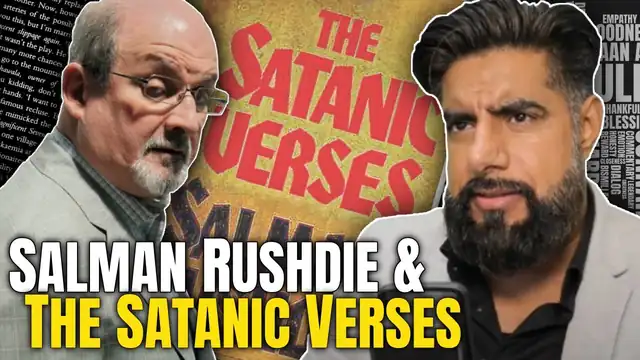 Play from 1:52:45
The video loads from YouTube only when you press play. Click a time in the transcript to seek.
Watch this part
Open on YouTube at 1:52:45The player starts at 1:52:45, the beginning of this part.
This segment1:52:45 to 1:58:54 · 6 min 09 sGeneral teaching
What this part covers
machinesummary, machine-writtenMufti Abu Layth recaps that Rushdie's novel was an insult rather than a critique and that the satanic verses story is a fabrication rejected by al-Tabari, Ibn Khuzayma and Qadi Iyad, recommending al-Shifa and al-Albani's book.
In more detail
Mufti Abu Layth recaps the session: an overview of Salman Rushdie, whose surname was an affiliation chosen by his father after the great Maliki Ibn Rushd, a psychoanalysis of why he may have written the book, its characters, and why it was blasphemous rather than a critique. He repeats that anyone who does not believe in Islam has the right to critique it, but not a licence to insult or swear at others, and that democracy means courtesy and choice, not a right to insult. He summarises the satanic verses story as false, scaffolded on the prostration at Surah al-Najm and later attached to 22:52, which he says is a general verse reminding people that some wishes can derail them. He says al-Tabari records the reports but calls them false, and that Ibn Khuzayma, Qadi Iyad and many others called them fabricated and haram to transmit, while Ibn Hajar, al-Suyuti and Ibn Taymiyya, invested in the isnad project, gave the story a basis, which he calls incoherent even by their own principles since the Shafi'is do not accept mursal reports. He recommends Qadi Iyad's al-Shifa and al-Albani's book for further reading.
- Some terms in this segment are uncertain
Position stated
No position summary has been recorded for this segment.
Kind: general teachingTranscript
machine1:52:45 to 1:58:54 · click a time to seek · dotted terms open the glossary
he had walked on these streets on this soil that dear eye he refused to ride a horse or any whether it was a mule or anything inside the inner part of medina said no i won't do it this is where the prophet walked out of love for the prophet salallahu so when we see these things it's it's just it's this is just a reminder okay i really wanted to recover it because of why it was relevant the whole satanic verses what is it an overview of salman rushdie sorry [Music] not not any
to him but to uh because the name is actually not his surname as i mentioned it's actually an affiliation decided by his father to the great maliki so an overview of him a psychoanalysis on why he may have authored that book his lifestyle his way of thinking what his book was about the kind of characters the novel why it was blasphemous we covered that it wasn't just that he was critiquing islam he has the right to critique islam any person doesn't accept islam or believe in islam or anything you if you don't believe in something you have the right to critique it
but let's not conflate that with i just have a free license to insult you i can just swear at you i can just call your mom this and this and this and this just because i have the right to to wag my tongue and i have to i have the ability to do it that's not how human societies are built you know people say oh the human society this is democracy no it isn't democracy is showing people courtesy that they get a choice in things you see just coming out just saying democracy is my right to just swear at
people and insult them and insult them no it isn't that's that sure that's a very twisted way of looking at it but then what were these satanic verses in arabic called okay hadith so we looked at that we looked at where um first of all how these were utterly false and there were a story that was uh scaffolded uh it was on the base of an incident of surah najam where the where everybody in the haram
prostrate prostate prost prostrates and the question was why did they do that so some later people gave an explanation this start to attach it to this verse of the quran which we covered in the beginning about the verse being that it's nothing about that the verse is a general verse and it gives meaning it gives strength to people it reminds us that look sometimes when we have certain wishes some wishes can derail us some wishes we can be we need to focus always on the present and the future and we gain strength
from that so we are taking a look at verse 52 from and some of us serene just saw the the trade cells they had to start putting this in but tabari even though he put it in but he mentions at the end all these are before him the um or around his time his kind of era in the 300s you've got ibnakozema mentioning it's absolutely fabricated from people
then you've got goddamn you've got many we showed many people many people showing this is utterly unacceptable it's disrespectful it's blasphemous it's haram it's like a jews they said you know you can't say this kind of stuff but yes you had some people who were so um committed to the is nad project of chain that they felt you can't just dismiss any chains even if they're weak because they invested in the project like even hajjar and
after himsuti and you also had ibn samia now they said well in that case we're going to say this has some basis which was actually incoherent because even by their principles by the way the shaffer is to do not accept mursal so the rewayats that are not connected at the end they don't accept the masahi so for him to say that oh but i suppose he's saying that well uh i accept they're all weak but because there's several we're going to say it has a basis but if it has a basis are you going to say well it has some basis based on okay these people prostrated we don't know why
or you're saying well no this incident actually happened and then they start justifying that which was absolutely unwarranted but they did it but that's fine i mean okay it's not fine but it's them and we don't need to blindly follow them they did it they were wrong and you've got clear explanations got lengthy anybody wants to read can read detailed explanation i advise you for further reading you can read the shifter this section of qadhafi's which he cites is a very similar to avocado artery if you want a very good and more recent
several books albany's book on this it's actually really fascinating because he's bringing all these people he's bringing he brings him to me as well and he brings uh called the earth he brings our work he clearly shows that this is unacceptable this is utterly unacceptable we can't be saying things like this so that's the summary of what this hadith is and the satanic verses i hope inshallah for anyone that want to have a certain grasp on the topic this has been helpful cool
Paragraphs overlapping 1:52:45 to 1:58:54. Full text on the recording page.
Cite this segment
Stable id, transcript version and tier are part of the citation. Every change to a transcript is logged.Mufti Abu Layth Archive, segment 2022-08-19-S21, auto-transcribed, may contain errors. https://muftiabulayth.org/r/t0phqrnjjby/s/21/ (accessed 1 November 2026)
- APA 7
Mufti Abu Layth. (2022, August 19). Recap: the novel, insult versus critique, and the false story summarised [Video, segment 2022-08-19-S21, auto-transcribed, may contain errors]. Mufti Abu Layth Archive. Retrieved November 1, 2026, from https://muftiabulayth.org/r/t0phqrnjjby/s/21/
- Chicago author-date
Mufti Abu Layth. 2022. "Recap: the novel, insult versus critique, and the false story summarised." Video, segment 2022-08-19-S21, auto-transcribed, may contain errors. Mufti Abu Layth Archive. Recorded August 19, 2022. Accessed November 1, 2026. https://muftiabulayth.org/r/t0phqrnjjby/s/21/
- BibTeX
@misc{abulayth-2022-08-19-S21,
  author = {Mufti Abu Layth},
  title = {{Recap: the novel, insult versus critique, and the false story summarised}},
  year = {2022},
  month = {8},
  date = {2022-08-19},
  howpublished = {\url{https://muftiabulayth.org/r/t0phqrnjjby/s/21/}},
  url = {https://muftiabulayth.org/r/t0phqrnjjby/s/21/},
  organization = {Mufti Abu Layth Archive},
  urldate = {2026-11-01},
  note = {Segment 2022-08-19-S21, auto-transcribed, may contain errors}
}
Something wrong here?
Tell us what is wrong and it will be checked against the recording. Nothing changes until a person has reviewed it.
Sending a note needs JavaScript, which is off or unavailable in this browser. Nothing has been sent.
No name, email address or account is asked for or stored, and the inbox does not store your IP address. For rate limiting it keeps an unreadable fingerprint of your connection for 48 hours, and our database provider's own logs record connections as every website's do. Only your note, its kind, the page and the moment in the recording are kept, for review.