
Recordings › Salman Rushdie & The Satanic Verses | Mufti Abu Layth · 19 Aug 2022 › Segment 9 of 21
Why did Salman Rushdie write The Satanic Verses?
wudhu wudoo wuzu ablution al-wudu wudhoo muftis deen al-din ad-deen ad-dinWhy he wrote it: identity, a father's disappointment and the backlash
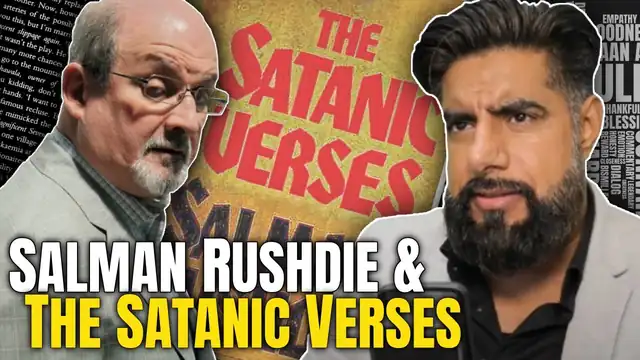 Play from 44:48
The video loads from YouTube only when you press play. Click a time in the transcript to seek.
Watch this part
Open on YouTube at 44:48The player starts at 44:48, the beginning of this part.
This segment44:48 to 52:44 · 7 min 56 sGeneral teaching
What this part covers
machinesummary, machine-writtenIn his personal opinion, Rushdie wrote the novel chiefly as defiance of his father, did not expect the backlash, and has since been abandoned even by the left he championed.
In more detail
Mufti Abu Layth recaps his psychoanalysis: a man from a privileged elite family who struggled all his life with where he belonged, resented his father for embracing his Muslimness and moving to Pakistan, and wanted to be English but remained a brown outsider. He says Rushdie resents Imran Khan, who refused to share a stage with him and was more readily accepted in Britain, and describes Rushdie's remarks about him at a conference. In what he calls his personal opinion, Mufti thinks Rushdie never expected the reaction the book received, longed for fame and notoriety, and wrote the novel first and foremost as a gesture of defiance at his father and then at the mullah class. He says Rushdie's father saw his history degree and leftist causes as a waste, and that the left Rushdie thought he was championing now regards him as a bigot for attacking Muslims, while even non-Muslim literary figures avoided sharing a stage with him. He ends this part with a joke about Rushdie's hairline and where he would begin washing his face in wudu.
Position stated
Not yet double-checkedA summary of the view expressed is published here only after a second, independent review has found the sentence in the transcript where he says it. Until then, the transcript and the recording speak for themselves.
Kind: general teachingTranscript
machine44:48 to 52:44 · click a time to seek · dotted terms open the glossary
criticized religion and therefore they had reformations sure you've got you know you've got several reformations have taken place he speaks of in one of his conferences about copernicus okay about martin luther about the you know not martin protestants and the whole thing see sure where is your critique of islam what that you're just going to say that old the prophet was this this person who was delusional and he
you're going to call his wife the biggest prostitute that there was and you're going to say and then you're going to say it's something oh no i'm talking about the prophet what made you think i'm talking about the prophet oh and then later on he's very clear in his later interviews oh i was talking about the prophet i have the right to talk about him so now this is the so this goes to show that these things are i just want to explain give a kind of an overview of the story and and anchor in in the kind of evaluation the mental evaluation of this individual
who struggled all his life with identity that where does he belong you know coming from privilege coming from money his family were from an elite upper class in india his his dad was a successful lawyer from cambridge in the time the british raj you know coming from that but his dad still embracing his muslimness his dad's disappointment in him which baffled him he resented his father for his dad moving to pakistan because of muslims him hating this
him going back to india but not really fully fitting in where do you fit in him wanting to be british english but back then see now okay there's a lot more cultural but back then you see you you're still brown it doesn't matter it's very articulate but you're still brown and he always resents imran khan and imran khan refused to attend the conference that he was at any place imran khan had this policy that i refused to sit at any table that is so there's a an interview of salman rushdie on not an interview he speaks at one of his confidence really
you could see how hurt he is so he is about imran khan he goes oh you know when he used to be a playboy when he used to be he could see the resentment coming up now imran khan clearly had a lot more acceptance in the uk just because of how good looking he was i mean let's face it randhan's an absolute stunt so that's different
right so you got this this guy who's i mean just and you've got so a lot of these things led to his complex his issues and and then obviously i'm sure he wasn't happy about certain things muslims did as well that added to it but him thinking i this is my personal opinion i feel that he never you know with the book satanic verses i think he never expected it to get the reaction he got and he never even
wrote it for that kind of diaspora the muslim to cotton onto it i feel he longed for a fame because his family were from this elite privileged class and he wanted the kind of notoriety and he did get a book award for his midnight children because he spoke all about the the the partition and how separation and identity and not knowing where you belong and the i think his book satanic verses was firstly first and foremost a big middle finger to his own dad
it was to his father and then by extension to that kind of maybe that mullah class that he was fed up with in india because remember in india he still always reminded his name is still muslim and even if you know you're always still at some point a muslim and this is what so i think his first thing was it was almost it was this middle thing this is what i feel to his father first and foremost who he was really upset with
and and then upset that he was upset with him because to him the reason one of the reason obviously it's more that you see one of the reasons his father was upset with him is because he wanted to be this this he was doing a degree in history he wanted to be this leftist culture anti-kind of right anti-people on the right you know it's all about being new and all for freedoms and but in his interview he says this in his recent interviews that you can watch that he's gutted that the left now is hates people who criticize religion and he says this isn't how he used to be
or watched this interview he's saying you know it used to be people on the right the pope criticized me for criticizing islam now people on the left they say oh why are you criticizing islam leave them alone and he's like what's wrong with these people and he's so [Laughter] because he felt his dad saw that as a waste being on the left and he stood up for he did his degree in history which is a waste let's be honest for people from his dad's perspective that you're a businessman i've sent you to cambridge spent a lot of money on you and you're studying history what on earth are you going to do with that oh i'm going to write books
so his dad saw him as a huge disappointment and he's stood at it for this i'm championing this leftist cause and a part of this was a big fu to want to his dad and then to the right of religion which had clearly been an issue for him but as time moves forward it had this huge reaction which he wasn't expecting this hateful reaction so people start boycotting him people start don't what even if it's maybe many people don't have an issue with him but they don't want to share a stage with him because they don't want that negativity
even non-muslims like in india there's many literary people who have a muslim audience as well i'm thinking well i'm gonna you know jeopardize my audience because this guy maybe they haven't got an issue with his book but they feel so he sees all of this and as time progresses the left which he thought he was championing is anti-him because they feel he's a bigot like why are you attacking muslims so it's it's really left this guy in quite a pickle but yeah so that's um my psychoanalysis of him uh a person who really yes
he's reached this stage of life and still if you watch his interviews even in his 70s so resentful still i mean but then again you know you look at him and you can sense almost a malice an energy of unsettling ah like i mean i mean you don't even know where the forehead begins and we're
i mean now i get why he hated muslims because it's like bachara didn't know where to do wudu from he's like at what point do i start doing masa of the head is it like from here [Laughter] do i start washing the face wrong
Paragraphs overlapping 44:48 to 52:44. Full text on the recording page.
Cite this segment
Stable id, transcript version and tier are part of the citation. Every change to a transcript is logged.Mufti Abu Layth Archive, segment 2022-08-19-S09, auto-transcribed, may contain errors. https://muftiabulayth.org/r/t0phqrnjjby/s/9/ (accessed 1 November 2026)
- APA 7
Mufti Abu Layth. (2022, August 19). Why did Salman Rushdie write The Satanic Verses? [Video, segment 2022-08-19-S09, auto-transcribed, may contain errors]. Mufti Abu Layth Archive. Retrieved November 1, 2026, from https://muftiabulayth.org/r/t0phqrnjjby/s/9/
- Chicago author-date
Mufti Abu Layth. 2022. "Why did Salman Rushdie write The Satanic Verses?" Video, segment 2022-08-19-S09, auto-transcribed, may contain errors. Mufti Abu Layth Archive. Recorded August 19, 2022. Accessed November 1, 2026. https://muftiabulayth.org/r/t0phqrnjjby/s/9/
- BibTeX
@misc{abulayth-2022-08-19-S09,
  author = {Mufti Abu Layth},
  title = {{Why did Salman Rushdie write The Satanic Verses?}},
  year = {2022},
  month = {8},
  date = {2022-08-19},
  howpublished = {\url{https://muftiabulayth.org/r/t0phqrnjjby/s/9/}},
  url = {https://muftiabulayth.org/r/t0phqrnjjby/s/9/},
  organization = {Mufti Abu Layth Archive},
  urldate = {2026-11-01},
  note = {Segment 2022-08-19-S09, auto-transcribed, may contain errors}
}
Something wrong here?
Tell us what is wrong and it will be checked against the recording. Nothing changes until a person has reviewed it.
Sending a note needs JavaScript, which is off or unavailable in this browser. Nothing has been sent.
No name, email address or account is asked for or stored, and the inbox does not store your IP address. For rate limiting it keeps an unreadable fingerprint of your connection for 48 hours, and our database provider's own logs record connections as every website's do. Only your note, its kind, the page and the moment in the recording are kept, for review.