
Recordings › Salman Rushdie & The Satanic Verses | Mufti Abu Layth · 19 Aug 2022 › Segment 4 of 21
What made Salman Rushdie so hostile to Islam?
averroes ibn rushd al-hafid qiyas qiyaas muftis iman imaan eemaan eeman fitnah fitna fitan trial salam as-salamu alaykum assalamu alaikum assalamualaikum salaam salaams salam alaykum wa alaykum as-salam greeting deen al-din ad-deen ad-dinA psychoanalysis: Rushdie, his father, Freud and the move to Pakistan
Most recent answer on Islamic psychology7 earlier answers on this topic, oldest 2017 ↓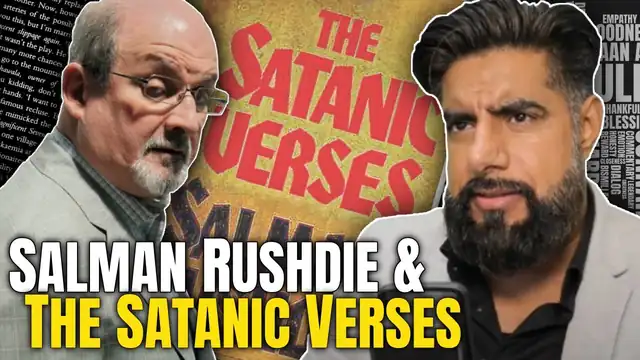 Play from 15:50
The video loads from YouTube only when you press play. Click a time in the transcript to seek.
Watch this part
Open on YouTube at 15:50The player starts at 15:50, the beginning of this part.
This segment15:50 to 25:03 · 9 min 13 sGeneral teaching
What this part covers
machinesummary, machine-writtenMufti Abu Layth suggests that Rushdie's hostility to Islam is rooted in an unresolved resentment of his father, who embraced his Muslim identity and moved to Pakistan.
In more detail
Mufti Abu Layth says the difficult relationship with his father shaped Rushdie's life: while Rushdie was studying in England in the 1960s, his father, who took pride in a rational Islam and admired Ibn Rushd, became more conscious of his Muslim identity and moved from Bombay to Karachi, a move Rushdie writes he never understood. Drawing on Freud's The Future of an Illusion, in which God is explained as the projection of a father figure, Mufti suggests that Rushdie's resentment of his father extended to the faith and is anchored in his childhood, contrasting him with atheists who are secure and calm about religion, whereas Rushdie, he says, shows spite towards Islam in all his interviews. He doubts Rushdie's claim to have resolved the matter with his father later in life, pointing to the character Saladin in The Satanic Verses, who finds a kind of reconciliation by shaving his father. He adds that Rushdie was the only son among three sisters and that a father who was a Cambridge lawyer turned businessman would have seen a history degree as a disappointment, and says this dynamic appears to have characterised Rushdie's whole life.
Position stated
Not yet double-checkedA summary of the view expressed is published here only after a second, independent review has found the sentence in the transcript where he says it. Until then, the transcript and the recording speak for themselves.
Kind: general teachingTranscript
machine15:50 to 25:03 · click a time to seek · dotted terms open the glossary
and does his degree in history see what's interesting is salman khan khan salman he has a very difficult relationship with his father he never got on with his dad and this is important because i feel it shaped the dynamic for his life
you see and part of the reason is that later while salman rushdie is here in the uk in boarding school when he reaches college in the 60s now his father who is very successful see his father was not i'm not aware that his father was an atheist as far as whatever i researched his father may have been critical of the mullah class and things and not liked the movies but he embraced his muslimness maybe he wasn't religious as in praying
and stuff but he embraced that he took pride in his own kind of rational islam this is why he loved ibn rush they named himself after ibn rush his father started to become more conscious of his muslim identity later in life because in the 60s whilst salman rushdie is in the uk studying his father moves from bombay to karachi in pakistan so he abandons india and moves to pakistan this always puzzled salman rusty he writes
later in life that i never like this was something he could never understand why his dad moved to pakistan like why now because partition was in 1947 why move in the 60s and it was because his father was becoming more conscious of a kind of and by muslim not to be confused with uh like a practicing islamic so it doesn't mean he became like a maulana but he started to realize that what is the status of a muslim in india now surrounded by
a majority hindu major populace so he moves this unsettled salman rashid quite a lot and he never got on with his dad and he had this bitter now it's interesting that you will see as freud explains that the authority of the father comes second to what the authority of god because god often in many of these faiths is almost portrayed as an authoritarian father figure
very clearly in christianity and although in islam we don't call allah the father but some people they present this the this not as a not as if they don't say father but this this this understanding of god that he is like a strict father almost as an as a kind of analogy that he loves his child but he will beat the child and it's interesting that in um freud's uh illusion of a future he
explains that he tries to explain it backwards in saying god is actually just the projection of the father figure onto the sky so that's how freud explains why people believe you know this whole understanding of god is people just having the image of a father and then projecting it onto the onto the heavens and that is then god so you see this this this this kind of strife this gulf this gap unsettling gap and very problematic
uh gulf between salman rusty and his dad and muslimness being an issue and his father moving to pakistan which was never salman rushdie never was happy with that when he goes back to india later in life he goes back to india he doesn't want to go back to pakistan he doesn't really want that and he never felt that this and he feels that this muslimy thing is ah just backwards and he hates his dad for it and by extension hates the faith now this is an important point in
understanding his mentality and why he always till today has this very strong being is bonnet so to speak and it's very constantly like uh has to make a point in hating on islam because it's a it's like a uh anchored in his childhood and it was something that he never truly resolved because you'll have atheists who find they don't believe in religion they may believe religion is a fast they may believe it's all stupid they may believe all these things about religion
but they're very secure in themselves they don't need to be making a song and don't need to on every event be bring it's sure to them people believe in religion maybe they think religion is dumb and stupid and nonsensical take it but they're very calm about it they have a serenity to them a calmness you'll find some atheists like that tell honesty now you can check almost i must have watched several of his interviews um you know my own
with a heavy heart i must say always disturbed he's very like he has this spitefulness towards islam as in all of his lectures in all of his sorry interviews and and he has that and you can see it in child in one of his interviews he claims that he resolved his issue with his dad in later life i think he may not have resolved it to the extent he liked to have resolved it if he resolved it at all i think this may just also be
a kind of wishful back projection uh that he kind of feels as in to bring some peace to himself claims he resolved it um i think the truth allahu allah speculation may be that this is he never actually resolved anything um and he then plays this back into his mind because you see the characters in his books with this issue even in the satanic verses uh the character saladin and we'll come to that and his issue with his father and although in the end he tries to find some reconciliation where his father is and i'll come to that
where he's he's kind of shaving his father for once and he's never had this comfort of even being able to touch his father's face and he's touching it time and time again as as the character saladin uh shaves his father and finds some kind of conciliatory peace in that and a truce but the truth is that are they or is it just what he's feeling and i think this is what's happened with salman rushdie he was the only boy in his family so he has three sisters so you can imagine from that age the
uh especially back then the image and men and they what they expect from their sons and he's only got one son and let's face it from his father being a a bright intellectual who understood philosophy and inspired by these great philosophers and ibn arush then a talented lawyer from cambridge who turns into a thriving businessman coming from this elite thing who has a son who's just doing history at cambridge what a disappointment absolutely disappointing so you can see
this dynamic between the father and son appears to have characterized salman rushdie's entire life so it's it's fascinating to to see that from a psychoanalysis perspective um and i thought i'd mention that the rest is i mean we know a lot about him look he he has written several books as salman rusty has and he had a prize for his midnight's children which is most of his books speak about things like partition between pakistan india the struggle because one of the things that you find
in salman rushdie's life is look as a child he always wanted to be this yet this inferiority complex for the gori the british raj the british the ingress he comes here and he's not truly one of them the brown kid you know he's the oh from india and he tries to he speaks well he's very very eloquent he's very articulate he tries to copy them he tries to do everything tries to shed his indian-ness almost but whilst he's shedding his indian nurse his dad leaves india to become a
Paragraphs overlapping 15:50 to 25:03. Full text on the recording page.
Cite this segment
Stable id, transcript version and tier are part of the citation. Every change to a transcript is logged.Mufti Abu Layth Archive, segment 2022-08-19-S04, auto-transcribed, may contain errors. https://muftiabulayth.org/r/t0phqrnjjby/s/4/ (accessed 1 November 2026)
- APA 7
Mufti Abu Layth. (2022, August 19). What made Salman Rushdie so hostile to Islam? [Video, segment 2022-08-19-S04, auto-transcribed, may contain errors]. Mufti Abu Layth Archive. Retrieved November 1, 2026, from https://muftiabulayth.org/r/t0phqrnjjby/s/4/
- Chicago author-date
Mufti Abu Layth. 2022. "What made Salman Rushdie so hostile to Islam?" Video, segment 2022-08-19-S04, auto-transcribed, may contain errors. Mufti Abu Layth Archive. Recorded August 19, 2022. Accessed November 1, 2026. https://muftiabulayth.org/r/t0phqrnjjby/s/4/
- BibTeX
@misc{abulayth-2022-08-19-S04,
  author = {Mufti Abu Layth},
  title = {{What made Salman Rushdie so hostile to Islam?}},
  year = {2022},
  month = {8},
  date = {2022-08-19},
  howpublished = {\url{https://muftiabulayth.org/r/t0phqrnjjby/s/4/}},
  url = {https://muftiabulayth.org/r/t0phqrnjjby/s/4/},
  organization = {Mufti Abu Layth Archive},
  urldate = {2026-11-01},
  note = {Segment 2022-08-19-S04, auto-transcribed, may contain errors}
}
Something wrong here?
Tell us what is wrong and it will be checked against the recording. Nothing changes until a person has reviewed it.
Sending a note needs JavaScript, which is off or unavailable in this browser. Nothing has been sent.
No name, email address or account is asked for or stored, and the inbox does not store your IP address. For rate limiting it keeps an unreadable fingerprint of your connection for 48 hours, and our database provider's own logs record connections as every website's do. Only your note, its kind, the page and the moment in the recording are kept, for review.