
Recordings › Salman Rushdie & The Satanic Verses | Mufti Abu Layth · 19 Aug 2022 › Segment 5 of 21
Identity, Midnight's Children, the fatwa and the years in hiding
fatwah fatawa fatwaa fataawa legal opinion muftis Most recent answer on Book Lounge and book reviews3 earlier answers on this topic, oldest 2020 ↓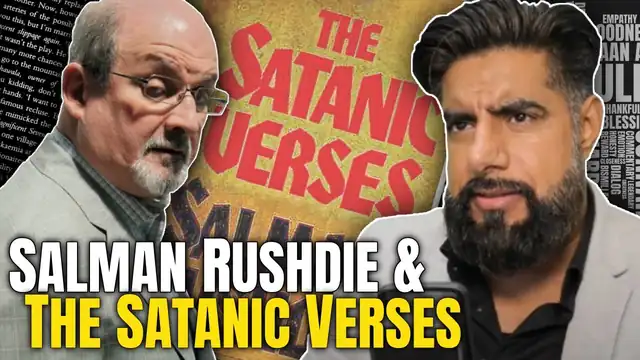 Play from 25:03
The video loads from YouTube only when you press play. Click a time in the transcript to seek.
Watch this part
Open on YouTube at 25:03The player starts at 25:03, the beginning of this part.
This segment25:03 to 27:41 · 2 min 38 sGeneral teaching
What this part covers
machinesummary, machine-writtenMufti Abu Layth says Rushdie's lack of a secure identity runs through his books, and recounts Midnight's Children, Khomeini's fatwa and the years in hiding before turning to The Satanic Verses.
In more detail
Mufti Abu Layth says that Rushdie, the brown boy who tried to shed his Indian-ness to be accepted by the British while his father became Pakistani, had no secure anchor of identity, Indian, Pakistani, Muslim or British, and that most of his books, The Satanic Verses included, put this struggle into their characters. He mentions that Midnight's Children, about partition and identity, was praised and won an award before The Satanic Verses, and that after the latter was published Rushdie went into hiding for about ten years under the alias Joseph Anton, following Ayatollah Khomeini's fatwa calling for his death, with a failed assassination attempt among other attacks. He begins to summarise The Satanic Verses, a novel of 546 pages, listing its main characters, Gibril Farishta, Saladin Chamcha, Pamela Lovelace, Rekha and Mahound, and says the last two are the point of concern.
Position stated
No position summary has been recorded for this segment.
Kind: general teachingTranscript
machine25:03 to 27:41 · click a time to seek · dotted terms open the glossary
in salman rushdie's life is look as a child he always wanted to be this yet this inferiority complex for the gori the british raj the british the ingress he comes here and he's not truly one of them the brown kid you know he's the oh from india and he tries to he speaks well he's very very eloquent he's very articulate he tries to copy them he tries to do everything tries to shed his indian-ness almost but whilst he's shedding his indian nurse his dad leaves india to become a
pakistani this child who then resents his father has no anchorage of secure identity is he an indian is he a pakistani is he a muslim is he british this deeply troubles him right throughout his life so most of his books are him putting this into characters having identity issues and struggling which is also one of the themes of his book the satanic verses so he does get his book midnight's
children has been praised by many people and it's he received that was before satanic verses and he had an award for it he did go into once he published the satanic verses went into hiding for 10 years and lived by the alias joseph anton and we know the fatwa of to la romani against him for his death and there had been several attacks uh there had been a a failed assassination attempt on his life but his his book satanic verses which is the center of our attention right now um
very briefly i won't take too much time the book what is it about okay so the book which has 546 pages and it has these key characters gibril farishta saladin jamcha pamela lovelace reika you got mohand the last two are the point of concern okay but the story to just to bring you guys up to speed rapidly it's a novel okay and the story is about these two key characters
one is called gibril farishta and the other is saladin champcha now salman rushdie sometimes he tried to play off that oh i wasn't even speaking about islam and i don't know why these people uh he clearly knew what he's doing in other more especially later interviews he acknowledges of course it's about islam i have the right to insult islam i have the right to he feels do these things so in several in fact there's several interviews of his on youtube where he's asked by non-muslims by indians
Paragraphs overlapping 25:03 to 27:41. Full text on the recording page.
Cite this segment
Stable id, transcript version and tier are part of the citation. Every change to a transcript is logged.Mufti Abu Layth Archive, segment 2022-08-19-S05, auto-transcribed, may contain errors. https://muftiabulayth.org/r/t0phqrnjjby/s/5/ (accessed 1 November 2026)
- APA 7
Mufti Abu Layth. (2022, August 19). Identity, Midnight's Children, the fatwa and the years in hiding [Video, segment 2022-08-19-S05, auto-transcribed, may contain errors]. Mufti Abu Layth Archive. Retrieved November 1, 2026, from https://muftiabulayth.org/r/t0phqrnjjby/s/5/
- Chicago author-date
Mufti Abu Layth. 2022. "Identity, Midnight's Children, the fatwa and the years in hiding." Video, segment 2022-08-19-S05, auto-transcribed, may contain errors. Mufti Abu Layth Archive. Recorded August 19, 2022. Accessed November 1, 2026. https://muftiabulayth.org/r/t0phqrnjjby/s/5/
- BibTeX
@misc{abulayth-2022-08-19-S05,
  author = {Mufti Abu Layth},
  title = {{Identity, Midnight's Children, the fatwa and the years in hiding}},
  year = {2022},
  month = {8},
  date = {2022-08-19},
  howpublished = {\url{https://muftiabulayth.org/r/t0phqrnjjby/s/5/}},
  url = {https://muftiabulayth.org/r/t0phqrnjjby/s/5/},
  organization = {Mufti Abu Layth Archive},
  urldate = {2026-11-01},
  note = {Segment 2022-08-19-S05, auto-transcribed, may contain errors}
}
Something wrong here?
Tell us what is wrong and it will be checked against the recording. Nothing changes until a person has reviewed it.
Sending a note needs JavaScript, which is off or unavailable in this browser. Nothing has been sent.
No name, email address or account is asked for or stored, and the inbox does not store your IP address. For rate limiting it keeps an unreadable fingerprint of your connection for 48 hours, and our database provider's own logs record connections as every website's do. Only your note, its kind, the page and the moment in the recording are kept, for review.