
Recordings › In Depth: The Sanaʽa Manuscript -Mufti Abu Layth · 1 Mar 2019 › Segment 9 of 11
How did Uthman standardise the Quran, and does that explain the Sana'a text?
hadeeth ahadith ahaadeeth hadis hadees ahaadith muftis koran quraan al-quran sahabi sahabiyyah sahabiyat 'alim aalimUthman's standardisation, the flexibility of the undotted script, and the two possible explanations
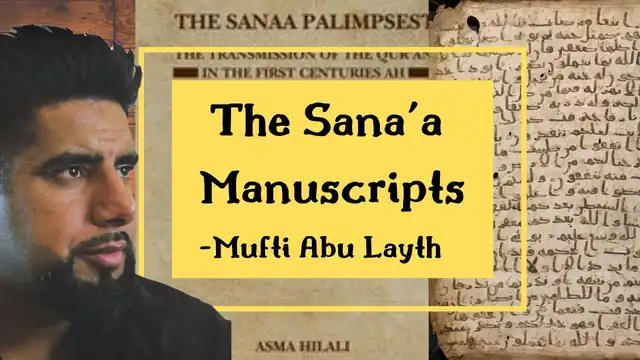 Play from 24:43
The video loads from YouTube only when you press play. Click a time in the transcript to seek.
Watch this part
Open on YouTube at 24:43The player starts at 24:43, the beginning of this part.
This segment24:43 to 28:39 · 3 min 56 sGeneral teaching
What this part covers
machinesummary, machine-writtenUthman locked in one reading in an undotted script that still allowed the known variant readings, so the lower text is either a person's mistaken note or, less likely, a reading not locked in at that time. Mufti Abu Layth prefers the first, as simple human error from memory.
In more detail
Mufti Abu Layth says that a few decades later Uthman, seeing that people had begun to misread the Quran, standardised and brought together the readings and wrote a particular script. That script was still flexible, because it lacked diacritical marks and most dots, so some words could be read in more than one way, for instance 'what they do' or 'what you do'; these variants are all part of the one Uthmanic reading, and the seven or ten ways of reading are within that one way, which a scholar [?] highlights in his book. He says it is no hidden knowledge that there were other readings from the Prophet's time that were not locked in, and that Uthman took the endeavour to lock in one reading so that people would not be confused. He therefore offers two explanations of the lower text: most likely it was someone's personal note of a reading he mistakenly thought correct, or possibly it was a way of reading those verses learned from the Prophet that was not the one locked in. He prefers the first, since a missing word looks like human error from people who had memorised, were on military campaigns and travelling, and did not sit with a library behind them; he adds that hadith record companions misreading verses, as everyone does, and that he himself would make many mistakes reciting from memory without revision.
- Some terms in this segment are uncertain
Position stated
Mufti Abu Layth says Uthman standardised a single reading whose undotted script still allowed the variant readings, and that the Sana'a lower text is either a mistaken personal reading, which he thinks more likely, or a reading from the Prophet's time that was not locked in.
“this under text of the manuscript was most likely somebody's personal note who thought that that reading was how it was and most likely I feel that he was mistaken”
Category: historical claim
Kind: general teachingTranscript
machine24:43 to 28:39 · click a time to seek · dotted terms open the glossary
been writing uh certain verses of the Quran for himself and this seems to be that and it seems to be his personal reading which I feel firstly that he may have been mistaken in or that may have been his way of what he thought was the Quran now that's most plausible okay that's most likely what has happened here and then maybe a few decades later uh what's happened is when they've started to realize because we know withman as
well we know that he said that people have started to misread the Quran so let's standardize and let's bring together the readings of the Quran and he wrote a particular script now his script is still flexible so because it never had the diacritical marking like the dots and it never had most the dots anyway so some words could be read in different ways so for example could be read as so because there wasn't the dot you could read it as or like that they are act what the actions
they do or the actions you do that it could be read like that and this is all part this ommani reading is all one reading of the Quran even with these variants okay it's not so we do accept that there were other readings that have then gone that they were in the time of the Prophet how they read certain things we have that in our tradition but we know that one main reading was um locked into for people to be transmitted andman he took that endeavor in saying let's lock it in so people don't get confused
and it's easy for people to read now even how he locked in and still had room to read in different variations now this is no hidden knowledge this is transparent knowledge Muslims have been saying these things for ages I mean it's written in all our books and it's very clear so the people say the seven ways to read or the 10 ways to read certain things they're all part of this one way so highlights that okay so just to he highlights that in his Mah by the way as well and in his other books so now this is just to be clear about this so this under text of the manuscript was most
likely somebody's personal note who thought that that reading was how it was and most likely I feel that he was mistaken uh why do I feel this this is most likely what I feel the plausible response the second response is that it may also be it may also be that he was not mistaken but this was a way to read the those verses of the Quran that he learned from the prophet it could be that this was a way that was then locked wasn't the one that was locked in it's possible but I actually feel it was more
option a uh it was the fact that he was most likely mistaken why do I say this and by the way in some of the in some of these discrepancies it may be the second thing it may be that some of the discrepancies were the the the kind of fluency of how to read but but the first um but some of them like when he missed out words I think that was just his mistake as in he thought that because remember language it was their language they were doing a lot of other things as well and and and it's quite it's human error so that's
fine and we have Hadith telling us that the sahaba Sometimes some sahabah did misread certain verses it's you know like we all misread verses today you know it's not it's nothing so huge and remember they were memorizing and they weren't just sitting down students of knowledge all day there were people that were in campaigns military campaigns fighting for here traveling the world they weren't people just sitting with a library behind them and saying well oh you know let me pull this out I mean I've memorized the Quran and if I've read the Quran today I from my memory I'll make tons and tons of mistakes you know I'll need to revise and revise and
Paragraphs overlapping 24:43 to 28:39. Full text on the recording page.
Cite this segment
Stable id, transcript version and tier are part of the citation. Every change to a transcript is logged.Mufti Abu Layth Archive, segment 2019-03-01-S09, auto-transcribed, may contain errors. https://muftiabulayth.org/r/k6faz7xw53y/s/9/ (accessed 1 November 2026)
- APA 7
Mufti Abu Layth. (2019, March 1). How did Uthman standardise the Quran, and does that explain the Sana'a text? [Video, segment 2019-03-01-S09, auto-transcribed, may contain errors]. Mufti Abu Layth Archive. Retrieved November 1, 2026, from https://muftiabulayth.org/r/k6faz7xw53y/s/9/
- Chicago author-date
Mufti Abu Layth. 2019. "How did Uthman standardise the Quran, and does that explain the Sana'a text?" Video, segment 2019-03-01-S09, auto-transcribed, may contain errors. Mufti Abu Layth Archive. Recorded March 1, 2019. Accessed November 1, 2026. https://muftiabulayth.org/r/k6faz7xw53y/s/9/
- BibTeX
@misc{abulayth-2019-03-01-S09,
  author = {Mufti Abu Layth},
  title = {{How did Uthman standardise the Quran, and does that explain the Sana'a text?}},
  year = {2019},
  month = {3},
  date = {2019-03-01},
  howpublished = {\url{https://muftiabulayth.org/r/k6faz7xw53y/s/9/}},
  url = {https://muftiabulayth.org/r/k6faz7xw53y/s/9/},
  organization = {Mufti Abu Layth Archive},
  urldate = {2026-11-01},
  note = {Segment 2019-03-01-S09, auto-transcribed, may contain errors}
}
Something wrong here?
Tell us what is wrong and it will be checked against the recording. Nothing changes until a person has reviewed it.
Sending a note needs JavaScript, which is off or unavailable in this browser. Nothing has been sent.
No name, email address or account is asked for or stored, and the inbox does not store your IP address. For rate limiting it keeps an unreadable fingerprint of your connection for 48 hours, and our database provider's own logs record connections as every website's do. Only your note, its kind, the page and the moment in the recording are kept, for review.