
Recordings › Sajdah Mark on Forehead | Mufti Abu Layth · 11 Oct 2019 › Segment 1 of 1
Is a prayer mark on the forehead a sign of piety in Islam?
salah salat salaah namaz salaat namaaz as-salah al-salah salawat tafseer exegesis tafasir tafaseer commentary sajdah sajda sujood muftis jahannam jahanam jahannum ayah aya ayat ayaat aayah aayat sahabah sahabi sahabiyyah sahabiyat as-salaf salaf al-salih salaf us-salih al-salaf early generations taqwa taqwaa muttaqi god-consciousnessWhy do some Muslims burn a prayer mark into their forehead?
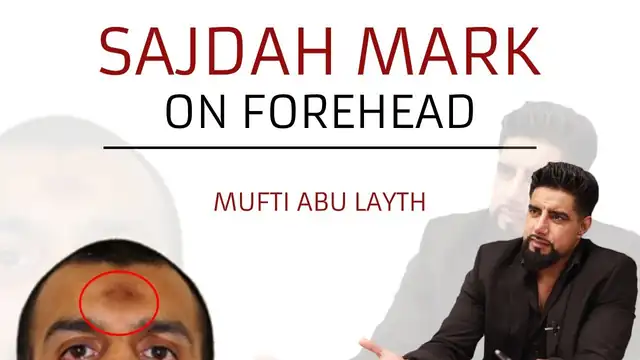 Play from 0:01
The video loads from YouTube only when you press play. Click a time in the transcript to seek.
Watch the answer
Open on YouTube at 0:01The player starts at 0:01, where the answer begins.
This segment0:01 to 4:10 · 4 min 09 sGeneral teaching
The answer in brief
machinesummary, machine-writtenA burn mark on the forehead from prostration has nothing to do with Islam and is not a sign of piety. The verse about the believers' mark on their faces refers to a glow of commitment, and an early report rebukes a man who bore such a mark.
In more detail
Mufti Abu Layth reads the question of why some Muslims rub or burn their forehead in prayer, and jokes about the marks some people carry. He explains that the marks come from rubbing the forehead across the ground in sujud, and says this has nothing to do with Islam: it is a misconception. He says al-Qurtubi discusses it in his tafsir under the verse that the believers' mark is on their faces, which he says meant a radiance, a glow and a visible sense of commitment, not a burnt forehead, though some people understood it as the latter and began doing it in the time of the salaf. He recounts a report, which he attributes tentatively to a figure whose name is unclear in the recording [?], in which a man who had met the companions saw someone with a mark he compared to a camel's knee and told him that he had reached eighty years of age and met many great people, none of whom had this on their forehead, asking whether foreheads had become heavier or the earth harsher. Mufti concludes that people should avoid burning their foreheads and that it is not a sign of piety.
Question as read aloud · questioner not identifiedWhy do some Muslims rub or burn their forehead in prayer?
- Some terms in this segment are uncertain
- Low audio confidence in the transcript
Position stated
Mufti Abu Layth says that a burn mark on the forehead from prostration has nothing to do with Islam and is not a sign of piety, and that the verse about the believers' mark on their faces refers to a radiance and visible commitment rather than a burnt forehead.
“now this is this is nothing to do with Islam okay this is ridiculous it's a misunderstanding it's a misconception”
Category: teaching
Kind: general teachingTranscript
machine0:01 to 4:10 · click a time to seek · dotted terms open the glossary
right now why do some Muslims rug why do some Muslims rug burn their forehead in prayer you know you see some people and they've got like a hole like a camouflage they've got like a hole I don't know like a special a SWAT team operation going on on their forehead and you're like what the hell has happened to your forehead did you not even sandpaper did you get one of those
grinding machines in just new right so now they so people get these kind of burn marks because when they do such that they will like let's say they'll instead of doing they'll go like they'll start over here and then the stop like rubbing across burning their forehead now this is this is nothing to do with Islam okay this is ridiculous it's a misunderstanding it's a misconception this is in fact let me tell you something you know the seller
people like a man ought to be they speak about this he brings this in his stuff seed under things like the verse was Seema whom fee would you him so Allah speaks about there will be people who believe in online is messenger and you will see in their faces see man that they they that they kind of sign is in their faces but what this meant was are like a kind of rate of radians a glow it meant a sense of commitment you will see the passion in their eyes this is what it meant so what some people understood
this to mean is oak it meant the the burnt forehead now so in the time of the seller they started to do this so if I'm hood to be brings a narration from some of the terrain right and some of the Sahaba so I some of this sold the seller and I believe there's a particular one I think it may have been at a berry so this is somebody who met the Companions he sees someone and they've got this big burnt-out mark over there so they used to refer to as a rocket bottle by the
the me cap of a camel so he says to him now what's this nikka camels knee cap doing lucky they never camel but this camel knee cap they said what's this camel knee cap doing on your forehead and right so the person said oh this is because of my such does my prostration so this guy says to him well ye I've
reached 80 years of age that this is the turban saying to him I've become 80 years old yeah like I've met many great people before you like as in you know from the Sahaba none of them had this in their foreheads he says and he say and he says to this person he says follow a dream a sock all at Emeril's I'm Russian until he says the Lord knows have the foreheads of the heads just got heavier or has the earth become harsher because those who went before you were so much
more powerful so much more you know so much more achieving in this theme and they never had anything like this so yeah so these things people avoid kind of burning your foreheads and it's not a sign of piety cool
Paragraphs overlapping 0:01 to 4:10. Full text on the recording page.
Cite this segment
Stable id, transcript version and tier are part of the citation. Every change to a transcript is logged.Mufti Abu Layth Archive, segment 2019-10-11-S01, auto-transcribed, may contain errors. https://muftiabulayth.org/r/7najzrtcnz0/s/1/ (accessed 1 November 2026)
- APA 7
Mufti Abu Layth. (2019, October 11). Is a prayer mark on the forehead a sign of piety in Islam? [Video, segment 2019-10-11-S01, auto-transcribed, may contain errors]. Mufti Abu Layth Archive. Retrieved November 1, 2026, from https://muftiabulayth.org/r/7najzrtcnz0/s/1/
- Chicago author-date
Mufti Abu Layth. 2019. "Is a prayer mark on the forehead a sign of piety in Islam?" Video, segment 2019-10-11-S01, auto-transcribed, may contain errors. Mufti Abu Layth Archive. Recorded October 11, 2019. Accessed November 1, 2026. https://muftiabulayth.org/r/7najzrtcnz0/s/1/
- BibTeX
@misc{abulayth-2019-10-11-S01,
  author = {Mufti Abu Layth},
  title = {{Is a prayer mark on the forehead a sign of piety in Islam?}},
  year = {2019},
  month = {10},
  date = {2019-10-11},
  howpublished = {\url{https://muftiabulayth.org/r/7najzrtcnz0/s/1/}},
  url = {https://muftiabulayth.org/r/7najzrtcnz0/s/1/},
  organization = {Mufti Abu Layth Archive},
  urldate = {2026-11-01},
  note = {Segment 2019-10-11-S01, auto-transcribed, may contain errors}
}
Something wrong here?
Tell us what is wrong and it will be checked against the recording. Nothing changes until a person has reviewed it.
Sending a note needs JavaScript, which is off or unavailable in this browser. Nothing has been sent.
No name, email address or account is asked for or stored, and the inbox does not store your IP address. For rate limiting it keeps an unreadable fingerprint of your connection for 48 hours, and our database provider's own logs record connections as every website's do. Only your note, its kind, the page and the moment in the recording are kept, for review.