
Recordings › Prof. Dr Khalil Andani | The Oral Text & the Ontology of The Quran | Mindtrap with Mufti #28 · 3 Jul 2020 › Segment 3 of 23
Did Muslims always see the Quran as God's word in the form of a book?
hadeeth ahadith ahaadeeth hadis hadees ahaadith tafseer exegesis tafasir tafaseer commentary muftis koran quraan al-quran qira'at qira'ah qiraa'aat qira'aat wahy wahi wahee ahl al-sunnah ahl as-sunnah ahlus sunnah ahl al-sunna sunnis shia shiah shiite twelver ithna ashari 'alim aalim ulama ulema ulamaaIs the Quran the word of God in the form of a book? The guest's thesis
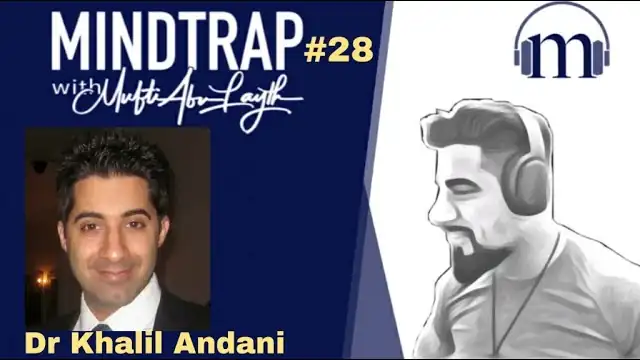 Play from 7:40
The video loads from YouTube only when you press play. Click a time in the transcript to seek.
Watch this part
Open on YouTube at 7:40The player starts at 7:40, the beginning of this part.
This segment6:48 to 12:59 · 6 min 11 sA view quoted in order to be discussed, not a position held
What this part covers
machinesummary, machine-writtenThe guest argues that the idea of the Quran as God's literal words in book form was not held by all Muslims historically, and that the Quran presents itself as a series of oral revelations manifesting a heavenly writing.
In more detail
Mufti Abu Layth introduces the debate over the nature of the Quran, whether it is static or dynamic and what the ahruf are, mentioning that Dr Shehzad [?] has given his perspective on the show and he himself has given his. The guest says his dissertation studied Muslim theories of what the Quran is and how it was revealed over about five hundred years, up to around 1200, across Sunni and Shi'i genres. He says the textbook claim that for all Muslims the Quran is the direct word of God in the form of a book contains two claims, that its Arabic words are literally God's and that its form is a written book, and that historically Muslims did not all think this way from the beginning; he stresses he is not making a theological judgement. Reading the Quran on its own terms without hadith or tafsir, he says it presents itself not as a closed book but as a historical series of oral revelations, each instance of which is 'Quran', claiming to manifest a transcendent heavenly writing.
- Some terms in this segment are uncertain
Position stated
This segment presents a view in order to discuss or respond to it. It is recorded as quoted, never as held, and no position is attributed from it.
Kind: a view quoted in order to be discussed, not a position held Speakers: host and guest; guest speech is labelled and excluded from positionsTranscript
machine6:48 to 12:59 · click a time to seek · dotted terms open the glossary
A guest speaks in this segment. Guest speech is labelled and is excluded from the positions layer.
This segment states a view in order to discuss it. It is recorded as a quoted view, not as a position held.
You need to fix up your sound. I need to fix up my sound. [laughter] It's like fix yourself, god dammit. Mufti, what's wrong with you? That's the story of my life, people. It's the story of my life. Uh is it is there all right now? I've refreshed it. Uh what's going on? Mi gente, let's see. Mufti Saab is saying uh I'm incorrect. Okay, thanks.
Uh guys, chill chill chill now. Chill chill chill. Shanti shanti. Right. So, those of you that are familiar with this whole discussion of the nature of the Quran. Uh it's caused quite a bit of confusion amongst a lot of people. What is the essence um and is it something that is in my definition of it is something static?
Is it dynamic? Is there um you know, what are these ahruf? What is the where has is there confusion and when has that confusion arisen? We've had quite a few different perspectives. We've had Dr. Shehzad on the show with his uh perspective. I've given my aspect. Now, Professor, you've uh this has been an area um of expertise for you.
I mean, it's something the nature of the Quran. And you have a particular theory on this, don't you? So, do share that with us. Oh, yeah. I'd be happy to. So, um my So, just for everyone knows, my thesis, my dissertation uh which it was supposed to be available publicly but I don't know what happened to it. Harvard maybe forgot to put it online.
But my my thesis is a study of different Muslim theories of what the Quran is and how the Quran was revealed from God to the world over a 500-year period. So, from the time of Prophet Muhammad as far as we can estimate what what people thought at that time uh all the way to about 1200.
So, that's what I've studied um and I haven't just studied it in according to one tradition but I've studied this according to multiple uh Sunni and Shi'i uh genres and traditions. So, what I've noticed is contrary to what we are told in textbooks. So, you know, a typical textbook on on intro to Islam and and many academics to this day uh repeat almost like a mantra that for all Muslims of all times and all places, the Quran is the direct word of Allah, the word of God
in the form of a book. This is what we often hear. Uh sometimes they use this expression according to Islam, the Quran is the word of God made into a book. And this has just become the popular narrative for many for many people um non-Muslim and Muslim on sort of what the Muslim what the Muslim view of the Quran is.
And there's two claims being made in that narrative. Like the first claim is that the words of the Quran in Arabic are literally and directly the words of God. That's one claim. And the second claim in this narrative is that the Quran, the form that the word of God has is essentially that of a physical book, a a something written.
And um this narrative I found during my study is simply not true. Uh it's not true historically. So, the earliest versions of Muslim leaders and scholars what part specifically are you saying you found not to be true? So, when I say they're not true, I don't mean they're not true in a in a in a theological sense. That's up to each person whether they think it's not not true.
I find that it's not true in a universal sense from a historical perspective in that it is not the case that Muslims all thought about the Quran this way at one point in time. And it's not the case that all Muslims have thought about the Quran this way since the very beginning. And and And what is just to narrow that for people who don't What is the thing that you're saying they didn't think of it like? Just to be very precise.
So, so if I were to summarize it, what I looked at in my work, again, this is over five centuries and I can't I I'm not going to say I read every Muslim text written in in those centuries about the issue, but I like any scholar, I looked at a sample of texts and authors from different uh traditions or what you could call truth projects. So, what I found is that if you focus on a particular genre of Muslim writing or thinking, um it may have a whole a very different idea of what the Quran is and how it is revealed from another genre.
And and to summarize very quickly, um in one perspective, we could call the Quranic perspective. In other words, if we try to read the Quran uh more or less literally on its own terms without using Hadith or Tafsir, so we just focus on the Quran and we try to understand the meaning of the Quran's claims about itself, as it would have been understood in the 7th century, which of course we're estimating, but we make an attempt.
What we will find is that there's a distinct Quranic view of what revelation is, Mhm. where the Quran and we can go into the details, but I'll just summarize it. In my estimation, the Quran presents itself not as a book, not as a closed physical composite document, but as a historical series of oral revelations.
Okay. the the term Quran here applies not to simply like the collection, but each instance of revelation that was delivered at a particular time. Each instance is Quran in that sense. And that these individual or you could say these serial Qurans, these recitations, they claim to be the manifestation of a transcendent or heavenly divine writing.
Paragraphs overlapping 6:48 to 12:59. Full text on the recording page.
Cite this segment
Stable id, transcript version and tier are part of the citation. Every change to a transcript is logged.Mufti Abu Layth Archive, segment 2020-07-03-S03, auto-transcribed, may contain errors. https://muftiabulayth.org/r/xznxiyp0b5s/s/3/ (accessed 1 November 2026)
- APA 7
Mufti Abu Layth. (2020, July 3). Did Muslims always see the Quran as God's word in the form of a book? [Video, segment 2020-07-03-S03, auto-transcribed, may contain errors]. Mufti Abu Layth Archive. Retrieved November 1, 2026, from https://muftiabulayth.org/r/xznxiyp0b5s/s/3/
- Chicago author-date
Mufti Abu Layth. 2020. "Did Muslims always see the Quran as God's word in the form of a book?" Video, segment 2020-07-03-S03, auto-transcribed, may contain errors. Mufti Abu Layth Archive. Recorded July 3, 2020. Accessed November 1, 2026. https://muftiabulayth.org/r/xznxiyp0b5s/s/3/
- BibTeX
@misc{abulayth-2020-07-03-S03,
  author = {Mufti Abu Layth},
  title = {{Did Muslims always see the Quran as God's word in the form of a book?}},
  year = {2020},
  month = {7},
  date = {2020-07-03},
  howpublished = {\url{https://muftiabulayth.org/r/xznxiyp0b5s/s/3/}},
  url = {https://muftiabulayth.org/r/xznxiyp0b5s/s/3/},
  organization = {Mufti Abu Layth Archive},
  urldate = {2026-11-01},
  note = {Segment 2020-07-03-S03, auto-transcribed, may contain errors}
}
Something wrong here?
Tell us what is wrong and it will be checked against the recording. Nothing changes until a person has reviewed it.
Sending a note needs JavaScript, which is off or unavailable in this browser. Nothing has been sent.
No name, email address or account is asked for or stored, and the inbox does not store your IP address. For rate limiting it keeps an unreadable fingerprint of your connection for 48 hours, and our database provider's own logs record connections as every website's do. Only your note, its kind, the page and the moment in the recording are kept, for review.