
Recordings › Prof. Dr Khalil Andani | The Oral Text & the Ontology of The Quran | Mindtrap with Mufti #28 · 3 Jul 2020 › Segment 2 of 23
Who is Dr Khalil Andani and how did he come to study Islam academically?
aqidah aqeedah aqida creed aqeeda aqaid muftis riba ribaa sood usury iman imaan eemaan eeman kalam ilm al-kalam kalaam koran quraan al-quran deen al-din ad-deen ad-dinThe guest's journey: from accountancy to a Harvard PhD in Islamic studies
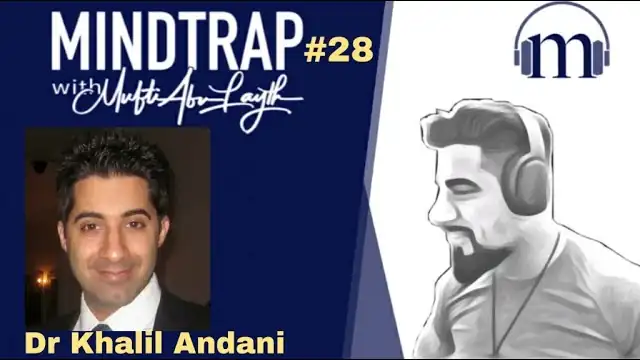 Play from 3:01
The video loads from YouTube only when you press play. Click a time in the transcript to seek.
Watch this part
Open on YouTube at 3:01The player starts at 3:01, the beginning of this part.
This segment3:01 to 6:48 · 3 min 47 sA view quoted in order to be discussed, not a position held
What this part covers
machinesummary, machine-writtenThe guest describes leaving a career in accountancy to study Islamic studies at Harvard, where he finished a PhD and now teaches religion at a US college.
In more detail
Asked about his journey, the guest says he was born and raised in Canada and became interested in high school in the historical, academic study of Islam, reading published books on Islamic political thought, theology, metaphysics and mysticism for fun. He trained as an accountant and CPA, then about twelve or thirteen years ago left his financial career to do a master's and then a PhD in Islamic studies at Harvard, finishing at the end of the previous year. He now teaches religion, Islamic studies and Christian-Muslim interfaith studies at a liberal arts college in the US, and mentions the challenge of learning classical Arabic and Persian coming from a maths background. The segment ends with a sound check prompted by viewers' comments.
Position stated
This segment presents a view in order to discuss or respond to it. It is recorded as quoted, never as held, and no position is attributed from it.
Kind: a view quoted in order to be discussed, not a position held Speakers: host and guest; guest speech is labelled and excluded from positionsTranscript
machine3:01 to 6:48 · click a time to seek · dotted terms open the glossary
A guest speaks in this segment. Guest speech is labelled and is excluded from the positions layer.
This segment states a view in order to discuss it. It is recorded as a quoted view, not as a position held.
But the holiday is today so. Nice. So. Those of you that are not familiar uh with Professor Khaleel uh Professor from Canada but currently teaching as a professor in the United States. His background and expertise is in Islamic theology, Islamic studies, history, the diverse kind of denominational kind of developments throughout Islam as well.
Professor, in your words, tell us a bit about your journey uh to this whole this this wealth of uh of knowledge. Sure. So, uh as you said, I'm from Canada uh you know, born and raised. And uh I would say uh when I was in high school and that's about 20 years ago now uh I became really interested in in uh learning more about Islam and religion but from a more historical academic point of view uh like many Muslims, you know, I was raised with uh you know, probably the the more sort
of common somewhat mythical notions of religion and faith and things like that. So, I was always curious to sort of see well, what's what's the story behind the story. Uh so, from from high school, I would be picking up you know, buying academic published books on the history of Islamic political thought and theology and things like this um metaphysics, mysticism and I would just read these things for fun.
And like a good uh South Asian boy at that time uh I went into accounting and finance. So, I'm actually a uh CPA uh by training. At least that was my first education. Um but I I always kept up this this reading interest. So, you could say I was like this sort of self-read amateur um you know, reader of uh academic Islamic studies.
Uh but I I fell so much in love with the subject uh and these sort of ideas that I was learning about that I made the decision about 12, 13 years ago to leave my financial career and uh go do a master's degree in Islamic studies, which I had I was dreaming of doing that and I finally just took the plunge and I left a well-paying job to do this.
And um I did that and I followed that up with the a PhD. Uh so, these this was all done at at Harvard. And 8 years, 9 years later um I have a PhD now. So, I finished at the end of last year and now I'm a assistant professor of religion. So, I basically I teach courses on religion, uh Islamic studies a little bit as well uh and interfaith Christian-Muslim interfaith studies uh at a uh college or liberal arts college in the US.
So, that's sort of like the quick story. Uh of course, there was a lot of work uh in between. Uh it's a big shift especially starting when you come from a math background like me, uh it's interesting to start learning classical Arabic and classical Persian. It's it's a different game uh in a sense. But yeah, that's that's my journey in a nutshell. Uh and and you shouldn't try it at home.
[laughter] You know, uh just just to double-check with some of our viewers that I I saw some comments about sound saying there's sound issues. I'm just doing a quick sound check. Uh guys, is the sound I did refresh the mic right now so when I saw that comment. So, let me just check the YouTube mi gente as well. You need to fix up the guest Mufti Saab.
You need to fix up your sound. I need to fix up my sound. [laughter] It's like fix yourself, god dammit. Mufti, what's wrong with you? That's the story of my life, people. It's the story of my life. Uh is it is there all right now? I've refreshed it. Uh what's going on? Mi gente, let's see. Mufti Saab is saying uh I'm incorrect. Okay, thanks.
Uh guys, chill chill chill now. Chill chill chill. Shanti shanti. Right. So, those of you that are familiar with this whole discussion of the nature of the Quran. Uh it's caused quite a bit of confusion amongst a lot of people. What is the essence um and is it something that is in my definition of it is something static?
Paragraphs overlapping 3:01 to 6:48. Full text on the recording page.
Cite this segment
Stable id, transcript version and tier are part of the citation. Every change to a transcript is logged.Mufti Abu Layth Archive, segment 2020-07-03-S02, auto-transcribed, may contain errors. https://muftiabulayth.org/r/xznxiyp0b5s/s/2/ (accessed 1 November 2026)
- APA 7
Mufti Abu Layth. (2020, July 3). Who is Dr Khalil Andani and how did he come to study Islam academically? [Video, segment 2020-07-03-S02, auto-transcribed, may contain errors]. Mufti Abu Layth Archive. Retrieved November 1, 2026, from https://muftiabulayth.org/r/xznxiyp0b5s/s/2/
- Chicago author-date
Mufti Abu Layth. 2020. "Who is Dr Khalil Andani and how did he come to study Islam academically?" Video, segment 2020-07-03-S02, auto-transcribed, may contain errors. Mufti Abu Layth Archive. Recorded July 3, 2020. Accessed November 1, 2026. https://muftiabulayth.org/r/xznxiyp0b5s/s/2/
- BibTeX
@misc{abulayth-2020-07-03-S02,
  author = {Mufti Abu Layth},
  title = {{Who is Dr Khalil Andani and how did he come to study Islam academically?}},
  year = {2020},
  month = {7},
  date = {2020-07-03},
  howpublished = {\url{https://muftiabulayth.org/r/xznxiyp0b5s/s/2/}},
  url = {https://muftiabulayth.org/r/xznxiyp0b5s/s/2/},
  organization = {Mufti Abu Layth Archive},
  urldate = {2026-11-01},
  note = {Segment 2020-07-03-S02, auto-transcribed, may contain errors}
}
Something wrong here?
Tell us what is wrong and it will be checked against the recording. Nothing changes until a person has reviewed it.
Sending a note needs JavaScript, which is off or unavailable in this browser. Nothing has been sent.
No name, email address or account is asked for or stored, and the inbox does not store your IP address. For rate limiting it keeps an unreadable fingerprint of your connection for 48 hours, and our database provider's own logs record connections as every website's do. Only your note, its kind, the page and the moment in the recording are kept, for review.