
Recordings › Prof. Dr Khalil Andani | The Oral Text & the Ontology of The Quran | Mindtrap with Mufti #28 · 3 Jul 2020 › Segment 4 of 23
What difference does it make that the Quran was first oral and only later written down?
salah salat salaah namaz salaat namaaz as-salah al-salah salawat tafsir tafseer exegesis tafasir tafaseer combining prayers jam' al-salah jam bayn al-salatayn jam' al-salatayn qiyas qiyaas muftis koran quraan al-quran ayah aya ayat ayaat aayah aayat qira'at qira'ah qiraa'aat qira'aat tilawah tilawat tilaawah wahi wahee shia shiah shi'i twelver ithna ashari ummah umma ummatOral revelation versus the written Mushaf: Google Maps and a printed map
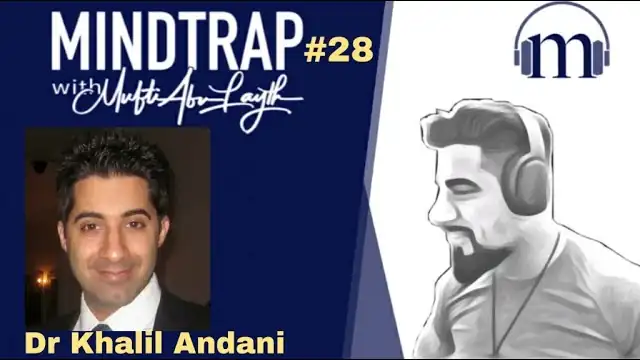 Play from 13:26
The video loads from YouTube only when you press play. Click a time in the transcript to seek.
Watch this part
Open on YouTube at 13:26The player starts at 13:26, the beginning of this part.
This segment12:59 to 19:58 · 6 min 59 sA view quoted in order to be discussed, not a position held
What this part covers
machinesummary, machine-writtenThe guest argues that the Mushaf is a secondary product that loses the context and immediacy of the oral revelation, like a printed map compared with live navigation.
In more detail
Mufti Abu Layth asks what difference it makes whether the Quran is oral or written down. The guest says the oral Quran, delivered over twenty years, behaved not like a book but as real-time guidance, commentary and apologetics suited to changing situations, and that compiling the written material later, partly jumbled and without the context, created a new phenomenon in the Mushaf. He compares the oral Quran to driving with Google Maps rerouting you and the Mushaf to a static printed map; Mufti suggests it is like going from three dimensions to two, which the guest accepts, adding that ritual recitation in prayer partly relives the original. Mufti asks whether this was not inevitable once the Prophet died, and the guest says he personally does not think the compilation into a single Mushaf had to happen and calls it a contingent historical moment.
Position stated
This segment presents a view in order to discuss or respond to it. It is recorded as quoted, never as held, and no position is attributed from it.
Kind: a view quoted in order to be discussed, not a position held Speakers: host and guest; guest speech is labelled and excluded from positionsTranscript
machine12:59 to 19:58 · click a time to seek · dotted terms open the glossary
A guest speaks in this segment. Guest speech is labelled and is excluded from the positions layer.
This segment states a view in order to discuss it. It is recorded as a quoted view, not as a position held.
Okay. the the term Quran here applies not to simply like the collection, but each instance of revelation that was delivered at a particular time. Each instance is Quran in that sense. And that these individual or you could say these serial Qurans, these recitations, they claim to be the manifestation of a transcendent or heavenly divine writing.
You know short. That's the Quranic idea of revelation, what I believe it to be. Do you I mean, how much of a distinction do you see between the oral Quran and the written Quran? I mean, to many people who are listening, they will think, "Sure, the Quran was revealed verbally, like as in the prophet spoke it." Um what difference does it make if it's written down on a book?
Like I mean, how how does the how is there a phenomenological or an ontological uh difference? So, the first difference is a phenomenological difference, which means there's a difference in how the Quran behaves as a oral piecemeal revelation and as it behaves as a book that's been put together and that people are now reading. Big difference.
Um one big difference is when we can tell from the Quran itself, even though it's in book form, you can almost deconstruct and work backwards to find out what it would have been like in the oral form. So, the first difference is the oral revelatory Quran, that is during the 20 years of the Prophet Muhammad's mission, uh it doesn't behave like a book.
In other words, what's happening is that the prophet is reciting oral Quranic guidance suited to the time and situation that he finds himself in and that the community is in. And it it what would take what tends to happen is that the delivery of these recitations is quite ad hoc. And we know this because often the Quran is commenting or answering questions or answering objections that are put against the prophet in real time.
So, the Quran is offering what you would call real-time guidance, real-time commentary, real-time apologetics right in the very moment. And then what we find is that when the ground situation changes, a new set of recitations come often with guidance that is very different from the prior guidance. You know, so so the Quran itself is an evolving phenomenon as it's being revealed.
Uh and it doesn't have this sort of fixity in terms of what's been commanded at one time versus another time. But now think about this. This was This happened over 20 years, right? And it happened in particular situations. So, different Qurans address different situations at that time. If you then recorded all of this, wrote it down in many separate materials, and then 20 years after the fact, you put the written material together, but you jumble it up a little bit, and you don't know the ground situation, this thing you've created, this um this
text you've created is a new phenomenon. Because when I pick up the Mushaf, as they call it, I don't have the same experience of the Quran when I'm encountering the Mushaf than I would have had had I been encountering the Quran live. The best analogy in my view to talk about this is that the oral the oral revelatory Quran is sort of like the experience of driving in your car with Google Maps guiding you.
Mhm. And you know, Google Maps reroutes you, it like changes if there's a traffic jam. It's like totally updated guidance and it just continuous. Whereas um if I if I didn't have Google Maps and I didn't have my data plan, I would have to print out like a map from on my printer. And and this printed map is static and it doesn't evolve. And every time I drive, I might be in the wrong direction and I have to keep interpreting my fixed map You're You're kind of saying it's almost like a 2D to 3D kind of uh a difference that you that while the Quran the revelatory process
is taking place, those who are uh in that atmosphere where wahy or revelation is being received, to them it's a three-dimensional experience, a phenomenon. To us, it's something that's being told that oh well, this was said. Is this Are we along the same kind of Is this what we Is this what's being said? What you're saying? Yeah, I think I think more or less. I think 3D to 2D is a good It's a good analogy.
Basically, there's a downsizing that happens cuz you're losing the context, but you're also losing the charisma of the original moment. Now, I would admit that the way the Quran is used ritually among Muslim communities, notice how it's recited in prayer. It's not read in prayer, for example. I think that is somewhat reliving the the original revelation partially, but that seems to be an attempt to sort of experience it as it happened.
But generally speaking, the Mushaf, the written form of the Quran, we have to see it as a secondary product. It's not the original revelatory product. It's a change. It's been It's been changed, not necessarily in content, but it's been altered in its form to constitute a a new a a novel a novel occurrence. And and that's just something we have to you see, it would be just just to to grasp this from the viewers or from people's perspective, anything beyond its lifetime, so beyond
the prophet's lifetime, the Quran could only be just told anyway. It couldn't be kind of lived beyond the prophet's lifetime. So, is this not an inevitable and for the for the most part an utter inevitability? It It could be. I mean, it really depends. I don't I personally don't think the compilation of the Quran and the different surahs and verses into a single Mushaf where everything is more or less scrambled to some degree.
I don't think that was that had to happen. I think it's a purely contingent historical moment that led to that. I mean, the fact that like let's say the phenomenological experience. Like we are here now and something happens and a verse is revealed and the prophet he teaches, he says, "Look, you know, ya ayyuhannas, oh people, do do this, do this." That could only happen during the prophet's lifetime. I mean, once the prophet isn't there, there isn't going to be any more wahy.
And so, that phenomenological experience, if it was so core, I mean, I'm not saying it it unquestionably is of paramount importance. But what I'm trying to say is if that was at the forefront of what the Quran is meant to be, then it only had a very short time span because it couldn't because that could only be when the prophet was there.
It I you know, it's a very good question. It's a very good question. Now, the answer to that question really depends on one's persuasion because one may argue that for a certain for certain Shiite Muslims, the phenomenon of Revelation did not come to an end. In the sense that some portion of the divine inspiration that manifested as the Quran, some portion of that some mode of that continues through the Shiite Imamate.
Paragraphs overlapping 12:59 to 19:58. Full text on the recording page.
Cite this segment
Stable id, transcript version and tier are part of the citation. Every change to a transcript is logged.Mufti Abu Layth Archive, segment 2020-07-03-S04, auto-transcribed, may contain errors. https://muftiabulayth.org/r/xznxiyp0b5s/s/4/ (accessed 1 November 2026)
- APA 7
Mufti Abu Layth. (2020, July 3). What difference does it make that the Quran was first oral and only later written down? [Video, segment 2020-07-03-S04, auto-transcribed, may contain errors]. Mufti Abu Layth Archive. Retrieved November 1, 2026, from https://muftiabulayth.org/r/xznxiyp0b5s/s/4/
- Chicago author-date
Mufti Abu Layth. 2020. "What difference does it make that the Quran was first oral and only later written down?" Video, segment 2020-07-03-S04, auto-transcribed, may contain errors. Mufti Abu Layth Archive. Recorded July 3, 2020. Accessed November 1, 2026. https://muftiabulayth.org/r/xznxiyp0b5s/s/4/
- BibTeX
@misc{abulayth-2020-07-03-S04,
  author = {Mufti Abu Layth},
  title = {{What difference does it make that the Quran was first oral and only later written down?}},
  year = {2020},
  month = {7},
  date = {2020-07-03},
  howpublished = {\url{https://muftiabulayth.org/r/xznxiyp0b5s/s/4/}},
  url = {https://muftiabulayth.org/r/xznxiyp0b5s/s/4/},
  organization = {Mufti Abu Layth Archive},
  urldate = {2026-11-01},
  note = {Segment 2020-07-03-S04, auto-transcribed, may contain errors}
}
Something wrong here?
Tell us what is wrong and it will be checked against the recording. Nothing changes until a person has reviewed it.
Sending a note needs JavaScript, which is off or unavailable in this browser. Nothing has been sent.
No name, email address or account is asked for or stored, and the inbox does not store your IP address. For rate limiting it keeps an unreadable fingerprint of your connection for 48 hours, and our database provider's own logs record connections as every website's do. Only your note, its kind, the page and the moment in the recording are kept, for review.