
Recordings › Shaykh Dr. Shabir Ally | Juxtaposing the Quran, Jumbling Aisha's age & Jinn Possession | MindTrap#16 · 22 Apr 2020 › Segment 2 of 23
Have Muslims moved towards giving the Quran primacy over hadith?
hadeeth ahadith ahaadeeth hadis hadees ahaadith al-bukhari imam bukhari sahih al-bukhari sahih bukhari saheeh al-bukhari saheeh bukhari imam al-bukhari muftis hukm ahkam hukum hukam ahkaam sunna sunnat sunan prophetic practice iman imaan eemaan eeman koran quraan al-quran ulama ulema ulamaa umma ummat communityRecap of the guest's journey and whether Muslims have moved towards the primacy of the Quran
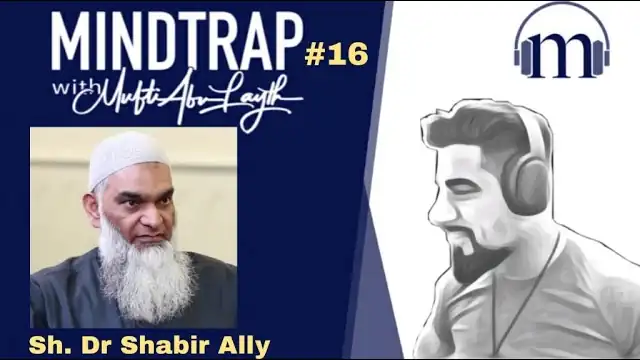 Play from 3:44
The video loads from YouTube only when you press play. Click a time in the transcript to seek.
Watch this part
Open on YouTube at 3:44The player starts at 3:44, the beginning of this part.
This segment2:24 to 6:20 · 3 min 56 sA view quoted in order to be discussed, not a position held
What this part covers
machinesummary, machine-writtenThe guest says the ummah has split: a traditional strand that in practice lets hadith override the Quran, and a growing body of thinking lay Muslims who already see the Quran as primary. Some scholars agree but are trapped in traditional discourse or silenced by dangerous circumstances.
In more detail
Mufti Abu Layth recaps the previous week's discussion of the guest's journey: reconnecting with the faith, university and further studies, and arriving at the view that the Quran must have a central place in Muslim discourse in practice and not only in theory. He asks whether, from where the guest began to today, the general Muslim sentiment has moved along with him. After clarifying the question, the guest says it has moved to some extent, but that there is a great dichotomy, even a splintering, in the ummah. One strand, scholars and lay people alike, remains traditional, will not listen to anything new, and in practice lets the Sunnah, meaning the hadith, trump the Quran when a ruling is sought, though nobody would admit it in those words. On the other hand many lay Muslims, including those on internet forums, are thinking people who have the textbooks open before them, find problematic narratives in Bukhari and Muslim, realise a rethinking is needed, and are waiting for someone to confirm what they already know: that the Quran is primary and everything else is secondary explanation. He adds that some scholars have reached a similar understanding but are trapped in traditional spheres of discourse, and that some live in dangerous circumstances where voicing a contrary opinion could bring harm to them and their families, so they do not speak as clearly as one would expect.
Position stated
This segment presents a view in order to discuss or respond to it. It is recorded as quoted, never as held, and no position is attributed from it.
Kind: a view quoted in order to be discussed, not a position held Speakers: host and guest; guest speech is labelled and excluded from positionsTranscript
machine2:24 to 6:20 · click a time to seek · dotted terms open the glossary
A guest speaks in this segment. Guest speech is labelled and is excluded from the positions layer.
This segment states a view in order to discuss it. It is recorded as a quoted view, not as a position held.
something we've got an incredible long awaited discussion full of insights for you guys tonight so just sharing this out so chef all right so I bring this up right we were in the in the middle of a discussion last week we spoken a bit about your journey how you'd kind of reconnected with the faith and you'd gone on to study at university you'd gone on pursued further studies and then even
your kind of exploration throughout that time and and then arriving at this understanding of saying the Quran really needs a I mean everybody says in theory it has a central place but in practice it needs to have a central place within the Muslim discourse sure would you feel that from where you began where you set off kind of reconnecting with the faith to where we are today things have changed things around you the general of the general kind of
sentiments of the Muslim mindset I'm not sure if I understand your question shift so you're asking about the position that I've arrived at thinking that the Quran has a primacy and you're wondering if that is different from what Muslims generally perceive the case to be sure I meant more so I mean that that could be by extension I meant more so from where you began do you feel people today have kind of moved along with you as well as as a as a massive moving as a whole or
people still is the general Muslim sentiment still maybe where it was to some extent it's moved however things I think yeah there is a great dichotomy within the the Muslim Ummah it's more than the economy there is a splintering of the Muslim Ummah and there is one strand that remains very traditional both in terms of the scholarship and the lay people so they follow a traditional bent they will not listen to anything new and it will carry on as they are to them the Quran and the Sunnah go
together the son sometimes Trump's the Quran if you want to find a ruling we may find it in the hadith and that can be more important than what we find in the Quran itself of course people wouldn't admit to say it in this way but yeah but that's what it happened what that's what it amounts to in essence but but but some will continue with that traditional bent now on the other hand there are a lot of lay persons a lot of Muslims many who will join us on internet forums who are thinking people they are examining there they have all
of the textbooks open before them they can check for fari and Muslim and so on they come across narratives that they find problematic and they realize that it has to be a rethinking about how how all of this is packaged together so there are many of the average Muslims out there who are waiting for somebody to confirm what they already know that the Quran is primary everything else is secondary and comes by way of explanation now there are some Muslim scholars as well who have begun to arrive at a similar understanding but many of them are caught up with in
traditional spheres of discourse and they find themselves in a way trapped in those spheres of discourse so they cannot voice a contrary opinion of course some scholars live in dangerous circumstances so if they've voiced an opinion which is different from what the traditional populace in those circumstances think to be non-negotiables then then they might suffer harm to themselves and maybe to their families and so on so if they tend to not speak as clearly
Paragraphs overlapping 2:24 to 6:20. Full text on the recording page.
Cite this segment
Stable id, transcript version and tier are part of the citation. Every change to a transcript is logged.Mufti Abu Layth Archive, segment 2020-04-22-S02, auto-transcribed, may contain errors. https://muftiabulayth.org/r/ksqksrxndnw/s/2/ (accessed 1 November 2026)
- APA 7
Mufti Abu Layth. (2020, April 22). Have Muslims moved towards giving the Quran primacy over hadith? [Video, segment 2020-04-22-S02, auto-transcribed, may contain errors]. Mufti Abu Layth Archive. Retrieved November 1, 2026, from https://muftiabulayth.org/r/ksqksrxndnw/s/2/
- Chicago author-date
Mufti Abu Layth. 2020. "Have Muslims moved towards giving the Quran primacy over hadith?" Video, segment 2020-04-22-S02, auto-transcribed, may contain errors. Mufti Abu Layth Archive. Recorded April 22, 2020. Accessed November 1, 2026. https://muftiabulayth.org/r/ksqksrxndnw/s/2/
- BibTeX
@misc{abulayth-2020-04-22-S02,
  author = {Mufti Abu Layth},
  title = {{Have Muslims moved towards giving the Quran primacy over hadith?}},
  year = {2020},
  month = {4},
  date = {2020-04-22},
  howpublished = {\url{https://muftiabulayth.org/r/ksqksrxndnw/s/2/}},
  url = {https://muftiabulayth.org/r/ksqksrxndnw/s/2/},
  organization = {Mufti Abu Layth Archive},
  urldate = {2026-11-01},
  note = {Segment 2020-04-22-S02, auto-transcribed, may contain errors}
}
Something wrong here?
Tell us what is wrong and it will be checked against the recording. Nothing changes until a person has reviewed it.
Sending a note needs JavaScript, which is off or unavailable in this browser. Nothing has been sent.
No name, email address or account is asked for or stored, and the inbox does not store your IP address. For rate limiting it keeps an unreadable fingerprint of your connection for 48 hours, and our database provider's own logs record connections as every website's do. Only your note, its kind, the page and the moment in the recording are kept, for review.