
Recordings › Should Muslims Establish Khilafah - Shaykh Akram Nadwi & Mufti Abu Layth · 9 Sep 2017 › Segment 2 of 4
Did the Prophet migrate to Madinah to set up a state, and when did the khilafah end?
hadeeth ahadith ahaadeeth hadis hadees ahaadith shafi shafei shafiite shafi'i school hukm ahkam hukum hukam ahkaam koran quraan al-quran hijra hijrat hijri khalifa caliph khilafat caliphate khilafa khulafa ar-rashidun rightly guided caliphs rashideen khulafa-e-rashideen mecca makka mekka medina madina al-madinah madeenah yathribThe hijrah was not to found a state; the khilafah rashidah ended with Ali and the promise was for the first generation
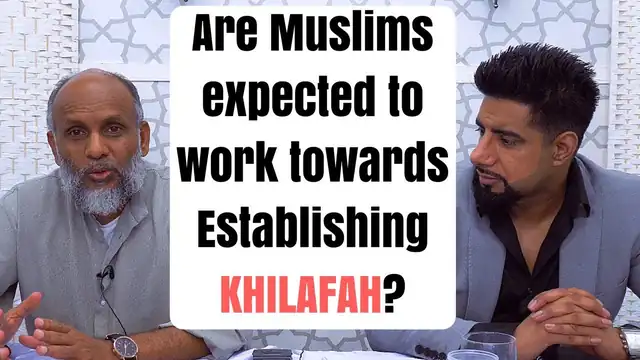 Play from 2:10
The video loads from YouTube only when you press play. Click a time in the transcript to seek.
Watch this part
Open on YouTube at 2:10The player starts at 2:10, the beginning of this part.
This segment2:10 to 5:11 · 3 min 01 sA view quoted in order to be discussed, not a position held
What this part covers
machinesummary, machine-writtenThe guest says the Prophet left Makkah because he was forced out, not to found a state, and the khilafah rashidah ended with Ali, after which Umayyads and Abbasids were kings in all but name. The Quranic promise of khilafah was for the first generation only, and the 1924 abolition ended a powerless kingship, not a khilafah.
In more detail
The guest says the understanding that believers have a duty to establish the khilafah is not right: when people gain power their duty is to run it by Allah's command, but obtaining power was never the command. Saying the Prophet moved to Madinah to establish a state is a big misunderstanding: the hadith says he did not like leaving, was forced out by the people, and turned to Makkah saying that had its people not forced him he would never have left; in Makkah he established no khilafah, implemented no Islamic law and was a minority. The state emerged by Allah's plan without the Prophet having a plan, and once he had power he told people to follow Allah's command. He says that those who speak of khilafah do not understand it: the khilafah rashidah, ruling by the command of Allah and His Messenger, lasted only until Ali ibn Abi Talib; after that came kingship, Mu'awiya and his dynasty, Marwan ibn al-Hakam and his, then the Abbasids, who called themselves khalifah but were kings, and Abu Hanifa, Malik and al-Shafi'i lived under them without ever trying to establish a khilafah, though some argue the time of Umar ibn Abd al-Aziz was similar. The Quran's promise 'He will make them khalifah' [?] was, he says, only for the Khulafa al-Rashidun, the first Muhajirun and Ansar; since then there has been no promise and no khilafah, only the potential for kingship, and what was abolished in 1924 was a powerless man named khalifah, not a khilafah. The khilafah Muslims love is the khilafah rashidah.
- Some terms in this segment are uncertain
Position stated
This segment presents a view in order to discuss or respond to it. It is recorded as quoted, never as held, and no position is attributed from it.
Kind: a view quoted in order to be discussed, not a position held Speakers: host and guest; guest speech is labelled and excluded from positionsTranscript
machine2:10 to 5:11 · click a time to seek · dotted terms open the glossary
A guest speaks in this segment. Guest speech is labelled and is excluded from the positions layer.
This segment states a view in order to discuss it. It is recorded as a quoted view, not as a position held.
Actually the Qur'an makes all of these four people as examples for the Believers. And the Qur'an says {Arabic}. "Follow their guidance". And the same for Ibrahaim (as). This understanding that the Believers have a duty to establish the Khilafah, this is not right. When people get the power, then their duty is they should be running according to Allah's Command. That is the command. But it is not the command that you must get it (state power). This never has been the command. Even when people say that the Prophet (saw) moved to Madinah Munawwarah to establish a state, this is a big misunderstanding. Because the Hadith says that when the Prophet (saw) did Hijrah (migration), he did not like that. Actually he was forced by the people to leave Makkah.
And when he was going to Madinah and he left Makkah, he turned to Makkah and he said "O Makkah, had your people not forced me, I would have never left you". While he was in Makkah, he did not establish any Khilafah. He was not even implementing Islamic law. He was basically a minority. But he didn't want to leave Makkah. He only left Makkah because he was forced but people think he left Makkah because he wanted to establish a state. This never happened.
This thing happened according to Allah's Plan but the Prophet (saw) did not have any plan. It just happened. It emerged to him. But he was doing only what Allah commanded him. Until it became very clear to him that once he got the power, then he should tell people to follow Allah's Command. What people take as Khilafah, They really don't understand what Khilafah means. If people say Khilafah means to rule the world or govern the world according to the command of Allah and His Messenger, what they call as Khilafah Rashidah, then that Khilafah only happened in Islam until the life of `Ali ibn Abi Talib.
After that, that Khilafah (Rashidah) finished. It never returned again. It was all like kingship basically. Mu`awiyah (ra) & his dynasty, then Marwan ibn Hakam & his dynasty, then Abbasids & their dynasty. None of them are Khilafah. They called themselves Khalifah but "Khalifah" really means king here. And Abu Hanifah, Malik, and Shafi`i, they live under the same rule but never did they try to establish a Khilafah. It was all dynasty like a kingship. There was no Khilafah.
Khilafah finished after the death of `Ali (ra). The Khilafah never came back except some people argue that in the time of `Umar ibn `Abdil `Aziz, it was you know, may be similar to the Khilafah but real Khilafah (Rashidah) for which Muslims have been promised in the Qur'an. Qur'an says that Allah (swt) has made a promise. {Arabic} "He will make them Khalifah". That promise was only for the Khulafa' Rashidun. For early Mahujirun. The Quran says that actually.
That it was for those people who accepted Islam early. The promise for Khilafah was only for the Sabiqun and the Awwalun from the Muhajirun and the Ansar. After that, there is no promise from Allah and since then, until now, the Khilafah has never been established. There is potential for kingship. When they say that Khilafah was demolished in 1924, that is not Khilafah. That is somebody named "Khalifah" but he had no power. Nothing. It was just a kingship.
So we have to understand that the Khilafah that we actualy love is the Khalifah Rashidah. And the Khalifah Rashida in Islam only lasted just 30 years. After that, there was no Khilafah Rashidah. It was just kingship. Some times there were good kings. Some times there were bad kings. Some times good people like Salahuddin Ayyubi & `Umar ibn `Abdil `Aziz. In India, we have gotten good kings but very often we gotten bad kings. They are like in any other world tradition. This is what happened.
Paragraphs overlapping 2:10 to 5:11. Full text on the recording page.
Cite this segment
Stable id, transcript version and tier are part of the citation. Every change to a transcript is logged.Mufti Abu Layth Archive, segment 2017-09-09-S02, auto-transcribed, may contain errors. https://muftiabulayth.org/r/ij2ml87ptrs/s/2/ (accessed 1 November 2026)
- APA 7
Mufti Abu Layth. (2017, September 9). Did the Prophet migrate to Madinah to set up a state, and when did the khilafah end? [Video, segment 2017-09-09-S02, auto-transcribed, may contain errors]. Mufti Abu Layth Archive. Retrieved November 1, 2026, from https://muftiabulayth.org/r/ij2ml87ptrs/s/2/
- Chicago author-date
Mufti Abu Layth. 2017. "Did the Prophet migrate to Madinah to set up a state, and when did the khilafah end?" Video, segment 2017-09-09-S02, auto-transcribed, may contain errors. Mufti Abu Layth Archive. Recorded September 9, 2017. Accessed November 1, 2026. https://muftiabulayth.org/r/ij2ml87ptrs/s/2/
- BibTeX
@misc{abulayth-2017-09-09-S02,
  author = {Mufti Abu Layth},
  title = {{Did the Prophet migrate to Madinah to set up a state, and when did the khilafah end?}},
  year = {2017},
  month = {9},
  date = {2017-09-09},
  howpublished = {\url{https://muftiabulayth.org/r/ij2ml87ptrs/s/2/}},
  url = {https://muftiabulayth.org/r/ij2ml87ptrs/s/2/},
  organization = {Mufti Abu Layth Archive},
  urldate = {2026-11-01},
  note = {Segment 2017-09-09-S02, auto-transcribed, may contain errors}
}
Something wrong here?
Tell us what is wrong and it will be checked against the recording. Nothing changes until a person has reviewed it.
Sending a note needs JavaScript, which is off or unavailable in this browser. Nothing has been sent.
No name, email address or account is asked for or stored, and the inbox does not store your IP address. For rate limiting it keeps an unreadable fingerprint of your connection for 48 hours, and our database provider's own logs record connections as every website's do. Only your note, its kind, the page and the moment in the recording are kept, for review.