
Recordings › Should Muslims Establish Khilafah - Shaykh Akram Nadwi & Mufti Abu Layth · 9 Sep 2017 › Segment 1 of 4
Are Muslims obliged to establish an Islamic state or khilafah?
salah salat salaah namaz salaat namaaz as-salah al-salah salawat sawm roza siyam rozah saum hadeeth ahadith ahaadeeth hadis hadees ahaadith fard farz faraid fard ayn fard kifayah fardh sunna sunnat sunan prophetic practice koran quraan al-quran hijra hijrat hijri khalifah khalifa caliph khulafa khilafat caliphate khilafa mecca makka mekka medina madina al-madinah madeenah yathrib sheikh shaikh sheik shuyukh shaykhs zikr zikar dhikar zikir adhkar azkar tawbah tawba tauba taubah deen al-din ad-deen ad-din ibada ibaadah ibadatReligion is personal; believers are not obliged to establish a society or a state
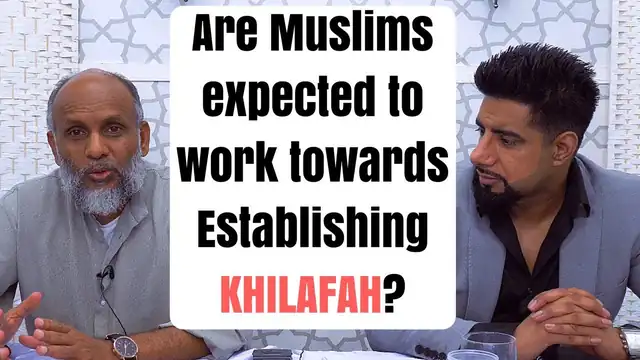 Play from 0:00
The video loads from YouTube only when you press play. Click a time in the transcript to seek.
Watch this part
Open on YouTube at 0:00The player starts at 0:00, the beginning of this part.
This segment0:00 to 2:10 · 2 min 10 sA view quoted in order to be discussed, not a position held
What this part covers
machinesummary, machine-writtenThe guest says religion is a personal matter between a person and God, and believers have no obligation to obtain a society or a state, though if they have power they must run it by God's command. Prophets such as Ibrahim and Isa, and Zakariya, Yahya and Maryam under Roman rule, never sought power and remain examples.
In more detail
The guest, Shaykh Akram Nadwi, says that what is missed in understanding the religion is that, according to the Quran and Sunnah, religion is basically a personal matter between a person and their Lord. When many people accept it a society comes about, and then the command of Allah is that the society be run according to His command, enjoining good and forbidding evil; when believers gain power they are commanded to obey Allah in running the state. But, he says, none of them has an obligation to make an effort to obtain a society or a state; sometimes things move in that direction and sometimes it never happens. Many prophets and messengers had believers but never established a society or any power, such as Ibrahim and Isa, and it did them no harm; they were still the best and chosen people, and some lived under non-Muslim rule and remain examples for the believers. He cites the last four prophets of the Jewish people, Zakariya, Yahya, Maryam and Isa, who lived under the Roman Empire, never rebelled or tried to establish Jewish rule, and taught only the personal religion of worship, prayer, remembrance, fasting and repentance, while the Quran praises them, makes them examples and says 'follow their guidance' [?], as it does for Ibrahim.
- Some terms in this segment are uncertain
Position stated
This segment presents a view in order to discuss or respond to it. It is recorded as quoted, never as held, and no position is attributed from it.
Kind: a view quoted in order to be discussed, not a position held Speakers: host and guest; guest speech is labelled and excluded from positionsTranscript
machine0:00 to 2:10 · click a time to seek · dotted terms open the glossary
A guest speaks in this segment. Guest speech is labelled and is excluded from the positions layer.
This segment states a view in order to discuss it. It is recorded as a quoted view, not as a position held.
[Shaykh Akram] One thing we keep missing from our understanding of the Religion is that we don't exactly get what the Qur'an and Sunnah is teaching. Religion is basically a personal matter between the people and their Lord. Nothing more than that. Your religion is just between you and your Lord. Mine is between me and my Lord. I believe in Him. I worship Him. I fear Him. Religion must always be personal. It's just between you and Allah (swt).
What happens is that when religion is established and many many people start to accept it, you get a society. Then the Command of Allah comes. That society should be according to Allah's Command. If there is no society, then you are just an individual. But when society is there, then you have to run the society according to Allah's Command. The Command is to enjoin the good and forbid the evil. After that, the Believers, they get power as well so they are commanded that when they run the state and whatever, they also obey Allah's Command. But none of them have an obligation upon them to make an effort to get a society. And it is not an obligation upon them to get a state. But it could be that sometimes they move towards that direction
but sometimes it never happens. There are many many Prophets and Messengers who came and some people believed in them, but they never established any society. They never got any power - no Khilafah - like Ibrahim (as) and `Isa (as). There were many good people (who had no khilafah) and it did them no harm. They were still the best people. They were the chosen people. You know, some of them were actually living under non-Muslim rule and they are still examples for the Believers. You know, that last four Prophets of the Jewish people Zaykariya (as), Yahya (as), Maryam (as) and `Isa (as).
These 4 people, all of them lived under the Roman Empire, Not a Jewish empire but under the Roman Empire. They never made an effort to rebel. They never made effort to establish Khilafah - Jewish Rule. They never ever did. What they actually taught was the personal religion. The religion which is actually `Ibadah, prayer, Dhikr, fasting, repenting to Allah, turning to Him. That is what they taught. Nothing else. And the Qur'an has so much praise for them.
Actually the Qur'an makes all of these four people as examples for the Believers. And the Qur'an says {Arabic}. "Follow their guidance". And the same for Ibrahaim (as). This understanding that the Believers have a duty to establish the Khilafah, this is not right. When people get the power, then their duty is they should be running according to Allah's Command. That is the command. But it is not the command that you must get it (state power). This never has been the command. Even when people say that the Prophet (saw) moved to Madinah Munawwarah to establish a state, this is a big misunderstanding. Because the Hadith says that when the Prophet (saw) did Hijrah (migration), he did not like that. Actually he was forced by the people to leave Makkah.
Paragraphs overlapping 0:00 to 2:10. Full text on the recording page.
Cite this segment
Stable id, transcript version and tier are part of the citation. Every change to a transcript is logged.Mufti Abu Layth Archive, segment 2017-09-09-S01, auto-transcribed, may contain errors. https://muftiabulayth.org/r/ij2ml87ptrs/s/1/ (accessed 1 November 2026)
- APA 7
Mufti Abu Layth. (2017, September 9). Are Muslims obliged to establish an Islamic state or khilafah? [Video, segment 2017-09-09-S01, auto-transcribed, may contain errors]. Mufti Abu Layth Archive. Retrieved November 1, 2026, from https://muftiabulayth.org/r/ij2ml87ptrs/s/1/
- Chicago author-date
Mufti Abu Layth. 2017. "Are Muslims obliged to establish an Islamic state or khilafah?" Video, segment 2017-09-09-S01, auto-transcribed, may contain errors. Mufti Abu Layth Archive. Recorded September 9, 2017. Accessed November 1, 2026. https://muftiabulayth.org/r/ij2ml87ptrs/s/1/
- BibTeX
@misc{abulayth-2017-09-09-S01,
  author = {Mufti Abu Layth},
  title = {{Are Muslims obliged to establish an Islamic state or khilafah?}},
  year = {2017},
  month = {9},
  date = {2017-09-09},
  howpublished = {\url{https://muftiabulayth.org/r/ij2ml87ptrs/s/1/}},
  url = {https://muftiabulayth.org/r/ij2ml87ptrs/s/1/},
  organization = {Mufti Abu Layth Archive},
  urldate = {2026-11-01},
  note = {Segment 2017-09-09-S01, auto-transcribed, may contain errors}
}
Something wrong here?
Tell us what is wrong and it will be checked against the recording. Nothing changes until a person has reviewed it.
Sending a note needs JavaScript, which is off or unavailable in this browser. Nothing has been sent.
No name, email address or account is asked for or stored, and the inbox does not store your IP address. For rate limiting it keeps an unreadable fingerprint of your connection for 48 hours, and our database provider's own logs record connections as every website's do. Only your note, its kind, the page and the moment in the recording are kept, for review.