
Recordings › Should Muslims Establish Khilafah - Shaykh Akram Nadwi & Mufti Abu Layth · 9 Sep 2017 › Segment 3 of 4
Why is the call to restore the khilafah dangerous for young Muslims?
salat salaah namaz prayer salaat namaaz al-salah salawat muftis sunna sunnat sunan prophetic practice dalil daleel adillah adilla evidence kufr kafir kaafir kufar kaafirun disbelief koran quraan al-quran khalifa caliph khulafa khilafat caliphate khilafa sheikh shaikh sheik shuyukh shaykhs deen ad-deen ad-din religionFantasy nostalgia for the khilafah, guilt-tripping the young and the breeding of extremism
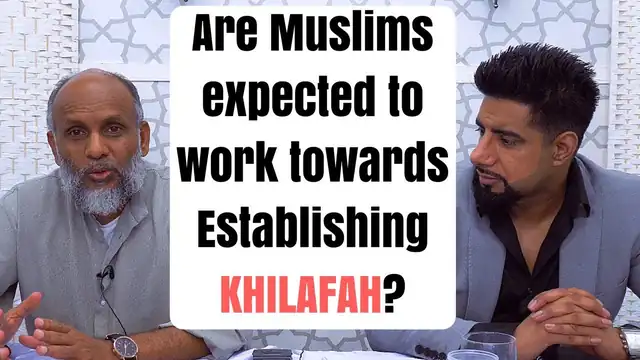 Play from 5:11
The video loads from YouTube only when you press play. Click a time in the transcript to seek.
Watch this part
Open on YouTube at 5:11The player starts at 5:11, the beginning of this part.
This segment5:11 to 8:49 · 3 min 38 sGeneral teaching
What this part covers
machinesummary, machine-writtenMufti Abu Layth says the nostalgic 'Bollywood version' of Islamic history, in which a perfect khilafah existed until 1924, is a fantasy, since the khilafah rashidah never went beyond Ali. Guilt-tripping young Muslims with it and with Dar al-Harb rhetoric breeds the extremist narrative and needs tackling.
In more detail
The guest finishes: the khilafah rashidah lasted only thirty years, after which there was kingship, sometimes good kings such as Salah al-Din al-Ayyubi and Umar ibn Abd al-Aziz, and in India too, very often bad ones, as in any other world tradition; there is no proof in the Quran and Sunnah that believers are obliged to work for the khilafah, and neither the prophets nor their followers did so. Mufti Abu Layth says the Shaykh has said enough and adds that this is a problem today because it misguides and guilt-trips many young and vulnerable people. People are given a romantic fantasy nostalgia, what he calls a Bollywood version of Islamic history, in which all was perfect until 1923 or 1924 and going back would fix every problem; but the single-state khilafah rashidah as they describe it never existed beyond Ali, as al-Amir al-San'ani [?] notes in his Rasa'il and Ahmad al-Raysuni has highlighted, and as the Prophet said it would turn to dynasties and kings. Those who point to Muslim suffering in Kashmir, Palestine and Burma and ask what the listener is doing produce a dangerous guilt; some then tell them that the whole world is Dar al-Harb without a khilafah, so that others become enemy combatants, and a handful may attack people, feeling they might as well die. He says this helps to breed the extremist narrative and traps sincere young people, who either become radicalised or carry the guilt for life, so it needs to be tackled.
- Guest speech overlaps this segment
- Some terms in this segment are uncertain
Position stated
Waiting for the speaker checkA guest speaks in this segment and the captions do not say who said what. The view found here is held back until the speaker-separated transcript confirms the words are his, or the channel verifies it. The transcript and recording are published in full.
Kind: general teaching Speakers: host and guest; guest speech is labelled and excluded from positionsTranscript
machine5:11 to 8:49 · click a time to seek · dotted terms open the glossary
A guest speaks in this segment. Guest speech is labelled and is excluded from the positions layer.
So we have to understand that the Khilafah that we actualy love is the Khalifah Rashidah. And the Khalifah Rashida in Islam only lasted just 30 years. After that, there was no Khilafah Rashidah. It was just kingship. Some times there were good kings. Some times there were bad kings. Some times good people like Salahuddin Ayyubi & `Umar ibn `Abdil `Aziz. In India, we have gotten good kings but very often we gotten bad kings. They are like in any other world tradition. This is what happened.
We don't have any proof in the Qur'an and Sunnah that the Believers are obliged to work for the Khilafah. Neither the Prophets did this. And neither their followers. [Mufti Abu Layth] I think the Shaykh has said a sufficient amount on that. This unfortunately in this day and age is a problem because it misguides and misleads many young vulnerable people and guilt trips them.
People will tell Muslims that first of all they've got a romantic, a fantasy nostalgia which isn't memory from Islam like you've heard. In Islam there were good kings and there were bad kings. The kings generally by today's standards, many of them by human rights standards, may not have been all that great but some of them may have been okay. Now the truth is that people present a what I call sometimes a Bollywood version of Islamic history but this fantasy nostalgia in saying "You know the world was all perfect in Islam until 1923 and 1924" and then they say "Oh so now the solution is
if we go back to that it will fix all the problems" And that's a fantasy because this one state Khilafah Rashidah the way they speak of it never existed beyond, as Shaykh Akram said, Sayyiduna `Ali (ra). And this is what Amir San`ani mentions in his Rasa`il. This is what many people today like Shaykh Ahmad Raysuni has highlighted that look it didn't go beyond that as the Prophet said it would be dynasts, kings & stuff like this.
But when people present this and they say "Look there's a lot of suffering in the world today. Look Muslims are dying... in Kashmir, in Palestine, in Burma, in here, in there.. what are you doing to change? What are you YOU are carrying the punishment. YOU will carry the burden". So the people don't know like what to do like they they feel guilty. And they say "Yeah, but are YOU doing anything?" This guilt is very dangerous because it takes some of them... You see if I guilt trip so many people, some of them may act out. It only takes a handful of them to say
"Okay, what should I do?". And people tell them "Oh, we live in Darul Harb. The whole world today is Darul Harb (War Zone) unless we have a Khilafah." So what naturally follows, if you are living in a war zone, what naturally follows is that the other people are enemy combatants. They are people - Muharibun - in the war. So some people say "Okay, I will attack some Kuffar. I might as well die because I'm taking all this guilt of all these people suffering and I'm not doing anything".
This is breeding. It's helping to breed the extremist narrative. And this is why it's a danger for young people who especially people who sometimes are sincere about Islam. They want to do something. They get trapped in this kind of thing. They want to get rid of the guilt and then, they end up, {wal iyadhu billah} either becoming radicalized, becoming like some nut cases or just pushing this for the rest of their lives, carrying this kind of guilt. So I think it needs to be tackled.
Paragraphs overlapping 5:11 to 8:49. Full text on the recording page.
Cite this segment
Stable id, transcript version and tier are part of the citation. Every change to a transcript is logged.Mufti Abu Layth Archive, segment 2017-09-09-S03, auto-transcribed, may contain errors. https://muftiabulayth.org/r/ij2ml87ptrs/s/3/ (accessed 1 November 2026)
- APA 7
Mufti Abu Layth. (2017, September 9). Why is the call to restore the khilafah dangerous for young Muslims? [Video, segment 2017-09-09-S03, auto-transcribed, may contain errors]. Mufti Abu Layth Archive. Retrieved November 1, 2026, from https://muftiabulayth.org/r/ij2ml87ptrs/s/3/
- Chicago author-date
Mufti Abu Layth. 2017. "Why is the call to restore the khilafah dangerous for young Muslims?" Video, segment 2017-09-09-S03, auto-transcribed, may contain errors. Mufti Abu Layth Archive. Recorded September 9, 2017. Accessed November 1, 2026. https://muftiabulayth.org/r/ij2ml87ptrs/s/3/
- BibTeX
@misc{abulayth-2017-09-09-S03,
  author = {Mufti Abu Layth},
  title = {{Why is the call to restore the khilafah dangerous for young Muslims?}},
  year = {2017},
  month = {9},
  date = {2017-09-09},
  howpublished = {\url{https://muftiabulayth.org/r/ij2ml87ptrs/s/3/}},
  url = {https://muftiabulayth.org/r/ij2ml87ptrs/s/3/},
  organization = {Mufti Abu Layth Archive},
  urldate = {2026-11-01},
  note = {Segment 2017-09-09-S03, auto-transcribed, may contain errors}
}
Something wrong here?
Tell us what is wrong and it will be checked against the recording. Nothing changes until a person has reviewed it.
Sending a note needs JavaScript, which is off or unavailable in this browser. Nothing has been sent.
No name, email address or account is asked for or stored, and the inbox does not store your IP address. For rate limiting it keeps an unreadable fingerprint of your connection for 48 hours, and our database provider's own logs record connections as every website's do. Only your note, its kind, the page and the moment in the recording are kept, for review.