
Recordings › Dr. Shehzad Saleem | the Preservation of the Quran & the Problem of Qira'at | MindTrap with Mufti#26 · 19 Jun 2020 › Segment 2 of 25
How did Dr Shehzad Saleem come to research the history of the Quran?
hadeeth ahadith ahaadeeth hadis ahaadith muftis koran quraan al-quran ayah aya ayat ayaat aayah aayat sahabah sahabi sahabiyyah sahabiyat ahl al-sunnah ahl as-sunnah ahlus sunnah ahl al-sunna sunnis shiah shi'i twelver ithna ashari umma ummat community in sha allah insha'allah in shaa allah insha allah inshaa allahThe guest's journey: how teaching the history of the Quran in 1999 raised the questions behind his book
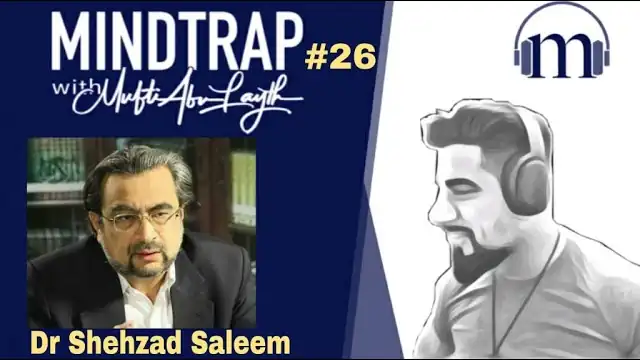 Play from 4:02
The video loads from YouTube only when you press play. Click a time in the transcript to seek.
Watch this part
Open on YouTube at 4:02The player starts at 4:02, the beginning of this part.
This segment2:56 to 10:32 · 7 min 36 sA view quoted in order to be discussed, not a position held
What this part covers
machinesummary, machine-writtenTeaching the history of the Quran at Al-Mawrid in 1999, the guest was shocked by questions in the Muslim sources themselves: multiple extant readings, reports of a lost rajm verse, compilation by two witnesses, differing companion codices and the Shia account. His book is the result of the quest that followed.
In more detail
Mufti Abu Layth thanks the guest and gives a brief overview of his work, holding up his book, The History of the Quran: A Critical Study, which grew out of a PhD spanning many years and several countries, and asks him to tell the story of his journey. The guest says it began in 1999 when he was asked to teach Quranic studies to graduate students at Al-Mawrid, including the history of the Quran, which he expected to be the easiest part since the Quran is preserved to perfection; preparing it, he was shocked by the questions that arose from the way the history is reported in the history and hadith books, and resolved to find answers for himself once the course ended. He lists the questions: why at least five versions of the Quran are extant, Hafs read by about ninety-seven percent of Muslims and Warsh and others in some eleven countries, with differences in words and word order, some affecting meaning, which seemed to shake the claim of word-for-word preservation and took him to Morocco, where the reading of Nafi' has been recited for twelve centuries; hadith reports that the Quran is incomplete, such as the verse of rajm, which Aisha is reported to have said was still being read when the Prophet died; the apparently haphazard compilation by the companions on the testimony of two witnesses, with Umar's rajm verse rejected for lack of a second witness; the differing codices ascribed to Ibn Mas'ud, Ubayy and Ali; and the Shia account of the collection, diametrically opposed to the Sunni one. Mufti says the book, published in November 2019, is underrepresented, and that he has read about forty percent of it and found it an immense study covering the traditional, contemporary and manuscript angles.
Position stated
This segment presents a view in order to discuss or respond to it. It is recorded as quoted, never as held, and no position is attributed from it.
Kind: a view quoted in order to be discussed, not a position held Speakers: host and guest; guest speech is labelled and excluded from positionsTranscript
machine2:56 to 10:32 · click a time to seek · dotted terms open the glossary
A guest speaks in this segment. Guest speech is labelled and is excluded from the positions layer.
This segment states a view in order to discuss it. It is recorded as a quoted view, not as a position held.
you've taken out this time to really enlighten us so I have to from the bottom on my heart first and foremost sugar and sugar and I deeply appreciate I can imagine only how busy you are folks I've reached out to dr. Shahzad Salim after watching some amazing lectures on this topic and I to be fair I thought you know what I wasn't expecting you to to get I thought you know my message might be totally drowned out and it'll take forever up so I was so glad I was over the moon when dr.
sob got back to me doctors harp for our audience who are not - who some some of whom may not be too familiar with your work just a brief overview so I'll just to kind of start it up and then I'd like you to expand if you could I know doctor Saab will be humble but he's done some groundbreaking work in this field he's done a whole PhD this you can see this is major book right there that is the history of the Quran a critical study part of which is a PhD study that's you know span many
years took dr. Shahzad across you know different countries different research but from this this journey in brief doctor Saab with the deem disconnection and then on to Quran studies could you tell us a bit about about that well it all started in 1999 when I was called about to teach Quranic studies at Elmore in our Institute to graduate students so when I started teaching for on part of that teaching was to introduce the Quran to the students which of course included
the language the history the background the Aundre the arrangement the coherent saw everything but what comes by the name of Elul quran so one part of that was was the history of the quran and i thought it would be the most easiest sailing because we know that the quran that we have today is preserved to perfection Dartford odd and so that's the end of that I would not have much to say but when I started preparing that for that subject about 20 years ago I was really dismayed to use a very soft word I was shocked because I had a lot of queries that built up in my
mind and these questions arose because of the way history of the Quran was divulged in our history and Hadees books and I thought that I would not be able to teach this course because gosh I cannot answer these questions which would stare me in the eye so how can i satisfy other people so I made this commitment to myself that once I am through with the course this was about six months I would do my best to find out the answers and so from here began my journey in November of 1999 when I finished that course I said that I must have the answers not to explain it to
others but to my own self because being a believer I need to find out how and why and when of this whole thing happened why is it that we have multiple versions of the Quran we know that there are at least five of them extent one that we know ourselves which is the huffs version which is prevalent in our time seven percent of the Muslim Ummah burn death there is three percent and there are about eleven countries which include that 3 percent which have four different versions of the Quran when I say different versions of course I refer to the fact that the words are different then there is this word order at times which is different then we have although
there these differences might not be very significant as far as their meaning is concerned although there are some others as well which have a significant change of meaning as well but still the claim that the Quran was preserved word for word in one format had that claims seemed to literally shake in its foundations so this was the one of the major question that that stared me and that took me actually to one of the North African countries Morocco where we have the naphtha is Kurata or nap is reading or Napa's version of the Quran so to speak and they have been reading this Quran for 12
centuries and for them the Quran of huffs that the Quran decree read is equally good and the Quran that theory is equally good as you will be knowing in your own scholarly approach but to me and to my students and of course to many other people this was quite disturbing and alarming and then of course there were other questions as well for example we know that in hadees literature there are hadees which tell us that the quran that we have is incomplete the regime verse is a is a very typical example it is called moon soo cuute lava do no hokum when you means that it was there yeah and we have the sparkling words
which the mother of faithful i sure said that the Prophet had was had just died and they still read that verse in the Quran and we know no that is no longer in the Quran and so person like I shall reporting that and then of course there were several other questions like for example the compilation the way the Sahaba went about it seemed as if it was a haphazardly sort of done thing things would not preserve properly and if they were gathered on the basis of two witnesses on the one hand we stake this claim that every person had the same I mean it was an all / sick pervasive sort of a thing in which all people remember
the Quran and there was not even need to call on two witnesses but here we find two witnesses being testifying in words been put in and we find Omar coming up with the regime worse and because he was the only witness his witness was not accepted because he didn't have a second witness with him so the question arose that was this the way of compliation the Quran in which just to pick missus were called and and whatever they came up it was accepted and then of course the sahabas the codices for example notices ascribed to abdullah bin abdullah al masud ali ali radiyaallah on whom all of
them differed with each other as they have reported in our history books and then there's an entirely new I would say color added if you look at the Shiite version of the collection of the Quran which is diametrically opposite to the Sunni version and it has its own story to tell so these were the questions of course I have just mentioned a few of them of creativeness this quest on this is fascinating voyage and that's amazing and I have to say that you know you've this book seriously
is I feel that it's you know it's I mean it really is underrepresented I don't know how long has this been in print by the way in circulation I just got hold of it very recent yeah it's savored for about six months I would say it was published in November of 2019 so it's about seven months it is an immense study honestly and I totally i-i've got through you about you know about 40% of it and I have been loving it the amount of research and not just from the theory from the contemporary approach the transparency angle the hadith e level the the discussion on us
our need you know for anybody who I suppose there's different layers of people there's people who just want an understanding that's fine but for somebody who's a bit more serious about the topic and they want a very kind of like a whole abroad detailed overview not just an overview and analysis then definitely history of the Quran and I would inshallah you know at some point like to you know go over as much as we can off of this in the future if we if we can because there's just so much to discuss but dr.
Paragraphs overlapping 2:56 to 10:32. Full text on the recording page.
Cite this segment
Stable id, transcript version and tier are part of the citation. Every change to a transcript is logged.Mufti Abu Layth Archive, segment 2020-06-19-S02, auto-transcribed, may contain errors. https://muftiabulayth.org/r/f2bcgwatu5g/s/2/ (accessed 1 November 2026)
- APA 7
Mufti Abu Layth. (2020, June 19). How did Dr Shehzad Saleem come to research the history of the Quran? [Video, segment 2020-06-19-S02, auto-transcribed, may contain errors]. Mufti Abu Layth Archive. Retrieved November 1, 2026, from https://muftiabulayth.org/r/f2bcgwatu5g/s/2/
- Chicago author-date
Mufti Abu Layth. 2020. "How did Dr Shehzad Saleem come to research the history of the Quran?" Video, segment 2020-06-19-S02, auto-transcribed, may contain errors. Mufti Abu Layth Archive. Recorded June 19, 2020. Accessed November 1, 2026. https://muftiabulayth.org/r/f2bcgwatu5g/s/2/
- BibTeX
@misc{abulayth-2020-06-19-S02,
  author = {Mufti Abu Layth},
  title = {{How did Dr Shehzad Saleem come to research the history of the Quran?}},
  year = {2020},
  month = {6},
  date = {2020-06-19},
  howpublished = {\url{https://muftiabulayth.org/r/f2bcgwatu5g/s/2/}},
  url = {https://muftiabulayth.org/r/f2bcgwatu5g/s/2/},
  organization = {Mufti Abu Layth Archive},
  urldate = {2026-11-01},
  note = {Segment 2020-06-19-S02, auto-transcribed, may contain errors}
}
Something wrong here?
Tell us what is wrong and it will be checked against the recording. Nothing changes until a person has reviewed it.
Sending a note needs JavaScript, which is off or unavailable in this browser. Nothing has been sent.
No name, email address or account is asked for or stored, and the inbox does not store your IP address. For rate limiting it keeps an unreadable fingerprint of your connection for 48 hours, and our database provider's own logs record connections as every website's do. Only your note, its kind, the page and the moment in the recording are kept, for review.