
Recordings › Ustadh Nouman Ali Khan & Mufti Abu Layth - A Discussion on Contemporary Issues · 15 Mar 2016 › Segment 4 of 7
Riba and Ibn Abbas: his disagreement on riba and his combining of prayers
salat salaah namaz salaat namaaz as-salah al-salah salawat saheeh sahih hadith saheeh hadith sound hadith authentic muftis sunna sunnat sunan prophetic practice ribaa sood interest usury saheeh muslim imam muslim muslim ibn al-hajjaj jahannam jahanam jahannum koran quraan al-quran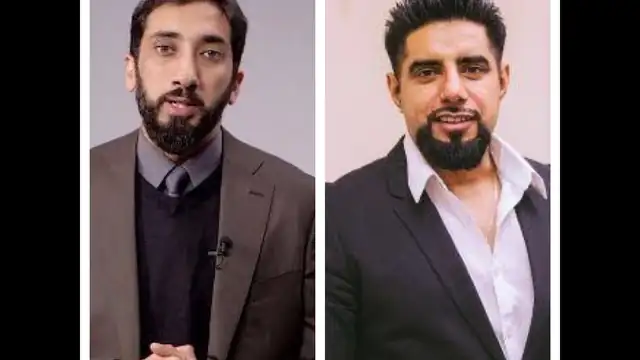 Play from 14:45
The video loads from YouTube only when you press play. Click a time in the transcript to seek.
Watch this part
Open on YouTube at 14:45The player starts at 14:45, the beginning of this part.
This segment14:45 to 17:23 · 2 min 38 sA view quoted in order to be discussed, not a position held
What this part covers
machinesummary, machine-writtenIbn Abbas is reported as holding that riba lies only in delayed exchange and as combining prayers without travel or fear, which one speaker uses to show that labelling a view easy or liberal is not an argument.
In more detail
One speaker, apparently Mufti Abu Layth [?], sketches how riba is broken down, as an increase in an exchange such as two kilos of dates for one, or a delay in which something is taken later, with an exception made for money, and says Ibn Abbas held that riba was only in the delayed transaction, disagreeing with the vast majority: exchanging one kilo of wheat for two on the spot would be fine as long as there was no delay. He says Ibn Abbas disagreed on many other matters, including salah, and recounts a report in Sahih Muslim in which Ibn Abbas was giving a speech, the time for a prayer passed, someone stood up to object, and he carried on, then combined the prayers and said the Prophet had combined without fear and without travel, adding that he did not want his address cut short. The speaker says this is the student of the Prophet, not just anybody, and that by the standard of today's labels people would dismiss him. The segment ends as he turns this into a point about method.
- Guest speech overlaps this segment
- Low audio confidence in the transcript
- May contain a view quoted in order to be discussed; no position is attributed until reviewed
Position stated
This segment presents a view in order to discuss or respond to it. It is recorded as quoted, never as held, and no position is attributed from it.
Kind: a view quoted in order to be discussed, not a position held Speakers: host and guest; guest speech is labelled and excluded from positionsTranscript
machine14:45 to 17:23 · click a time to seek · dotted terms open the glossary
A guest speaks in this segment. Guest speech is labelled and is excluded from the positions layer.
This segment states a view in order to discuss it. It is recorded as a quoted view, not as a position held.
you look at the the says that whenever the prophet fa two issues you know he always went with EAS if they say no no we don't mean by that we mean holding on to tradition well this is tradition like would you say you know like people like this is why I presented I said if you take your labels like this and look at sahab like with his descent and things like RBA and so on and and it's know his the point is people would just I don't know tell me okay well I mean I mean obviously is uh it's got many permutations here but they but they
look at it briefly they say that when they when they're breaking it down they say there's problem where you are kind of like um kind of like increasing so I say you know like I tell you what Give Me 2 kilos of date for 1 Kil of date and swap like that um or rib where this there's a delay like so I give you something but I'm going to take something after a while yeah so there's like a I don't know if if you want to consider a prepaid payment or but especially they make an ex exception for money and in all other things so let's say dates once again as typical examples they use back then so said that there was no R in like it
was only in and he disagreed entirely with every vast majority of everybody on that me an example so he said like if like so if somebody was to say look here's one kilo of wheat I want 2 kilos of wheat from you so one k he said well that's well that's fine as long as there isn't a delay like if we were transacting here that would because yeah so so this is so he says that this is just like in front of he says that only when there's a delay it triggers now now this is an example now
that would be considered I mean I I don't want to sound very controversial but obviously his disagreement in his disagreement in in so many things for example in Salah like or you do want [Laughter] to I tell you something really interesting one and this one is really in Muslim when is given a speech talking people and the time for is gone and somebody gets up and says time for is gone what the hell what you doing we should be praying you should be leading Us in Salah like pray Salah what you doing and and and he just
hears him and then just carries on and they finish and he combines the pra and he he says that the prophet he says the prophet Sall wasallam he combined without hope when there was no hope when there was no suffer and then just in case some people interpret that this was rain and whatever but okay different but he ends it he carries on he
says he wanted his not to be incomplete that meaning like this is who this is the student of the prophet it's not just anybody you know it's not so but by this but by this standard people would just say oh that's and this is my point that you see we don't have that discourse we have a discourse we Bas it on is the was this the understanding in the Quran was it in the Sunnah was this what the sah do they have this and they may have had a difference it's not about just because it sounds easier let's dismiss it by putting a label on it and just taking it out the you know just knock it off the table because we just
Paragraphs overlapping 14:45 to 17:23. Full text on the recording page.
Cite this segment
Stable id, transcript version and tier are part of the citation. Every change to a transcript is logged.Mufti Abu Layth Archive, segment 2016-03-15-S04, auto-transcribed, may contain errors. https://muftiabulayth.org/r/zbya7rqfyru/s/4/ (accessed 1 November 2026)
- APA 7
Mufti Abu Layth. (2016, March 15). Riba and Ibn Abbas: his disagreement on riba and his combining of prayers [Video, segment 2016-03-15-S04, auto-transcribed, may contain errors]. Mufti Abu Layth Archive. Retrieved November 1, 2026, from https://muftiabulayth.org/r/zbya7rqfyru/s/4/
- Chicago author-date
Mufti Abu Layth. 2016. "Riba and Ibn Abbas: his disagreement on riba and his combining of prayers." Video, segment 2016-03-15-S04, auto-transcribed, may contain errors. Mufti Abu Layth Archive. Recorded March 15, 2016. Accessed November 1, 2026. https://muftiabulayth.org/r/zbya7rqfyru/s/4/
- BibTeX
@misc{abulayth-2016-03-15-S04,
  author = {Mufti Abu Layth},
  title = {{Riba and Ibn Abbas: his disagreement on riba and his combining of prayers}},
  year = {2016},
  month = {3},
  date = {2016-03-15},
  howpublished = {\url{https://muftiabulayth.org/r/zbya7rqfyru/s/4/}},
  url = {https://muftiabulayth.org/r/zbya7rqfyru/s/4/},
  organization = {Mufti Abu Layth Archive},
  urldate = {2026-11-01},
  note = {Segment 2016-03-15-S04, auto-transcribed, may contain errors}
}
Something wrong here?
Tell us what is wrong and it will be checked against the recording. Nothing changes until a person has reviewed it.
Sending a note needs JavaScript, which is off or unavailable in this browser. Nothing has been sent.
No name, email address or account is asked for or stored, and the inbox does not store your IP address. For rate limiting it keeps an unreadable fingerprint of your connection for 48 hours, and our database provider's own logs record connections as every website's do. Only your note, its kind, the page and the moment in the recording are kept, for review.