
Recordings › Ustadh Nouman Ali Khan & Mufti Abu Layth - A Discussion on Contemporary Issues · 15 Mar 2016 › Segment 3 of 7
Western human rights, unquestioned presuppositions and the labels liberal and conservative
wudhu wudoo wuzu ablution al-wudu wudhoo tafsir tafseer exegesis tafasir tafaseer imam imaam prayer leader hukm ahkam hukum hukam ahkaam ribaa sood interest usury koran quraan al-quran sura soorah surat suwar soora chapter ayah aya ayat ayaat aayah aayat sahabah sahaba sahabi sahabiyyah sahabiyat ulama ulema ulamaa nikah nikkah nikaah nikah nama nikahnama deen al-din ad-deen ad-din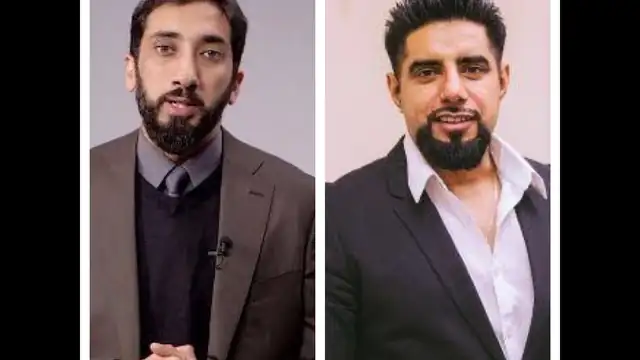 Play from 6:55
The video loads from YouTube only when you press play. Click a time in the transcript to seek.
Watch this part
Open on YouTube at 6:55The player starts at 6:55, the beginning of this part.
This segment6:55 to 14:45 · 7 min 50 sA view quoted in order to be discussed, not a position held
What this part covers
machinesummary, machine-writtenBoth speakers say Muslims should question their own presuppositions and scrutinise Western values rather than dismiss or adopt them wholesale. One objects that Western moral markers shift every decade; the other that labels like liberal and conservative replace argument.
In more detail
The segment opens with the end of the exchange on the verse about a degree over women: the first speaker objects to thirty pages of commentary about women's nature being used to reinforce a supposition before the primary text is given justice, and reports being told that his reading exists but the vast majority held otherwise. The other speaker replies, as he says he kept saying in that discussion, that earlier scholars tried their best for their own age and read the text through what was then normal, and that today there is a heightened cry for freedoms which affects everyone; he adds that some Muslims reject anything because the West has said it, as when he spoke of human freedoms and was told Islam has its own understanding of human rights. The first speaker, apparently the guest [?], says the problem is internal first: he performs wudu in an order he has never looked up, and most believers and even imams build on unquestioned presuppositions; after fourteen years of studying the Quran he cannot enter a surah with presuppositions and must ask critical questions even when they sound bad, which he calls genuine scholarship. He says the same scrutiny must be applied to the West, between the extreme that the tradition is perfect and the extreme that the West has better values, and objects that the Western human rights discourse shifts its markers every ten years, citing drug legalisation, the Supreme Court ruling on gay marriage, talk of polygamy and other demands, and earlier exposure of children to sexual content. The other speaker agrees that morals shift and says his point was to use the Western cry for freedoms as a point of reflection rather than embracing it wholesale; he adds that he dislikes the labels liberal and conservative, which are used to dismiss a point rather than argue it, notes that the Prophet chose ease when faced with two options, and says that applied to the Companions such labels would make some of them look liberal, which leads into the example of riba.
- Guest speech overlaps this segment
- Low audio confidence in the transcript
- May contain a view quoted in order to be discussed; no position is attributed until reviewed
- Some terms in this segment are uncertain
Position stated
This segment presents a view in order to discuss or respond to it. It is recorded as quoted, never as held, and no position is attributed from it.
Kind: a view quoted in order to be discussed, not a position held Speakers: host and guest; guest speech is labelled and excluded from positionsTranscript
machine6:55 to 14:45 · click a time to seek · dotted terms open the glossary
A guest speaks in this segment. Guest speech is labelled and is excluded from the positions layer.
This segment states a view in order to discuss it. It is recorded as a quoted view, not as a position held.
become all the other on how that and then on top of that there's is normal structure that's purely textual you know but then there's like 30 pages of well because they have menes and because they're their tongue and
because are like first at least do justice to the primary text before we jump you know on like reinforcing our supposition using like other Tech it's crazy I thought it was just wild and then I I discussed it said well that opinion also ex exists but the vast majority of all that I was like okay fine vast majority you why have this I just want to know what their thought process was and you've got to you see this is another this is what I kept saying in that discussion you've got to understand that people who trying they
may have tried their best for their own age like there's an understanding a global understanding like people may have felt at certain times this is fine everybody does this and they reflected they understood let's say from the the text so whatever it is based on their contextualized understanding so it's not so today there is a heightened I'm not saying that there wasn't you know throughout time a voice for human rights and stuff like but there is a heighten voice a cry for things like freedoms in this day you know since this last century there has been
now people that will have had an effect on people regardless it will have an effect on you and some people they feel that oh because the West have made this cry we have to be anti it like it's somehow like they like somehow some people feel anything that comes from uh let's say non-muslims are saying it that means oh this can't be Islam you know we've got our own understanding like I spoke about human freedoms human values somebody said oh are you talking about the ones that the human rights chter has kind of listed because in Islam you know we've got our own understanding of Human Rights and human and okay maybe on some discussions it'll be interesting to see
what they've got to say but the point is that this methodology of just ruling anything El that look as in the is it is the property of the Bel you know I think about this I've been think about this issue for a while too what I've arrived at is that first of all internally without even talking about what the West is internally we have a problem I'll I'll sum the problem up with a with an example why do I make wo the way I do I have never looked up my dad made it that way I made it that way I don't know the ad for and the vast majority of
the BET even the IMs of our M won't know why the W is in the order that I said we just do it we just do the there certain assumptions we that the Islam has a certain Baseline you don't question certain practices beliefs attitudes you don't question and everything we think about in terms of Islam we build on top of these presuppositions these a lot of them are just layers and and by the way is one of those prositions that's been well settled into the for a long time we're in an age now where this whole the whole concept of
we cannot afford any presuppositions like after 14 years of trying to study Quran I arriv to the conclusion that I cannot go into a Surah with any presuppositions I have to leave my assumptions aside and just study the text as genuinely as I can and ask as many critical critical questions as I can when I come across an interpretation that doesn't seem to add up for this reason that reason or the other reason I need to be able to ask these questions even if it sounds bad or you have to be genuine to the T right now when you do that you you cannot just do that with your own tradition first of all we have to start with our own tradition we have to do this with our own tradition this is actually genuine scholarship as far
Li that's what it always was people asking the tough questions but we have to do that with the West too not with this reactionary whatever they have to say is garbage but you've got two extremes now you've got the traditional which who says whatever we have is perfect and not subject to question and you got well you know they're on to something they have pretty good values too my problem with the Western model of of Human Rights discour as it is right now is that it shifts every 10 years the marker shifts and what is completely unacceptable
right now by their own standards will become acceptable will become acceptable and glorified and it'll change it'll absolutely change absolutely if if the80s were exhaustive discourse about the harms of drugs on your body and mind and and the immorality of drug use and things like that now it's legal in several States and like a human right almost to take marijuana for medical or Leisure purposes or whatever right gay marage just got signed off in the US you guys know about that Supreme Court signed off on right and the you know what the discussion is on Mormon and you know Orthodox Christian circles polygam
is next okay now we can fight for it now it's not imoral because they've opened the door to all kinds of M right so cuz they're say well if that's okay then this is okay and then they there are other groups that are coming and saying that marrying animals should be okay right cuz you open the door and you know what it's not entirely farfetched what is right now for example considered um like obscene or inent exposure to Children right because there's a there's an age before you before which you cannot get married and things like that right but now uh with the introduction
this the sexual content or you know suggestive content to even children earlier earlier ages how soon before Society decides that we can legalize some of this Stu I mean the morals are always shifting I think that's undeniable I think the the the angle I meant more one is one is okay let's just say look there is a cry in the West for human rights human values and let's just Embrace that whole Artic and just go with their blow well one is to understand that look use it as a point of reflection like to kind of say well look like people are criticizing like people are saying okay there should be Freedom like freedom of
religion is an example now there should be freedoms now you look at something rationally like we have our own pointers we have our own this was another thing this is why I had said that people throw around these terms nowadays and I I completely not only do I dislike these terms but I believe that they don't even stand within our within our discourse the Ed term let's say liberalism conservatism uh the problem with this is people will use this just to dismiss a point you have to say I've asked people to Define what they mean when they say things like this like you know when you say oh um oh you're just being liberal what do you mean you're just going being easy is that what it means does conservative mean being harsh because if
you look at the the says that whenever the prophet fa two issues you know he always went with EAS if they say no no we don't mean by that we mean holding on to tradition well this is tradition like would you say you know like people like this is why I presented I said if you take your labels like this and look at sahab like with his descent and things like RBA and so on and and it's know his the point is people would just I don't know tell me okay well I mean I mean obviously is uh it's got many permutations here but they but they
Paragraphs overlapping 6:55 to 14:45. Full text on the recording page.
Cite this segment
Stable id, transcript version and tier are part of the citation. Every change to a transcript is logged.Mufti Abu Layth Archive, segment 2016-03-15-S03, auto-transcribed, may contain errors. https://muftiabulayth.org/r/zbya7rqfyru/s/3/ (accessed 1 November 2026)
- APA 7
Mufti Abu Layth. (2016, March 15). Western human rights, unquestioned presuppositions and the labels liberal and conservative [Video, segment 2016-03-15-S03, auto-transcribed, may contain errors]. Mufti Abu Layth Archive. Retrieved November 1, 2026, from https://muftiabulayth.org/r/zbya7rqfyru/s/3/
- Chicago author-date
Mufti Abu Layth. 2016. "Western human rights, unquestioned presuppositions and the labels liberal and conservative." Video, segment 2016-03-15-S03, auto-transcribed, may contain errors. Mufti Abu Layth Archive. Recorded March 15, 2016. Accessed November 1, 2026. https://muftiabulayth.org/r/zbya7rqfyru/s/3/
- BibTeX
@misc{abulayth-2016-03-15-S03,
  author = {Mufti Abu Layth},
  title = {{Western human rights, unquestioned presuppositions and the labels liberal and conservative}},
  year = {2016},
  month = {3},
  date = {2016-03-15},
  howpublished = {\url{https://muftiabulayth.org/r/zbya7rqfyru/s/3/}},
  url = {https://muftiabulayth.org/r/zbya7rqfyru/s/3/},
  organization = {Mufti Abu Layth Archive},
  urldate = {2026-11-01},
  note = {Segment 2016-03-15-S03, auto-transcribed, may contain errors}
}
Something wrong here?
Tell us what is wrong and it will be checked against the recording. Nothing changes until a person has reviewed it.
Sending a note needs JavaScript, which is off or unavailable in this browser. Nothing has been sent.
No name, email address or account is asked for or stored, and the inbox does not store your IP address. For rate limiting it keeps an unreadable fingerprint of your connection for 48 hours, and our database provider's own logs record connections as every website's do. Only your note, its kind, the page and the moment in the recording are kept, for review.