
Recordings › Dr Javad T. Hashmi | Axis of Morality & Archetypal Myths in the Quran | MindTrap 46 |Mufti Abu Layth · 11 Dec 2020 › Segment 2 of 36
Is it better to study Islam at a madrasa or at a Western university?
muftis 'alim aalim madrasah madrassa madaris madrassah religious schoolAl-Azhar or Harvard? Why the guest chose the academic study of Islam
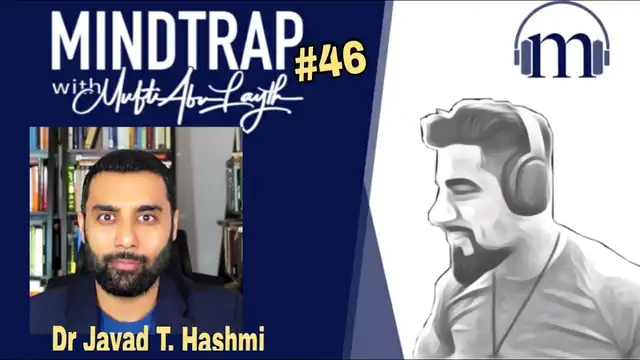 Play from 3:37
The video loads from YouTube only when you press play. Click a time in the transcript to seek.
Watch this part
Open on YouTube at 3:37The player starts at 3:37, the beginning of this part.
This segment3:37 to 6:44 · 3 min 07 sA view quoted in order to be discussed, not a position held
What this part covers
machinesummary, machine-writtenThe guest says he chose the critical academic study of Islam over al-Azhar, considering it superior, though he took two years of al-Azhar's online programme and recommends combining traditional and academic study.
In more detail
Mufti Abu Layth asks how studying Islam at Harvard fits together, since one would expect a madrasa or al-Azhar instead. The guest says that after residency he had to choose between the traditional route, with al-Azhar in mind, and the Western university; he completed two years of al-Azhar's online Arabic and Islamic studies programme and audited madrasa courses in Pakistan, which he found beneficial, but chose the critical scholarly route. He says he has come to the conclusion that the academic study of Islam is superior to the madrasa route, though the madrasa gives real skills, including language, and an understanding of the traditional view. He recommends combining both, which he says is what he tries to do and what he sees Mufti doing too.
Position stated
This segment presents a view in order to discuss or respond to it. It is recorded as quoted, never as held, and no position is attributed from it.
Kind: a view quoted in order to be discussed, not a position held Speakers: host and guest; guest speech is labelled and excluded from positionsTranscript
machine3:37 to 6:44 · click a time to seek · dotted terms open the glossary
A guest speaks in this segment. Guest speech is labelled and is excluded from the positions layer.
This segment states a view in order to discuss it. It is recorded as a quoted view, not as a position held.
It's not like it's not difficult for me. I enjoy it. So people sometimes ask me how many more years of the PhD you have left and when they hear they're like oh my god for no for me that's it's the journey is just wonderful. So wow. Uh that's awesome. this by by the way this whole thing of wanting to study Islam or deepen your knowledge on Islam um and then Harvard cuz it's not even though it's amazing in terms of you know these places when you think of Oxford, Cambridge, Harvard uh you don't really think of Islam you know
you don't really think I I want to learn Islam I I know let's go to Harvard. Uh how how is how is that? Because um I mean your thoughts on that just uh because that just almost seems as a a kind of like an oxymoron to some extent or a dichotomy in saying well Islam and Harvard or you know shouldn't you go to a madrasa or shouldn't you go to alazar?
Yeah. So uh once I finished my residency I had to make the choice whether or not I was going to study Islam in the traditional environment. uh and actually alar was the one that I had in mind or uh studying in the western university. So really you can think of it as alazar versus Harvard in my mind and to be honest I actually did study two years of the alazar Arabic Islamic studies program uh through their online program that they offer uh and it was beneficial to me but ultimately I decided that um I wanted to go the critical scholarly route.
So, in my mind, and this is a big debate, I was just watching another podcast, one of your competitors, actually. Uh, nowhere near your state, though, of course. [laughter] But, uh, they were saying, "Oh, they were saying this person's just a PhD from Georgetown. Uh, that's not a real Islamic scholar." But for me, I actually think I've come to the conclusion that I think the academic study of Islam in my mind is superior to the Madrasa route.
Um but I don't say that the Madrasa route has no benefits. Um it definitely does. You you you acquire all sorts of great skills from that route which is why I studied it for those two years that I did. Um but ultimately and that was and that was at what place the where you did the traditional? So I studied I I audited some course in Madrasa in Pakistan and then I also uh audited classes uh I took uh this is through Alazhar University.
They have the online Arabic and Islamic studies program. So I did two years of their curriculum there. Uh and it definitely helped me to understand the traditional view and all of this stuff and it also gives you good language skills for sure. Yeah, definitely. So so it's it's very useful but I think the best is to combine both and that's what I've been trying to do. So I always study do some traditional Islamic studies but my primary gig of course is in the academy.
So I think doing both is the best best route and I think you're you're obviously someone who does the same too cuz you trained in the traditional route and now you also read academic stuff. So I I think that combination is the best. Wow. You know just a quick question before uh moving on to something else. People ask me sometimes that uh look I I want to enhance my knowledge of Islam.
Paragraphs overlapping 3:37 to 6:44. Full text on the recording page.
Cite this segment
Stable id, transcript version and tier are part of the citation. Every change to a transcript is logged.Mufti Abu Layth Archive, segment 2020-12-11b-S02, auto-transcribed, may contain errors. https://muftiabulayth.org/r/zasz48lx_wi/s/2/ (accessed 1 November 2026)
- APA 7
Mufti Abu Layth. (2020, December 11). Is it better to study Islam at a madrasa or at a Western university? [Video, segment 2020-12-11b-S02, auto-transcribed, may contain errors]. Mufti Abu Layth Archive. Retrieved November 1, 2026, from https://muftiabulayth.org/r/zasz48lx_wi/s/2/
- Chicago author-date
Mufti Abu Layth. 2020. "Is it better to study Islam at a madrasa or at a Western university?" Video, segment 2020-12-11b-S02, auto-transcribed, may contain errors. Mufti Abu Layth Archive. Recorded December 11, 2020. Accessed November 1, 2026. https://muftiabulayth.org/r/zasz48lx_wi/s/2/
- BibTeX
@misc{abulayth-2020-12-11b-S02,
  author = {Mufti Abu Layth},
  title = {{Is it better to study Islam at a madrasa or at a Western university?}},
  year = {2020},
  month = {12},
  date = {2020-12-11},
  howpublished = {\url{https://muftiabulayth.org/r/zasz48lx_wi/s/2/}},
  url = {https://muftiabulayth.org/r/zasz48lx_wi/s/2/},
  organization = {Mufti Abu Layth Archive},
  urldate = {2026-11-01},
  note = {Segment 2020-12-11b-S02, auto-transcribed, may contain errors}
}
Something wrong here?
Tell us what is wrong and it will be checked against the recording. Nothing changes until a person has reviewed it.
Sending a note needs JavaScript, which is off or unavailable in this browser. Nothing has been sent.
No name, email address or account is asked for or stored, and the inbox does not store your IP address. For rate limiting it keeps an unreadable fingerprint of your connection for 48 hours, and our database provider's own logs record connections as every website's do. Only your note, its kind, the page and the moment in the recording are kept, for review.