
Recordings › Dr Javad T. Hashmi | Axis of Morality & Archetypal Myths in the Quran | MindTrap 46 |Mufti Abu Layth · 11 Dec 2020 › Segment 3 of 36
Should I go to Madinah University or a madrasa to study Islam?
muftis madina al-madinah madeenah yathrib madrasah madrassa madaris madrassah religious school alhamdulilah al-hamdu lillah alhumdulillah alhamdulillaah hamdulillahShould I go to Madinah University? Who the madrasa route suits
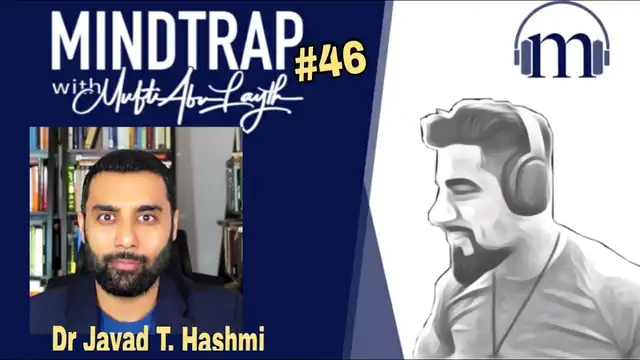 Play from 6:44
The video loads from YouTube only when you press play. Click a time in the transcript to seek.
Watch this part
Open on YouTube at 6:44The player starts at 6:44, the beginning of this part.
This segment6:44 to 10:05 · 3 min 21 sA view quoted in order to be discussed, not a position held
What this part covers
machinesummary, machine-writtenThe guest advises open-minded, critical thinkers against a traditional madrasa, which he says selects, programmes and isolates its students from current scholarship, citing his own rejection by Madinah University.
In more detail
Mufti Abu Layth says people often ask him whether to go to Madinah University or elsewhere to deepen their knowledge, and asks what the guest would recommend. The guest says it depends on the person: an open-minded, critical thinker should not go to a traditional madrasa. He describes a pre-selective process, saying he was himself rejected by the Islamic University of Madinah more than a decade ago even though it takes students straight from high school, then five to ten years of programming in which a student who thinks differently is either expelled or conforms. He adds that madrasa graduates are isolated from the world and from the latest Western academic scholarship on Islam, so that the average mullah cannot deal with much of it, with exceptions, and notes that Yasir Qadhi chose to do a PhD at Yale.
Position stated
This segment presents a view in order to discuss or respond to it. It is recorded as quoted, never as held, and no position is attributed from it.
Kind: a view quoted in order to be discussed, not a position held Speakers: host and guest; guest speech is labelled and excluded from positionsTranscript
machine6:44 to 10:05 · click a time to seek · dotted terms open the glossary
A guest speaks in this segment. Guest speech is labelled and is excluded from the positions layer.
This segment states a view in order to discuss it. It is recorded as a quoted view, not as a position held.
So I think doing both is the best best route and I think you're you're obviously someone who does the same too cuz you trained in the traditional route and now you also read academic stuff. So I I think that combination is the best. Wow. You know just a quick question before uh moving on to something else. People ask me sometimes that uh look I I want to enhance my knowledge of Islam.
Uh what should I do? Uh should I uh in fact I had a message from somebody just last week about uh should I go to Medina University? Should I go to uh and I get asked this a lot by people. Alhamdulillah it reflects people are interested in enhancing their knowledge. Would you recommend I I'm just curious what you'd recommend and would it be a western university or would it be something? I'm just curious.
Um that's one I think it depends on the person themselves what their religious views are. If you are an open-minded critical thinking kind of person then I don't think a traditional madrasa is the place for you to go. Uh I think first of all there's it's a pre-selective process. So I actually applied to the University of Medina many many years ago uh more than a decade ago and I actually got rejected.
Uh, meanwhile they accept Are you glad now that you Of course I'm of course I'm [laughter] glad. But but I think about they als they accept people straight out of high school. So how could they not have accepted me? Um I mean that's a little bit super sillious of me to say but uh you know I I was saying that's ridiculous how I didn't get accepted. Um but so there's a pre-selective process part of a divine plan. It's part of plan. Well, they decided they obviously don't want somebody who is going to be a freeth thinker who's going to think for themselves.
So, there's first a pre-selective process. Then once you get into the univers the Madrasa system, you have to study there for 5 to 10 years. Yeah. And during those 5 to 10 years, they're going to program you. And if you start thinking differently, one of two things is going to happen. Either you're gonna get kicked out or [laughter] or you're going to change your views to conform to them. you're going to do some sort of takya like uh you know just go along with everything but ultimately if you're and actually you had a good talk on this I remember about the problem with studying in a madrasa you become very isolated from the entire world and you don't even realize the discourses that are going on and it's not just by the way in the
geopolitics and you know what's going on sociologically it's actually you don't even know what's going on in the western academy what's the latest Islamic studies scholarship so I don't think a average moola can deal with much of the stuff that's coming out of the western academy. Um, now there are exceptions. There are some that are fantastic and wonderful, but for the most part that's not the case. And that's why even somebody like Sheh Yaser Kadi decided to do a PhD at Yale.
Now Yale is no Harvard. No, I'm just kid. That's just a joke. We have a rivalry with Harvard. Um but uh that shows you that he did find something of use in the western academy and I I I believe in that. So sorry the mic just slightly jumped in for a little while but uh uh right. Yep. So and you know just [clears throat] to to share on that um my my view as well very similarly is that I do feel that there's uh a lot of uh I mean there is a lot of good in what a madrasa can provide.
Paragraphs overlapping 6:44 to 10:05. Full text on the recording page.
Cite this segment
Stable id, transcript version and tier are part of the citation. Every change to a transcript is logged.Mufti Abu Layth Archive, segment 2020-12-11b-S03, auto-transcribed, may contain errors. https://muftiabulayth.org/r/zasz48lx_wi/s/3/ (accessed 1 November 2026)
- APA 7
Mufti Abu Layth. (2020, December 11). Should I go to Madinah University or a madrasa to study Islam? [Video, segment 2020-12-11b-S03, auto-transcribed, may contain errors]. Mufti Abu Layth Archive. Retrieved November 1, 2026, from https://muftiabulayth.org/r/zasz48lx_wi/s/3/
- Chicago author-date
Mufti Abu Layth. 2020. "Should I go to Madinah University or a madrasa to study Islam?" Video, segment 2020-12-11b-S03, auto-transcribed, may contain errors. Mufti Abu Layth Archive. Recorded December 11, 2020. Accessed November 1, 2026. https://muftiabulayth.org/r/zasz48lx_wi/s/3/
- BibTeX
@misc{abulayth-2020-12-11b-S03,
  author = {Mufti Abu Layth},
  title = {{Should I go to Madinah University or a madrasa to study Islam?}},
  year = {2020},
  month = {12},
  date = {2020-12-11},
  howpublished = {\url{https://muftiabulayth.org/r/zasz48lx_wi/s/3/}},
  url = {https://muftiabulayth.org/r/zasz48lx_wi/s/3/},
  organization = {Mufti Abu Layth Archive},
  urldate = {2026-11-01},
  note = {Segment 2020-12-11b-S03, auto-transcribed, may contain errors}
}
Something wrong here?
Tell us what is wrong and it will be checked against the recording. Nothing changes until a person has reviewed it.
Sending a note needs JavaScript, which is off or unavailable in this browser. Nothing has been sent.
No name, email address or account is asked for or stored, and the inbox does not store your IP address. For rate limiting it keeps an unreadable fingerprint of your connection for 48 hours, and our database provider's own logs record connections as every website's do. Only your note, its kind, the page and the moment in the recording are kept, for review.