
Recordings › Dr Javad T. Hashmi | Axis of Morality & Archetypal Myths in the Quran | MindTrap 46 |Mufti Abu Layth · 11 Dec 2020 › Segment 1 of 36
Why did a medical doctor choose to study religion at Harvard?
muftis makruh makrooh makruh tahrimi makruh tanzihi riba ribaa sood usury 'alim aalim ummah umma ummat ma sha allah masha'allah masha allah mashaa allah deen al-din ad-deen ad-dinIntroducing the guest: from medicine to the study of religion at Harvard
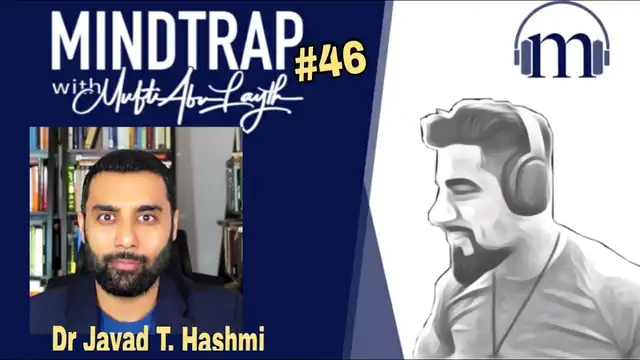 Play from 0:04
The video loads from YouTube only when you press play. Click a time in the transcript to seek.
Watch this part
Open on YouTube at 0:04The player starts at 0:04, the beginning of this part.
This segment0:04 to 3:37 · 3 min 33 sA view quoted in order to be discussed, not a position held
What this part covers
machinesummary, machine-writtenThe guest describes training as a physician and then turning to Arabic and Islamic studies at Berkeley and Harvard, where he is now a PhD candidate in the study of religion, despite his family's initial unease.
In more detail
Mufti Abu Layth opens the MindTrap episode by presenting his guest, Dr Javad Hashmi, with jokes about the prestige of Harvard, and the guest jokes that it is an honour to be on the 'Muslim Joe Rogan podcast'. Asked for an overview of his journey, the guest says he was born and raised in California, first studied engineering, which he hated, then medicine, which he also disliked but completed through residency. He then went back to university for a bachelor's in Arabic and Islamic studies at UC Berkeley and a master's at Harvard, and is now in the middle of a PhD in the study of religion, having also done a fellowship in medical ethics, while still practising part-time as a physician. Asked whether people in the South Asian community questioned a doctor becoming a religious scholar, he says his parents were not happy at first, that he told his wife after marrying that he would study religion, and that he loves the journey however long it takes.
Position stated
This segment presents a view in order to discuss or respond to it. It is recorded as quoted, never as held, and no position is attributed from it.
Kind: a view quoted in order to be discussed, not a position held Speakers: host and guest; guest speech is labelled and excluded from positionsTranscript
machine0:04 to 3:37 · click a time to seek · dotted terms open the glossary
A guest speaks in this segment. Guest speech is labelled and is excluded from the positions layer.
This segment states a view in order to discuss it. It is recorded as a quoted view, not as a position held.
Guys once again let me present to you right Dr. Javad Hashimi [snorts] from Harvard people. You have to say that with like an like almost with the word hazat before it. Hazat Harvard Sharif. [laughter] It is there so much prestige I have to say in saying uh you know from Harvard.
It's like wow. Welcome to Mind Trap Doc. [laughter] Thank you so much for having me. Right. It's an honor. If if you're cutting out the previous part, I got to repeat the statements. Go for it. It's an honor to be on the Muslim Joe Rogan podcast. So, thank you. [laughter] Wah and they embarrassed me. So, Doc, those of uh those uh of the viewers that are not so familiar with your journey, you've you're from the States, born and raised in California, which just sounds like
such a cool place. Anyway, just the name California. And then you know your journey your interest in Islam graduating from Harvard such a you know such prestige and that too in the department of religion in addition to being a medical doctor what is all of this about give us a bit of an overview about yourself doc. Sure I appreciate that. So just like any dy I had two options study engineering or medicine.
I first studied engineering. Uh I hated it. Switched to medicine and to be honest I hated it too. But I was too far in now to quit. So I uh finished my residency and uh decided immediately to go back to the university. So I went back to get a bachelor's in Arabic and Islamic studies from UC Berkeley, a master's from Harvard in uh Islamic studies and now I'm actually in my PhD for Islamic studies, the study of religion as you said.
Um so I I did eventually choose to study Islam in the academic environment in the Western University. Um so that's that's the short and long of it. And in between I also did a fellowship in medical ethics that kind of bridges my medical side to my interest in religion. So I still do practice as a physician part-time but my primary gig so to speak is my PhD. And so I'm I'm currently in the middle of my PhD. Weren't you um did you not get some of the comments that look now that you're you see a doctor the the medical do the medical the real doctor there were people say you know no I meant a real doctor those uh that's
like up there in the desi world as prestige you know mashallah doctor so when from that you thought you know I want to study religion I mean is this not a bit of an odd you know people say yeah he wants to be a mulvi what what the hell's wrong with this guy, you know? Yeah. Did you not get any of that from people? Of course. Of course I did. My parents were not the happiest initially when I decided to do this.
Uh, you know, at this point in time, I should just buy a nice house, some nice cars, settle down. Um, but instead, I've chosen this path, which is a lot more difficult. But, uh, really, I got married while I was a doctor and then I quickly told my wife, you know what, I'm going to go study religion. So, but I was already married. So, [laughter] So it's I I think in life you got to do what you love and uh I feel like I was meant to study what I'm studying now and so I absolutely love it.
It's not like it's not difficult for me. I enjoy it. So people sometimes ask me how many more years of the PhD you have left and when they hear they're like oh my god for no for me that's it's the journey is just wonderful. So wow. Uh that's awesome. this by by the way this whole thing of wanting to study Islam or deepen your knowledge on Islam um and then Harvard cuz it's not even though it's amazing in terms of you know these places when you think of Oxford, Cambridge, Harvard uh you don't really think of Islam you know
Paragraphs overlapping 0:04 to 3:37. Full text on the recording page.
Cite this segment
Stable id, transcript version and tier are part of the citation. Every change to a transcript is logged.Mufti Abu Layth Archive, segment 2020-12-11b-S01, auto-transcribed, may contain errors. https://muftiabulayth.org/r/zasz48lx_wi/s/1/ (accessed 1 November 2026)
- APA 7
Mufti Abu Layth. (2020, December 11). Why did a medical doctor choose to study religion at Harvard? [Video, segment 2020-12-11b-S01, auto-transcribed, may contain errors]. Mufti Abu Layth Archive. Retrieved November 1, 2026, from https://muftiabulayth.org/r/zasz48lx_wi/s/1/
- Chicago author-date
Mufti Abu Layth. 2020. "Why did a medical doctor choose to study religion at Harvard?" Video, segment 2020-12-11b-S01, auto-transcribed, may contain errors. Mufti Abu Layth Archive. Recorded December 11, 2020. Accessed November 1, 2026. https://muftiabulayth.org/r/zasz48lx_wi/s/1/
- BibTeX
@misc{abulayth-2020-12-11b-S01,
  author = {Mufti Abu Layth},
  title = {{Why did a medical doctor choose to study religion at Harvard?}},
  year = {2020},
  month = {12},
  date = {2020-12-11},
  howpublished = {\url{https://muftiabulayth.org/r/zasz48lx_wi/s/1/}},
  url = {https://muftiabulayth.org/r/zasz48lx_wi/s/1/},
  organization = {Mufti Abu Layth Archive},
  urldate = {2026-11-01},
  note = {Segment 2020-12-11b-S01, auto-transcribed, may contain errors}
}
Something wrong here?
Tell us what is wrong and it will be checked against the recording. Nothing changes until a person has reviewed it.
Sending a note needs JavaScript, which is off or unavailable in this browser. Nothing has been sent.
No name, email address or account is asked for or stored, and the inbox does not store your IP address. For rate limiting it keeps an unreadable fingerprint of your connection for 48 hours, and our database provider's own logs record connections as every website's do. Only your note, its kind, the page and the moment in the recording are kept, for review.