
Recordings › Shaykh Atabek Shukurov | Mortgages, Madhabs & Molvi-ism | MindTrap 48 | Mufti Abu Layth · 29 Jan 2021 › Segment 4 of 22
How do people react when a scholar from Uzbekistan challenges subcontinent scholars?
fiqah jurisprudence fikh hadeeth ahadith ahaadeeth hadis hadees ahaadith imam imaam prayer leader maaliki malikite malikiyyah maliki school hanafite hanafiyyah muftis 'alim aalim ulama ulema ulamaa deen al-din ad-deen ad-dinIslam in the UK from two cultures, and challenging subcontinent scholars from Uzbekistan
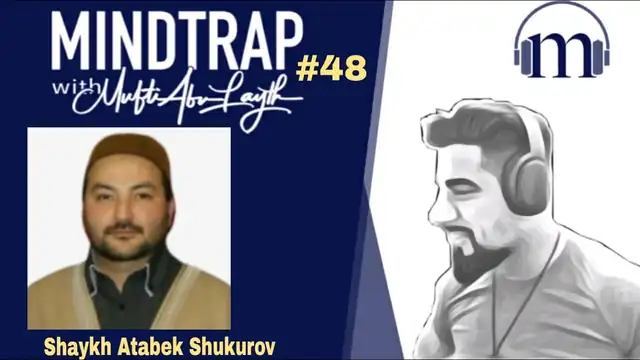 Play from 15:01
The video loads from YouTube only when you press play. Click a time in the transcript to seek.
Watch this part
Open on YouTube at 15:01The player starts at 15:01, the beginning of this part.
This segment13:06 to 17:37 · 4 min 31 sGeneral teaching
What this part covers
machinesummary, machine-writtenMufti Abu Layth says UK Islam comes almost wholly from Indo-Pakistani and Saudi culture; the guest says challenging subcontinent scholars from Uzbekistan draws harsh reactions, but open-minded people keep him going.
In more detail
After a light aside on the guest's knowledge of Urdu, Mufti Abu Layth says that in the UK Islam comes almost entirely from two cultural sources, the Indo-Pakistani tradition and Saudi Arabia, and asks how the guest has fared challenging those cultures while championing the Hanafi school. The guest says he was once part of that cultural movement and challenged himself, which made it easier for him to change. He says that in our time the scholars of the subcontinent are regarded as the imams of fiqh and hadith, so a young man from a former communist country who challenges them provokes disturbing reactions, which he understands because being challenged on what one takes to be Islam is painful. He says open-minded people who are willing to test what he presents and accept it if true are what keep him going.
- Guest speech overlaps this segment
Position stated
Waiting for the speaker checkA guest speaks in this segment and the captions do not say who said what. The view found here is held back until the speaker-separated transcript confirms the words are his, or the channel verifies it. The transcript and recording are published in full.
Kind: general teaching Speakers: host and guest; guest speech is labelled and excluded from positionsTranscript
machine13:06 to 17:37 · click a time to seek · dotted terms open the glossary
A guest speaks in this segment. Guest speech is labelled and is excluded from the positions layer.
It's it's just an amazing thought. SH uh out of curiosity I want to actually ask a minute ago uh random question here about you're in Pakistan you speak udu then or you understand ud yeah yeah I do bothh [laughter] so people if you're speaking in front of udu and you you try it just remember he's clocking you he's [laughter] like he's like a he's like in his mind he's like [laughter] right so yeah and you know here this
thing about culture this is so entrenched I mean it's entrenched everywhere but I feel that in the UK especially and the west but the UK especially uh Islam comes to us about I would say 95 97 98% even I would say really comes to us from two broad kind of cultural spots.
One is the Indopac thing, Pakistan mainly and then maybe some India, some Bangladesh like that. But that kind of strong Indopac tradition and the other is Saudi Arabia. Yeah. And it's these two things that are feeding through [clears throat] our entire understanding almost the cultural. So as somebody who even though you've spent time in both of those two places Yeah.
But you see when people look at you or meet you and they you know she shukurov now people okay so he's not Pakistani he's not Saudi and you know you're challenging all these cultures you're you're and and you're championing Hanfi at the same time. H how's that been? because that that just sounds like, you know, you're going to get a lot of people upset. [laughter] Yeah. Yeah.
Um I don't know. I mean, uh obviously uh because I by myself was part of this movement, isn't it? Cultural movement. Exactly. So, um I did experience everything on my own skin, you know. So, I know how painful is when someone challenges the thing which you practice as religion, you know. So but I was lucky that it was myself who have challenged myself you know so whatever I used to practice inbakistan assuming it to be Islam when I came to Pakistan I saw everything there and then I I I have challenged myself saying whatever I did there that
was wrong and so so it was easier for me to turn okay but but when it is for example um especially uh in our time uh the imams of and hadith it is the scholars of subcontinent. Mhm. So someone from Usbekistan comes and challenges those scholars. So um people uh um people will um uh uh look at it as by misery you know saying look you are just no one from Usbakistan and you are challenging our imams you know.
So that type of reaction you know that type of reaction. So uh because that you know that assumption of um uh I'm from subcontinent and we are the imams of the world in Islam you know and then this uh uh uh young man comes from the excommunist country and stands up. Okay. So I I don't think they can take it. So that's why uh quite a lot of you can say um disturbing you can say reactions will be received you know from them which which are excuse which because I know how difficult is um to uh to be challenged what you think to be as Islam you know
so I know how difficult how painful okay but yet we do have um quite uh quite a lot of open-minded people who are willing who are willing to look and test and accept if is true you know if what you're presenting is true so those people those people are making me to continue to you know they are the ones who are motivating I see but but the thing is because people might still see you as like like when you're preaching to people you're not sorry they might see you they see that you're obviously from an entirely different culture which we don't even people don't know too much about the Usbekcki kind of people and
their cultures and and you're teaching them uh you see because the reason I'm saying this let me just clarify the the let me add a caveat people that is that look you see to me I challenge people but one okay they're going to think well okay he's this but I look weird to them whatever but then I say oh but maliki you see so to them I'm calling to something not what they're calling to because I'm saying look oh leave all that Here's the Malik.
Paragraphs overlapping 13:06 to 17:37. Full text on the recording page.
Cite this segment
Stable id, transcript version and tier are part of the citation. Every change to a transcript is logged.Mufti Abu Layth Archive, segment 2021-01-29-S04, auto-transcribed, may contain errors. https://muftiabulayth.org/r/rtwywca2-pq/s/4/ (accessed 1 November 2026)
- APA 7
Mufti Abu Layth. (2021, January 29). How do people react when a scholar from Uzbekistan challenges subcontinent scholars? [Video, segment 2021-01-29-S04, auto-transcribed, may contain errors]. Mufti Abu Layth Archive. Retrieved November 1, 2026, from https://muftiabulayth.org/r/rtwywca2-pq/s/4/
- Chicago author-date
Mufti Abu Layth. 2021. "How do people react when a scholar from Uzbekistan challenges subcontinent scholars?" Video, segment 2021-01-29-S04, auto-transcribed, may contain errors. Mufti Abu Layth Archive. Recorded January 29, 2021. Accessed November 1, 2026. https://muftiabulayth.org/r/rtwywca2-pq/s/4/
- BibTeX
@misc{abulayth-2021-01-29-S04,
  author = {Mufti Abu Layth},
  title = {{How do people react when a scholar from Uzbekistan challenges subcontinent scholars?}},
  year = {2021},
  month = {1},
  date = {2021-01-29},
  howpublished = {\url{https://muftiabulayth.org/r/rtwywca2-pq/s/4/}},
  url = {https://muftiabulayth.org/r/rtwywca2-pq/s/4/},
  organization = {Mufti Abu Layth Archive},
  urldate = {2026-11-01},
  note = {Segment 2021-01-29-S04, auto-transcribed, may contain errors}
}
Something wrong here?
Tell us what is wrong and it will be checked against the recording. Nothing changes until a person has reviewed it.
Sending a note needs JavaScript, which is off or unavailable in this browser. Nothing has been sent.
No name, email address or account is asked for or stored, and the inbox does not store your IP address. For rate limiting it keeps an unreadable fingerprint of your connection for 48 hours, and our database provider's own logs record connections as every website's do. Only your note, its kind, the page and the moment in the recording are kept, for review.