
Recordings › Shaykh Kashif Khan | Policing thought, Pornography & Pandora's box | MindTrap with Mufti #15 · 19 Apr 2020 › Segment 31 of 35
Does Islam teach us to feel guilty?
imam ghazali imam al-ghazali imaam prayer leader hanafite hanafiyyah hanafi school shafei shafiite shafi'i school muftis haraam forbidden ribaa sood interest usury koran quraan al-quran salafis salafism wahhabi wahabi wahhabism ulama ulema ulamaa shaikh sheik shuyukh shaykhs barelwi barelvis brelvi barelwis zinaa zinah fornication adulteryIs guilt an Islamic idea? Forbidding evil only on what is agreed, and funeral customs
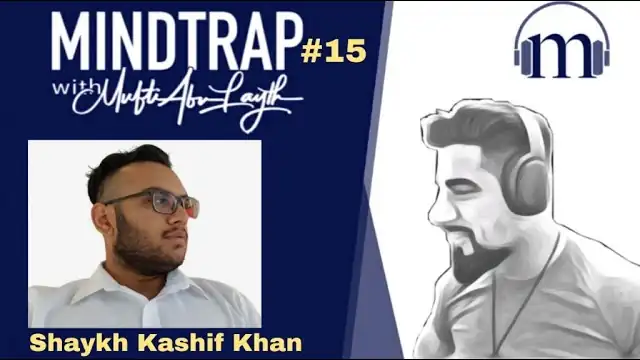 Play from 2:36:00
The video loads from YouTube only when you press play. Click a time in the transcript to seek.
Watch this part
Open on YouTube at 2:36:00The player starts at 2:36:00, the beginning of this part.
This segment2:36:00 to 2:41:14 · 5 min 14 sGeneral teaching
What this part covers
machinesummary, machine-writtenMufti Abu Layth says guilt-tripping is not an Islamic concept but one taken from the Judeo-Christian tradition, and the guest says forbidding evil applies only to what the texts clearly prohibit.
In more detail
The guest says guilt-tripping does not work, and that if something were truly haram God would have mentioned it, as with riba and zina; he cites al-Ghazali [?] that one cannot rebuke a Hanafi drinking nabidh or a Shafi'i eating lizard, since forbidding evil applies to what the texts prohibit, not to matters of difference. Mufti Abu Layth says he does not personally feel guilt is an Islamic thing, that the Arabic word used for it means sin rather than the wearing emotion of guilt, and that he feels the concept was injected from the Judeo-Christian tradition, particularly Catholicism. The guest says people nurtured on cultural practices from childhood cannot easily leave them, describing funeral customs in Pakistan and India that burden grieving families, and a case where a husband who had become Salafi objected to the tent and feast at his wife's father's funeral after holding them for his own father; a shaykh advised him that it was not the time to correct her. He says he does not force his posts on anyone, and that these opinions are in published and translated Hanafi books.
- Guest speech overlaps this segment
- Some terms in this segment are uncertain
Position stated
Waiting for the speaker checkA guest speaks in this segment and the captions do not say who said what. The view found here is held back until the speaker-separated transcript confirms the words are his, or the channel verifies it. The transcript and recording are published in full.
Kind: general teaching Speakers: host and guest; guest speech is labelled and excluded from positionsTranscript
machine2:36:00 to 2:41:14 · click a time to seek · dotted terms open the glossary
A guest speaks in this segment. Guest speech is labelled and is excluded from the positions layer.
of all if some scholars have said something is not Haram and you quoted Imam Shafi'i earlier on saying look when we believe something is Haram but some people don't believe that thing is Haram like let's say Nubby's an alcoholic kind of drink yeah most people believed it was Haram above honey first of Iran Authority these people didn't believe it was Haram and they used to drink it now you can't Imam Shafi saying well you can't impose your opinion on them the the thing with that in mind is killed a good thing anyway like is I mean I'm just asking what are your thoughts you know this thing on guilt this like.we
guilt trip people into being good people is this the way Islam teaches that we should be guilt-tripping people to be good people I think it doesn't work and if something is not naturally declared Haram by last Juan Alcala then it's not gonna work because it's not natural otherwise it would have mentioned it straightaway in the Quran like Lena RIBA things like which are mentioned in the Quran like the principles of amiable Maru 419 and moons are mentioned by Monica's Ali he said if for Hanafy is shrinking the beef or aschoff is eating
a lizard you cannot Horace ya think you cannot go and rebuke them you cannot go and announce them because the the enjoining the code and forbidding the evil is done on the things which are prohibited by by the news but to kill the attack not by its not on the things we have deferred upon not on the this thing comes to us from the judeo-christian kind of tradition this is this thing of like guilt-tripping
people making people feel real guilty I don't personally feel that this guilt is really an Islamic thing hence even the word for guilt within the Arabic language isn't really they like they use the word them which actually means kind of like sin or something but it's not the same is it because guilt is more like an emotion this kind of like you have this whole this this is wearing you down a sense of you know full of room or maybe not full of remorse but so I mean I I don't know that's my thoughts I feel
that Catholicism judeo-christian kind of tradition this injects this kind of concept of guilt into Islam islamically all the Muslims have that have pushed they have extracted it from the that's that's what I kind of feel I don't know how you feel about that share when people they have grown and when they are nurtured on these things from this childhood yeah when they grow up it's not easy to get away with these things right a lot of these practices you know like I buy opposed
when the funeral happens and people do lots of weird stuff and they gather up on the families and become a burden on them and then you have like a family's already in Greece and these people the neighborhood and the families they have become kind of burden on them now you have to feed them you have to take care of them like that's how it's done in Pakistan in India but at the time of funeral if you if you act and if you try to act against these norms of culture things what will happen the reaction of the people it will be so much more harsher than their and you definitely
like people are coming to attend the funeral and to want to pick condolence tradition is it's so fun like this is not the time because what happened once a guy used to be hanafi Barelvi and the both husband and wife this term becomes Salafi or the husband was become the Salafi so when the when his father died they did the chalice for everything tent and everything what they do what happened when her when her father-in-law passed away his
father-in-law story the final of the his father-in-law passed away so he went to his wife and he said that we should not be having Charlie saw he should not be having the the sattva and having the tent at Shami an eye on people to a commode them and serve them the food she said when your father died you had all these things but now my father has died you are opposing this thing because so this was the question came to us and and the Sheikh explained to him see this is not the time to tell her what is right what is wrong let her be and whatever it is because it's gonna create you know a
lot of backlash and things as to that but I'm not going to the random profiles of people and tell Oh should follow me and listen to me and therefore I say to a person if you don't like me discussing these things go unfriend me did I see you to pray to send me a request and to read my post yes not but be these things are also mentioned in the books of Mohammed methania Aziza fania bouhanni read the most are these all books are published and translated as well now so you should not be buying them greatly I feel that will not either these dialogues so me to be
hard but I've you know it's I've these kind of discussions have come up so many times being a share being you get asked this so many times you see it you see other imams discussing it the truth is that I've hardly ever come across anybody prepared to have a dialogue and I don't just mean me personally I think people in generally haven't come across anyone and and it's on everybody's mind these kind of questions they're so real this soul like kind of this dialogue itself I
Paragraphs overlapping 2:36:00 to 2:41:14. Full text on the recording page.
Cite this segment
Stable id, transcript version and tier are part of the citation. Every change to a transcript is logged.Mufti Abu Layth Archive, segment 2020-04-19b-S31, auto-transcribed, may contain errors. https://muftiabulayth.org/r/housirokbvu/s/31/ (accessed 1 November 2026)
- APA 7
Mufti Abu Layth. (2020, April 19). Does Islam teach us to feel guilty? [Video, segment 2020-04-19b-S31, auto-transcribed, may contain errors]. Mufti Abu Layth Archive. Retrieved November 1, 2026, from https://muftiabulayth.org/r/housirokbvu/s/31/
- Chicago author-date
Mufti Abu Layth. 2020. "Does Islam teach us to feel guilty?" Video, segment 2020-04-19b-S31, auto-transcribed, may contain errors. Mufti Abu Layth Archive. Recorded April 19, 2020. Accessed November 1, 2026. https://muftiabulayth.org/r/housirokbvu/s/31/
- BibTeX
@misc{abulayth-2020-04-19b-S31,
  author = {Mufti Abu Layth},
  title = {{Does Islam teach us to feel guilty?}},
  year = {2020},
  month = {4},
  date = {2020-04-19},
  howpublished = {\url{https://muftiabulayth.org/r/housirokbvu/s/31/}},
  url = {https://muftiabulayth.org/r/housirokbvu/s/31/},
  organization = {Mufti Abu Layth Archive},
  urldate = {2026-11-01},
  note = {Segment 2020-04-19b-S31, auto-transcribed, may contain errors}
}
Something wrong here?
Tell us what is wrong and it will be checked against the recording. Nothing changes until a person has reviewed it.
Sending a note needs JavaScript, which is off or unavailable in this browser. Nothing has been sent.
No name, email address or account is asked for or stored, and the inbox does not store your IP address. For rate limiting it keeps an unreadable fingerprint of your connection for 48 hours, and our database provider's own logs record connections as every website's do. Only your note, its kind, the page and the moment in the recording are kept, for review.