
Recordings › Dr Javad T. Hashmi | Axis of Morality & Archetypal Myths in the Quran | MindTrap 46 |Mufti Abu Layth · 11 Dec 2020 › Segment 15 of 36
How should the stories in the Quran be read?
aqidah aqeedah aqida creed aqeeda aqaid muftis riba ribaa sood usury kalam ilm al-kalam kalaam koran quraan al-quran jihaad mujahid deen al-din ad-deen ad-dinThe guest's research: jihad in the Quran and Khalafallah's narrative art of the Quran
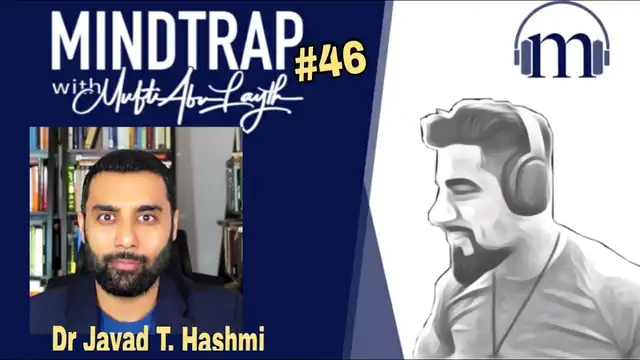 Play from 59:44
The video loads from YouTube only when you press play. Click a time in the transcript to seek.
Watch this part
Open on YouTube at 59:44The player starts at 59:44, the beginning of this part.
This segment58:24 to 1:02:23 · 3 min 59 sA view quoted in order to be discussed, not a position held
What this part covers
machinesummary, machine-writtenThe guest describes his dissertation on jihad in the Quran and his project translating Muhammad Ahmad Khalafallah's suppressed study of the Quran's narrative art, which he says is right.
In more detail
Mufti Abu Layth turns to the stories of the Quran and the Israelites' entry into the holy land, which touches on jihad, and asks the guest for his take. The guest says his dissertation is on jihad in the Quran in the formative period, but that his side project, with a fellow Harvard PhD candidate, is a translation and close reading of the book by Muhammad Ahmad Khalafallah, an Egyptian Islamic modernist, on the narrative art of the Quran, which was blocked as a dissertation in Egypt as too controversial. He describes his interest as Islamic academic theology, applying the critical insights of the Western academy to Islamic theology, and says he thinks the author has hit the nail on the head.
- Some terms in this segment are uncertain
Position stated
This segment presents a view in order to discuss or respond to it. It is recorded as quoted, never as held, and no position is attributed from it.
Kind: a view quoted in order to be discussed, not a position held Speakers: host and guest; guest speech is labelled and excluded from positionsTranscript
machine58:24 to 1:02:23 · click a time to seek · dotted terms open the glossary
A guest speaks in this segment. Guest speech is labelled and is excluded from the positions layer.
This segment states a view in order to discuss it. It is recorded as a quoted view, not as a position held.
Now of course you can read between the lines and you can tell where I lean. And this is like behind the scenes where I'm actually giving you my views. But in my in my class, I didn't, you know, I took a step back. Sure. But what I what I think a lot of students realized was, hey, I kind of agree with the Muzzlies. Their views are not that crazy on these issues. It just makes common sense. Um, so I I think that's why we need to go back. I think I want to move away from Sure. Sure. Sure. I mean, it's okay.
You know, this thing on uh stories uh because you mentioned the whole the Bunnel they were, you know, trapped in the uh or sorry, they weren't they were whether they were enslaved or not, but they were being kind of tortured socially u within Egypt. They escape, they go to the Middle. This whole thing, the narratives within the Quran. Now you have an interesting uh perspective and research on this and it ties into two things which I wanted to kind of discuss and we can come to the other point uh because with ban is the story of them going there and then waging a holy war
and you know regaining this land this uh of Canaan this whole ardul madasa this sacred territory it ties it taps into the topic of jihad and that's also an area that you uh have an incredible uh wealth of knowledge in so these two things I mean first of all the stories in the Quran um tell us about that doc what's your take on it so those are two uh topics I'd love to speak on thank you for that so because my dissertation topic is actually on jihad in the Quran and the formative period but actually the side project
that I'm working on right now uh I'm working on that with another fellow PhD candidates at Harvard Azie Gundus um was an amazing guy and I'm really grateful to work with him. But uh we're actually going through Muhammad Khalafah's Khalafah's book. Um he was a uh Egyptian Islamic modernist who wrote his dissertation called the literary art in the Quran of the Quran.
uh and he tried to uh submit this as his dissertation uh and he was blocked from doing so and his dissertation he was not allowed to publish it like that or or submit it. What what was the reason he was not allowed? It's just too controversial or too too controversial. So actually what uh me and him have been doing is we've been going through the entire text. We're almost done with it. We've been translating it and uh we're going to do a close reading of it.
We're not going to do a word for word translation of all of it. It's it's a very big book. Here I have it right here. So it's an Arabic book. Um and uh it's quite a wonderful what's what's it called in Arabic? Uh it's Alan Alasi uh hold on let's see the exact let me the Arabic titles are very fancy. So uh Phil Quran. So, I think it might have even been a longer title, but um I mean, so yeah, and I'm surprised that that anything is prohibited in academia to kind of like you said is this is the Islamic world.
I mean, come on. Uh you can you get persecuted all the time. So, this had this happened in Egypt. Oh, in Egypt. Sorry. Okay. Okay. Okay. I thought you meant the Western academic. No, no, no, no. [laughter] So, I was kind of shocked for a moment. I thought, whoa. Okay. So, so what I'm try, what I'm trying to do, so he is um Azie who is my colleague, he's uh more into Arab literature and so that's his interest in my interest.
There we go. We're back. Uh my interest in the topic is from an Islamic academic theological perspective. So I Islamic academic which Islamic academic theology is the idea that we take the insights the critical scholarly insights of the western academy and we apply those to our theology our Islamic religion and c does it change our views at all so what I'm trying to do is uh anyways that's something else but uh we're through this book and what this author is arguing I think he has hit the nail on its head Okay.
Paragraphs overlapping 58:24 to 1:02:23. Full text on the recording page.
Cite this segment
Stable id, transcript version and tier are part of the citation. Every change to a transcript is logged.Mufti Abu Layth Archive, segment 2020-12-11b-S15, auto-transcribed, may contain errors. https://muftiabulayth.org/r/zasz48lx_wi/s/15/ (accessed 1 November 2026)
- APA 7
Mufti Abu Layth. (2020, December 11). How should the stories in the Quran be read? [Video, segment 2020-12-11b-S15, auto-transcribed, may contain errors]. Mufti Abu Layth Archive. Retrieved November 1, 2026, from https://muftiabulayth.org/r/zasz48lx_wi/s/15/
- Chicago author-date
Mufti Abu Layth. 2020. "How should the stories in the Quran be read?" Video, segment 2020-12-11b-S15, auto-transcribed, may contain errors. Mufti Abu Layth Archive. Recorded December 11, 2020. Accessed November 1, 2026. https://muftiabulayth.org/r/zasz48lx_wi/s/15/
- BibTeX
@misc{abulayth-2020-12-11b-S15,
  author = {Mufti Abu Layth},
  title = {{How should the stories in the Quran be read?}},
  year = {2020},
  month = {12},
  date = {2020-12-11},
  howpublished = {\url{https://muftiabulayth.org/r/zasz48lx_wi/s/15/}},
  url = {https://muftiabulayth.org/r/zasz48lx_wi/s/15/},
  organization = {Mufti Abu Layth Archive},
  urldate = {2026-11-01},
  note = {Segment 2020-12-11b-S15, auto-transcribed, may contain errors}
}
Something wrong here?
Tell us what is wrong and it will be checked against the recording. Nothing changes until a person has reviewed it.
Sending a note needs JavaScript, which is off or unavailable in this browser. Nothing has been sent.
No name, email address or account is asked for or stored, and the inbox does not store your IP address. For rate limiting it keeps an unreadable fingerprint of your connection for 48 hours, and our database provider's own logs record connections as every website's do. Only your note, its kind, the page and the moment in the recording are kept, for review.