
Recordings › Dr Javad T. Hashmi | Axis of Morality & Archetypal Myths in the Quran | MindTrap 46 |Mufti Abu Layth · 11 Dec 2020 › Segment 14 of 36
If we all recognise harm, why do people still do terrible things?
muftis ihsaan excellence mutazilite mu'tazilah koran quraan al-quran ayah aya ayat ayaat aayah aayat deen al-din ad-deen ad-dinWhen empathy is overridden; consciousness, the zeitgeist and the Quran's undefined justice
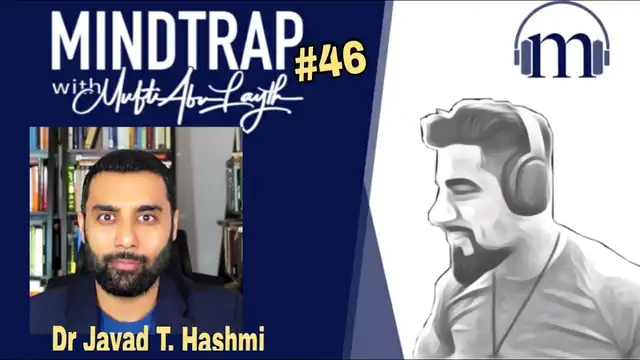 Play from 53:58
The video loads from YouTube only when you press play. Click a time in the transcript to seek.
Watch this part
Open on YouTube at 53:58The player starts at 53:58, the beginning of this part.
This segment53:58 to 58:24 · 4 min 26 sGeneral teaching
What this part covers
machinesummary, machine-writtenMufti Abu Layth says empathy can be overridden by instincts such as power, and that a shared consciousness shapes the moral feel of an age; he notes the Quran commands justice without defining it, which the guest links to the Mu'tazila.
In more detail
Mufti Abu Layth says people who commit atrocities still register the cries of a victim, but other instincts such as the drive for power override their empathy and they block it out. He adds a component he admits may sound 'woo-woo': since he believes consciousness is the ruh, there is a connectedness through which the feel of an age changes, giving the example that people in the West now recoil at being called racist in a way they did not in the 1980s or 1990s, which he thinks is more than the effect of information. The guest agrees that spirit is probably the religious, symbolic word for consciousness but questions shared consciousness by asking why views do not change in a closed country like North Korea. Mufti cites the verse that Allah commands justice and ihsan, noting that justice is not defined, as though it is simply known, and that the good is called ma'ruf, the known; the guest says this points to the early rationalists, the Mu'tazila, whose views students in his course found to be common sense.
- Guest speech overlaps this segment
Position stated
Waiting for the speaker checkA guest speaks in this segment and the captions do not say who said what. The view found here is held back until the speaker-separated transcript confirms the words are his, or the channel verifies it. The transcript and recording are published in full.
Kind: general teaching Speakers: host and guest; guest speech is labelled and excluded from positionsTranscript
machine53:58 to 58:24 · click a time to seek · dotted terms open the glossary
A guest speaks in this segment. Guest speech is labelled and is excluded from the positions layer.
the other needs the instinct for power the instinct for other things override our empathy. So it's not about raping that people wouldn't know. Like let's say a woman is crying. They would sense the empathy, but the instinct at the time would override it. So they they just wouldn't care. They'll block it out and they'll just do what they want to do. Or if you were saying about killing someone, if you said about killing children, it's not that the cries of the child, they don't register it, but they would just block it out and just just go ahead with the attack.
So I feel over time and the other component that I add which I suppose is a bit u maybe a bit woohoo to people is uh is the fact that I because I believe consciousness is the ru I feel that there is this kind of uh like a connectedness and as societies evolve over time uh there's a kind of even though it's very low level but a kind of like a feedback of the feel the kind of zeitgeist that you were saying that you know in a day and age people's like it's interesting how today racism in the west now is uh even though
it's unfortunately still there in in in several places in some places more than others but it's considered like horrible and even people you know even people who sometimes let's say in the west if they've done something they will take offense to even if it has stemmed from racism but if you said to them oh you're racist. They would find disgust at racist like oh my god like I'm not racist.
And whereas let's say in the '9s or the 80s this wasn't there. Now has is this just simply a result of one is it a result of just more advertising and propaganda and raising awareness or is it so just telling people it's information saying this is wrong don't do it. Or is it that as with the last few decades the kind of consciousness what I would feel is that the the feel has changed and so people have now it's not that they've read so much about it but they just feel that that's wrong.
Um and I obviously that part is really difficult to explain because the first part is obviously I can use evolutionary studies and I can use psychology but this is just my but yeah I I mean that was just saying if you wanted to say something about that but I also wanted to tap into uh you'd mentioned Quran the story of Israel and I wanted to come to that but yes sure uh yeah so I'll just say I'll end with one point which is I do agree with you that I think we can understand spirit as probably a it's the symbolic word for consciousness.
I think religion is describing consciousness. So I agree with you there. That's that's a probably a good theory uh that I agree with um that I lean towards. I don't know for sure but but I believe that the only point I would say is as far as this shared consciousness, I'm not [laughter] well I'm not I'm not discarding this idea completely. But what I would say is the problem you would run into is um then how come in let's say in North Korea where those ideas don't reach through mediums you don't have that change in cultural views.
So I think you have true but uh but in any case I I just just toal sure just to get I'm going to get in trouble. I don't know. I'm not an expert of moral. No, sure. I just wanted to uh Yeah, absolutely. But there was just this verse which I wanted to say before and that was it really ties in so well there and it sums that up is that when Allah says that really all God is commanding towards is justice and a compassion.
And it's interesting that the justice isn't expanded upon. It's kind of just said justice as though you will just know what justice is. enjoy the good and forbid the evil. Uh you know there's no mention it's like what is known as good. So uh this is this is a very good point that you've raised and this points us in the direction of hey maybe we should look at what these early Islamic rationalists these muzzes what they're saying. So what what I taught in my when I was teaching my course I do it in a more neutral way.
Now of course you can read between the lines and you can tell where I lean. And this is like behind the scenes where I'm actually giving you my views. But in my in my class, I didn't, you know, I took a step back. Sure. But what I what I think a lot of students realized was, hey, I kind of agree with the Muzzlies. Their views are not that crazy on these issues. It just makes common sense. Um, so I I think that's why we need to go back. I think I want to move away from Sure. Sure. Sure. I mean, it's okay.
Paragraphs overlapping 53:58 to 58:24. Full text on the recording page.
Cite this segment
Stable id, transcript version and tier are part of the citation. Every change to a transcript is logged.Mufti Abu Layth Archive, segment 2020-12-11b-S14, auto-transcribed, may contain errors. https://muftiabulayth.org/r/zasz48lx_wi/s/14/ (accessed 1 November 2026)
- APA 7
Mufti Abu Layth. (2020, December 11). If we all recognise harm, why do people still do terrible things? [Video, segment 2020-12-11b-S14, auto-transcribed, may contain errors]. Mufti Abu Layth Archive. Retrieved November 1, 2026, from https://muftiabulayth.org/r/zasz48lx_wi/s/14/
- Chicago author-date
Mufti Abu Layth. 2020. "If we all recognise harm, why do people still do terrible things?" Video, segment 2020-12-11b-S14, auto-transcribed, may contain errors. Mufti Abu Layth Archive. Recorded December 11, 2020. Accessed November 1, 2026. https://muftiabulayth.org/r/zasz48lx_wi/s/14/
- BibTeX
@misc{abulayth-2020-12-11b-S14,
  author = {Mufti Abu Layth},
  title = {{If we all recognise harm, why do people still do terrible things?}},
  year = {2020},
  month = {12},
  date = {2020-12-11},
  howpublished = {\url{https://muftiabulayth.org/r/zasz48lx_wi/s/14/}},
  url = {https://muftiabulayth.org/r/zasz48lx_wi/s/14/},
  organization = {Mufti Abu Layth Archive},
  urldate = {2026-11-01},
  note = {Segment 2020-12-11b-S14, auto-transcribed, may contain errors}
}
Something wrong here?
Tell us what is wrong and it will be checked against the recording. Nothing changes until a person has reviewed it.
Sending a note needs JavaScript, which is off or unavailable in this browser. Nothing has been sent.
No name, email address or account is asked for or stored, and the inbox does not store your IP address. For rate limiting it keeps an unreadable fingerprint of your connection for 48 hours, and our database provider's own logs record connections as every website's do. Only your note, its kind, the page and the moment in the recording are kept, for review.