
Recordings › Dr Javad T. Hashmi | Axis of Morality & Archetypal Myths in the Quran | MindTrap 46 |Mufti Abu Layth · 11 Dec 2020 › Segment 13 of 36
Do animals have morality, and does that mean morality just evolved?
muftis dalil daleel adillah adilla proof fitrat natural disposition deen al-din ad-deen ad-dinPrimates and justice: is morality merely the product of evolution?
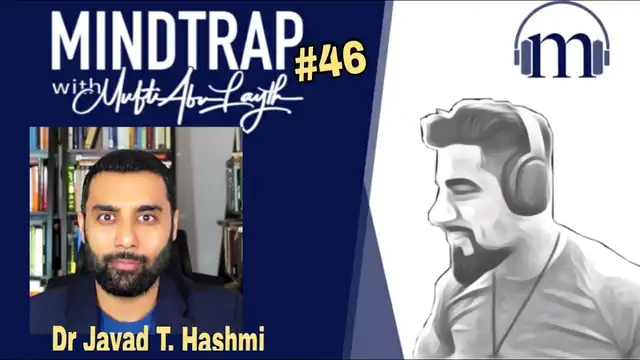 Play from 49:52
The video loads from YouTube only when you press play. Click a time in the transcript to seek.
Watch this part
Open on YouTube at 49:52The player starts at 49:52, the beginning of this part.
This segment49:52 to 53:58 · 4 min 06 sGeneral teaching
What this part covers
machinesummary, machine-writtenMufti Abu Layth sees a sense of justice in primates as evidence of a raw moral fitrah that humans develop further; the guest warns this can suggest morality is merely evolved and says rooting it in God is the necessary step.
In more detail
Mufti Abu Layth says that, as some viewers had commented, his view is that these moral components are very fundamental, as primate studies show a sense of justice: a female monkey later attacking one that had attacked her brother, and a monkey refusing to eat when another was given grapes and it an inferior food. He takes this as what Allah means by the fitrah, raw fundamentals that humans have in a more elevated form and build on in their environment. The guest cautions that animals also kill the runt of the litter and rape, so such evidence could suggest morality is simply a product of evolution; he accepts that morality may have evolved mechanistically, but says religion lets us say this is how God intended it, using symbols, metaphors and parables, and that rooting morality in God is the necessary step. Mufti replies that human morality is far more developed than any primate's and rests on two components, discerning harm and empathising with it.
- Guest speech overlaps this segment
Position stated
Waiting for the speaker checkA guest speaks in this segment and the captions do not say who said what. The view found here is held back until the speaker-separated transcript confirms the words are his, or the channel verifies it. The transcript and recording are published in full.
Kind: general teaching Speakers: host and guest; guest speech is labelled and excluded from positionsTranscript
machine49:52 to 53:58 · click a time to seek · dotted terms open the glossary
A guest speaks in this segment. Guest speech is labelled and is excluded from the positions layer.
We can get closer to acquiring it. That's that's what we can do. I mean, sure. I mean, that's uh and and and you've highlighted that this is not generally, you know, you're not this is not you're not uh uh philosophy of morality is not something you normally um delve into too much. Uh so just I mean just to I know some of the people had said in the comments that my perspective on it is that these things are very fundamental as in because we see in animals as well.
We see in primates that they have a sense of justice. Uh there is this thing of the virtue of justice. You can read up the studies amongst primates in primatology and you'll see that they sense like things like taking revenge and they will take revenge for siblings and family members from other uh within the same tribe when monkeys violate uh each other. So for so there's been studies.
So for example, this uh female monkey went and after an x amount of time went and and attacked one of those monkeys who had then previously uh attacked her brother. And there was but that it there'd been a time lapse and it was a sense of revenge because they felt justice and and there's other things as well when monkeys feel that they're being treated uh unfavorably when a particular monkey is being given.
saw the study where they were giving one monkey grapes and they were giving the other one first they were giving them the same and then the other monkey gets grapes and he just gets I I forgotten what they were feeding him but he sensed it was inferior so the monkey would refuse to eat until it also gets what the other monkey eats so I I would have thought that when Allah says about fra that he has built in a these core very raw fundamentals and we then obviously we have it slightly we have it more elevated than how primates have it like monkeys, but we then just build upon it within our environment and so on.
But yeah, that's just to uh yeah clarify. I I I think you're on to something. What I would only caution against is the idea that what someone could easily say in response to that is that monkeys and animals, they do all sorts of other things like kill the runt of the litter, they rape, uh they do all sorts of things. Um so also what this would indicate is actually that our morality is based on the evolutionary process.
Yeah. And that and that therefore um you can't really arrive at this theistic idea. But what I would say is I agree with you. I think that our morality may have evolved in an evolutionary manner from a mechanistic standpoint. But what religion does for us, it allows us to say we actually believe this is how God intended it to and we use these this language of symbols, metaphors and parables to understand this phenomenon and say that from a theological standpoint we believe that our morality is rooted in God.
And that's I think the necessary step that you need to make which is saying that our morality is rooted in God because otherwise it's just through evolution because so that's that's the only thing I because my my thing would be that obvious unquestionably humans have come a long way from even from an evolutionary point. So even if they share commonalities of concepts of let's say ethics or not ethics but some morality in primates human morality would be so much more developed.
It wouldn't be just and but I feel this morality thing even with primates or animals it comes down to this thing of I think there's two key those two key components that one is we can discern what hurting is and harm as in pain and we can then empathize uh because we then have a greater empathy. Now what happens is I feel with humans over you know millennia there's at times it's not that we can't empathize but our empathy hasn't like when we don't care uh there's because
the other needs the instinct for power the instinct for other things override our empathy. So it's not about raping that people wouldn't know. Like let's say a woman is crying. They would sense the empathy, but the instinct at the time would override it. So they they just wouldn't care. They'll block it out and they'll just do what they want to do. Or if you were saying about killing someone, if you said about killing children, it's not that the cries of the child, they don't register it, but they would just block it out and just just go ahead with the attack.
Paragraphs overlapping 49:52 to 53:58. Full text on the recording page.
Cite this segment
Stable id, transcript version and tier are part of the citation. Every change to a transcript is logged.Mufti Abu Layth Archive, segment 2020-12-11b-S13, auto-transcribed, may contain errors. https://muftiabulayth.org/r/zasz48lx_wi/s/13/ (accessed 1 November 2026)
- APA 7
Mufti Abu Layth. (2020, December 11). Do animals have morality, and does that mean morality just evolved? [Video, segment 2020-12-11b-S13, auto-transcribed, may contain errors]. Mufti Abu Layth Archive. Retrieved November 1, 2026, from https://muftiabulayth.org/r/zasz48lx_wi/s/13/
- Chicago author-date
Mufti Abu Layth. 2020. "Do animals have morality, and does that mean morality just evolved?" Video, segment 2020-12-11b-S13, auto-transcribed, may contain errors. Mufti Abu Layth Archive. Recorded December 11, 2020. Accessed November 1, 2026. https://muftiabulayth.org/r/zasz48lx_wi/s/13/
- BibTeX
@misc{abulayth-2020-12-11b-S13,
  author = {Mufti Abu Layth},
  title = {{Do animals have morality, and does that mean morality just evolved?}},
  year = {2020},
  month = {12},
  date = {2020-12-11},
  howpublished = {\url{https://muftiabulayth.org/r/zasz48lx_wi/s/13/}},
  url = {https://muftiabulayth.org/r/zasz48lx_wi/s/13/},
  organization = {Mufti Abu Layth Archive},
  urldate = {2026-11-01},
  note = {Segment 2020-12-11b-S13, auto-transcribed, may contain errors}
}
Something wrong here?
Tell us what is wrong and it will be checked against the recording. Nothing changes until a person has reviewed it.
Sending a note needs JavaScript, which is off or unavailable in this browser. Nothing has been sent.
No name, email address or account is asked for or stored, and the inbox does not store your IP address. For rate limiting it keeps an unreadable fingerprint of your connection for 48 hours, and our database provider's own logs record connections as every website's do. Only your note, its kind, the page and the moment in the recording are kept, for review.