
Recordings › Monday Nights with Mufti #210 | Q&A Unscripted & Unrestricted! 😉 | Mufti Abu Layth · 13 Apr 2021 › Segment 39 of 50
What did Ibn Rushd mean by the 'double truth' of religion and philosophy?
haj pilgrimage hadj averroes ibn rushd al-hafid shari'ah shariat sharee'ah muftis koran quraan al-quran deen al-din ad-deen ad-dinIbn Rushd's 'double truth': the sharia is built for the common person
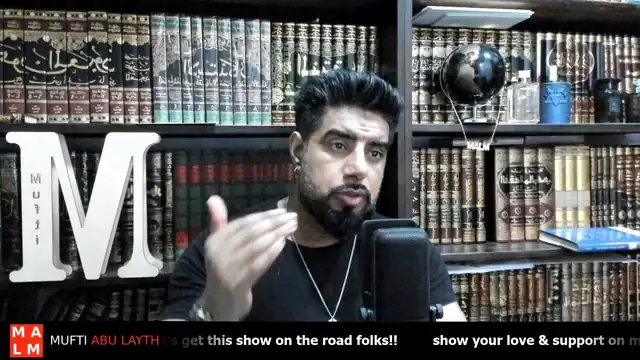 Play from 2:35:57
The video loads from YouTube only when you press play. Click a time in the transcript to seek.
Watch the answer
Open on YouTube at 2:35:57The player starts at 2:35:57, where the answer begins.
This segment2:35:57 to 2:42:28 · 6 min 31 sGeneral teaching
The answer in brief
machinesummary, machine-writtenMufti Abu Layth says it is not 'double truth', but he agrees fully with Ibn Rushd that the sharia is built for ordinary people while the gifted can find its deeper meanings.
In more detail
Asked for his thoughts on Ibn Rushd's double truth theory, Mufti Abu Layth says it is not double truth but that he agrees with it entirely, and that the message has dimensions; he adds that the sharia is not the divine message itself but an interpretation of what we think it says. He explains Ibn Rushd as saying that most people are not philosophers or deep critical thinkers, and compares this with lessons he once taught to mixed-ability classes: a task set for the average, starting from the lower-ability pupils, with the gifted and talented expected to do more with it. In the same way, he says, the sharia is aimed from the bottom up at the common person preoccupied with making a living, who needs structured and visible religion such as five daily prayers and hajj, while those gifted with deeper philosophical understanding can find its deeper codings. He says he agrees one hundred percent.
Question as read aloud · questioner not identifiedWhat are your thoughts on Ibn Rushd's double truth theory?
Position stated
Mufti Abu Layth says he agrees fully with Ibn Rushd that the sharia is designed for ordinary people, who need structured and visible religion, while those gifted with deeper understanding can discover its deeper meanings.
“so what ibn arush had said is that and i totally agree with that he said that in this world not everybody is a philosopher”
Category: teaching
Kind: general teachingTranscript
machine2:35:57 to 2:42:28 · click a time to seek · dotted terms open the glossary
you know what's the big deal great right so thoughts on ibn rush's double truth theory it's not double truth but i totally agree with all of that and i've got videos explaining it that i do believe that there are dimensions [Music] to to the message right this paradigms this dimensions dimensionality of uh you know of of of the divine message so now
what i mean by that oh i suppose not if we don't say it as divine message but we say as of the message because the sharia is not really the divine message per se it's an interpretation of what the divine message or we think is saying so what ibn arush had said is that and i totally agree with that he said that in this world not everybody is a philosopher not everybody is a deep analytic critical thinker not everybody is capable of you know profound evaluative thought and he says that in fact
the overwhelming majority of people are not which is you know pretty factual it's not something he's saying which is harsh so what he said is that it's like i don't know now how the classrooms in schools work but years ago when i used to teach um they used to have like so you've got mixed ability and you would have people who are special needs so they would call them like sen i don't know now and then you would have gifted and talented they would call them back then g and t then you'd have the majority in the class who also are on a spectrum like you know it's not
everybody's not equal in their ability to grasp things and some people are incredibly talented and this is sometimes within a certain class i know you have certain whole in schools you have certain obviously you have tears and people but within certain classes they were like this so what you had to do was you had to set your task as a teacher in a way that would begin by taking in this the the kind of lower ability pupils students it had to be begin by taking them in and it had to really be aimed at the average
but incorporating the lower and the gifted and talented were expected to be able to achieve more so there would be certain things within that that they could do based on their ability but you would never set the lesson in accordance to them you would always set it that it would start by incorporating the lowest ability and then so as to take in the the middle so in a similar way now that's years ago i don't know the whole teaching thing may have changed now but ibn roost is arguing that sharia is very
similar the sharia is not aimed at the gifted and talented people that it's actually aimed at the special needs it's based from them and it's taking in the common man who he says the common man in his day and age which still today is just preoccupied with in surviving and making a living so he says you know these people need to go out they need to go farming they need to do this they need and these people need structured religion for it to make sense because they're not gonna you know because he says really god wants you to contemplate
over him and appreciate and do this but you can't ask people to do these non-tangible things as you can ask them but you can't make that be the religion because most people are at an abstract level are not going to be that that person they're too too worried on like i need to make sure the crops have grown i need to do this and they're not actually you know they're just people who get by they're not creative minds they're not i mean maybe they're creative in their own way but they're not deeply philosophical so he says that the sharia has been highlighted to really cater for these people
and allah has set it in a way that those who are gifted and talented will figure out the deeper coding themselves and i agree with that one hundred percent [Laughter] because he says that those people who are that those who are the people of just as in that work you wouldn't change the task you would just allow that you would know that the gifted and talented would be able to do just different things with it uh and they would so that's how he says that sharia works so he says the reason
this whole net has been designed to be able to capture everyone so from the bottom up so the fact that it's had a structure that you pray that we have five prayers a day that we do this we give visible things okay go to hajj do this do this do this this is how we focus this is how we set out things because it's for the common man and he says that and religion needs this because the common person needs structure in their life and they they you can't just give them abstract you know intellectualism that in fact it would fail
with vast majority of mankind he says because they're just very busy in trying to make a living so he says this is why the sharia is like this but people who themselves have been gifted by god deeper philosophical understandings they can dive into the codings of this and realize that deeper messages
this is why you gotta love the malikiyah um mufti can you please talk about the actual crime of the people of luth the actual crime of the people of lut was that they rejected god it was the crime of all the prophets stories in the quran were that they rejected god that was the actual crime the second uh the second thing that is mentioned about them is always secondary so whether it was for example is mentioned in the quran that they for example would cheat people in trade now that's something going on everywhere you know it's going on today it's not the
Paragraphs overlapping 2:35:57 to 2:42:28. Full text on the recording page.
Cite this segment
Stable id, transcript version and tier are part of the citation. Every change to a transcript is logged.Mufti Abu Layth Archive, segment 2021-04-13-S39, auto-transcribed, may contain errors. https://muftiabulayth.org/r/8xuhmcz2n3u/s/39/ (accessed 1 November 2026)
- APA 7
Mufti Abu Layth. (2021, April 13). What did Ibn Rushd mean by the 'double truth' of religion and philosophy? [Video, segment 2021-04-13-S39, auto-transcribed, may contain errors]. Mufti Abu Layth Archive. Retrieved November 1, 2026, from https://muftiabulayth.org/r/8xuhmcz2n3u/s/39/
- Chicago author-date
Mufti Abu Layth. 2021. "What did Ibn Rushd mean by the 'double truth' of religion and philosophy?" Video, segment 2021-04-13-S39, auto-transcribed, may contain errors. Mufti Abu Layth Archive. Recorded April 13, 2021. Accessed November 1, 2026. https://muftiabulayth.org/r/8xuhmcz2n3u/s/39/
- BibTeX
@misc{abulayth-2021-04-13-S39,
  author = {Mufti Abu Layth},
  title = {{What did Ibn Rushd mean by the 'double truth' of religion and philosophy?}},
  year = {2021},
  month = {4},
  date = {2021-04-13},
  howpublished = {\url{https://muftiabulayth.org/r/8xuhmcz2n3u/s/39/}},
  url = {https://muftiabulayth.org/r/8xuhmcz2n3u/s/39/},
  organization = {Mufti Abu Layth Archive},
  urldate = {2026-11-01},
  note = {Segment 2021-04-13-S39, auto-transcribed, may contain errors}
}
Something wrong here?
Tell us what is wrong and it will be checked against the recording. Nothing changes until a person has reviewed it.
Sending a note needs JavaScript, which is off or unavailable in this browser. Nothing has been sent.
No name, email address or account is asked for or stored, and the inbox does not store your IP address. For rate limiting it keeps an unreadable fingerprint of your connection for 48 hours, and our database provider's own logs record connections as every website's do. Only your note, its kind, the page and the moment in the recording are kept, for review.